

Grupo Malwee: Evolution in textile production optimization with Opcenter APS
See how Grupo Malwee, one of the leading names in Brazil's textile and fashion industry, deployed Opcenter APS to optimize production sequencing, reduce setups, and improve inventory management — delivering greater agility and efficiency across its entire production chain.


Meet Grupo Malwee, one of the leading references in the textile and fashion industry in Brazil.
About us
Founded in 1968 in Jaraguá do Sul (SC), Grupo Malwee is one of the leading references in the textile and fashion industry in Brazil. Today, it has around 3,500 employees and reaches 80% of Brazilian territory with its products. The group produces more than 36 million garments per year, serving over 22,000 customers across the country.
Beyond the design and versatility of its garments, the company stands out for its strong commitment to sustainability. By investing in technologies to reduce water and energy consumption, as well as using recycled fabrics, Grupo Malwee reinforces its position as a benchmark in sustainable fashion in Brazil.
With a robust industrial structure, the company operates across the entire production chain, from manufacturing knit fabrics to producing garments. With its operations concentrated mainly in the city of Jaraguá do Sul, in Santa Catarina, it has a textile unit, responsible for producing knit fabrics in large volumes, and a garment unit, where clothes take shape before being distributed to the market. This verticalization ensures greater control over quality, innovation, and sustainability, consolidating Grupo Malwee as one of the main players in the national textile sector.
The challenge
With the company's rapid growth, in 2020 Grupo Malwee identified the need to improve inventory management and raise its service level, essential factors for a business model based on seasonal collections. Faced with this challenge, it became crucial to optimize the production flow and reduce the effort of production planning and control (PPCP). To this end, the company sought a market solution capable of automating these processes and generating significant gains in operational efficiency.
The partnership with NEO Digital Industries, which had already delivered results in the implementation of Opcenter APS in Grupo Malwee's garment sectors, once again proved to be the key to solving the challenges the production chain demanded. While the first project focused on garment processes, with a high complexity of third parties collaborating in manufacturing, this second project had to tackle the company's most machinery-intensive sectors, with processes that are extremely expensive and sensitive to efficiency losses given the greater production complexity. Some of the processes that make up this area, called Textile, are knitting, dyeing, different types of printing, as well as chemical finishing processes such as raising and calendering.
Production scheduling in the textile sectors was carried out in a decentralized manner, with different schedulers for each area, generating instabilities in the production flow, since the priorities of each sector were not connected to one another. Thus, a solution became essential that respected the individualities of each area, without losing sight of the need to serve the end customer: garment production (or, as they call it internally, Manufacturing), represented by its stock of finished knit fabrics.
At that time, the lack of integrated sequencing between the areas, combined with the short scheduling horizon that existed - a result of the absence of production orders generated automatically in the ERP - compromised service to garment production and made it difficult to meet the delivery dates of finished knit fabrics. This directly impacted garment planning, which had no visibility into when its inputs would be available.
The rotary printing sector was one of the company's main operational bottlenecks, with setup times directly impacting productivity. Before the implementation of Opcenter APS, production scheduling was done manually, taking around three days to complete. This process resulted in a scenario in which setup time occupied 50% of the sector's availability.
"The ability to generate scenarios and simulations was fundamental to making more strategic decisions. In addition, Opcenter APS demonstrated impressive flexibility in adapting to the specifics of the textile sector, such as managing colors and batch variations in production sequencing. We are satisfied with the results achieved so far and confident that this implementation will continue to bring improvements over time."— Ademiro Volkmann, Project Manager
The solution
Given the challenge presented, NEO developed a solution for Grupo Malwee taking into account business rules and production constraints across the entire Knitting and Finishing chain. In Knitting, weaving, drawstrings, and flat knitting were covered. In Finishing, the focus was on dyeing, printing, and finishing.
The data required for sequencing - such as routings, production orders, and technical sheets - is imported from the SAP ERP into Opcenter APS, allowing the integration of information into planning. In this solution, all sectors are sequenced simultaneously within a single model, ensuring an aligned flow between the stages of the production process.
The entire sequencing process is driven by NEO's Smart Balancing Rule, the nSBR (Smart Balancing Rule). Developed entirely by NEO's team through APIs, this rule enables dynamic prioritization of operations, considering various parameters configurable by the client. This makes it possible to optimize the balancing of production resources, ensuring greater efficiency in production planning and execution. In this project, the solution was able to optimize complex challenges, such as color grouping in dyeing, model control on flat knitting machines, and optimizing chemical use on finishing machines - this included reducing setups and restricting the allowed production windows - ensuring greater efficiency and better use of production resources and inputs.
The solution developed for printing focused on optimizing sequencing, considering three main setup scenarios: keeping the print and variant, keeping the print with a variant change, and changing the print. A custom rule, combined with the nSBR, was implemented to automatically analyze the similarity between production orders, calculating the exact setup time based on the number of cylinders and the type of change required. In addition, the model takes into account the parallelism between setup and process, as well as the cylinder washing time, ensuring more efficient planning and significantly reducing production losses.
The connection with the garment Opcenter APS was essential to ensure full control of Grupo Malwee's production chain. On the textile side, the requirement dates of the first garment process, Cutting, were imported to prioritize critical models - such as complex routings and special orders, while ensuring setup reductions - making sure the sequencing was aligned with the most relevant demands.
In addition, after finishing was sequenced in the textile area, the actual delivery dates were sent to knit fabric allocation, providing greater reliability in garment planning and ensuring compliance with the expected deadlines.
Beyond the sequencing model, a second solution was developed for printing that integrates the garment area's knit fabric allocation with the firm and planned orders of textile printing, enabling a production flow fully coordinated with material management and availability. The system analyzes this information together with available inventory and automatically generates production needs by SKU and period, ensuring that minimum and maximum batches are respected without exceeding actual demand. After the analysis, production order suggestions are sent to SAP, directed to the PPCP manager for approval. Approved orders are incorporated into the sequencing model in the next integration.
"The Opcenter project provided a strategic and detailed view of production order control in the textile operation. The solution brought the industrial mobility needed to define the best path each product should follow, at the ideal time, based on well-defined metrics. In addition, the project allowed a clearer analysis of our production processes, making it possible to rethink and optimize business rules and the productivity of work centers. This ensured that the effort applied in the operation was used to the fullest, providing better performance, reduced waste, and greater predictability in deliveries. This transformation reinforces our commitment to efficiency and excellence throughout the production chain."— Matheus Martini, PCP Coordinator
The results
The results of implementing Opcenter APS in the rotary printing sector were significant from the very first month of operation. Production scheduling time was reduced to just one day, while setup time dropped to 19% of the sector's availability, significantly increasing the schedulers' responsiveness. This progress allowed greater flexibility to meet shorter deadlines and better adaptation to market demands.
Still in printing, a comparison with the same period of the previous year, which had a similar demand volume, revealed a 58% increase in the meterage of printed fabric supplied. This growth was accompanied by a 57% increase in cylinder consumption and a 45% increase in the average process time per production order, demonstrating real efficiency gains even with a more varied product mix and more complex prints. One of the decisive factors for this success was the development of a specific algorithm for printing, which took into account the particularities of the production process and enabled the optimization of planning.
In addition to the advances in printing, the implementation of the system also brought significant impacts on inventory management, resulting in a substantial reduction of idle materials. There was a decrease of R$ 1.3 million in knit fabrics in knitting, R$ 297,000 in printed fabrics in process (WIP), and R$ 734,000 in rolls for garment production, optimizing the flow of materials and reducing operational costs.
The optimization of sequencing through the proprietary and extremely flexible rule, the Neo Smart Balancing Rule, or nSBR, raised the service level in sectors highly critical for serving garment production, such as the case of flat knitting machines, which increased their service level from 91% to 99% in less than a quarter.
This progress was made possible thanks to the system's adaptability to the particularities of this process, ensuring greater accuracy in scheduling. In addition, complete-model fulfillment - that is, all colors of the same material being shipped in the same batch - recorded a 58% increase, demonstrating its evolution and positive impact in increasing productivity and supplying the sewing lines.
The solution implemented for order generation in printing also brought a significant reduction in PCP's operational workload. Previously, the traditional process required around 85 hours per year to create the production orders used in scheduling. With the new solution, this time was reduced to approximately 52 minutes per year, resulting in a 99% reduction in the time dedicated to this process.
Future outlook
As next steps, Grupo Malwee is focusing on the implementation of NEO One, NEO Digital Industries' exclusive solution for analysis and management. The solution includes management dashboards connected to Opcenter APS data and scenarios for all production plants. These dashboards will provide a clear, real-time view of processes, allowing managers to monitor performance, quickly identify problems, and make more agile decisions, optimizing operations. The solution also offers web-based visualization of the Gantt chart, facilitating production control and planning.
"Over the past year, continuing our pursuit of operational efficiency, we reached a significant milestone by connecting the entire production chain through the implementation of Opcenter APS. This initiative has allowed us to reap the results anticipated during the project's planning, strengthening our delivery capacity and optimizing processes. We successfully completed the first phase of modernizing the company's Planning and Sequencing process, which made us more competitive, agile, and efficient, while promoting an optimized use of our resources. We are convinced that technological evolution in Planning and Sequencing is a fundamental pillar for the sustainability and continuous growth of our business, reaffirming our commitment to excellence and innovation."— Graciano José Bonetti, Supply Chain Manager
SEE MORE RESULTS LIKE THIS AND LEARN HOW TO PROJECT THE ROI FOR A SUPPLY CHAIN PLANNING PROJECT IN YOUR INDUSTRY:
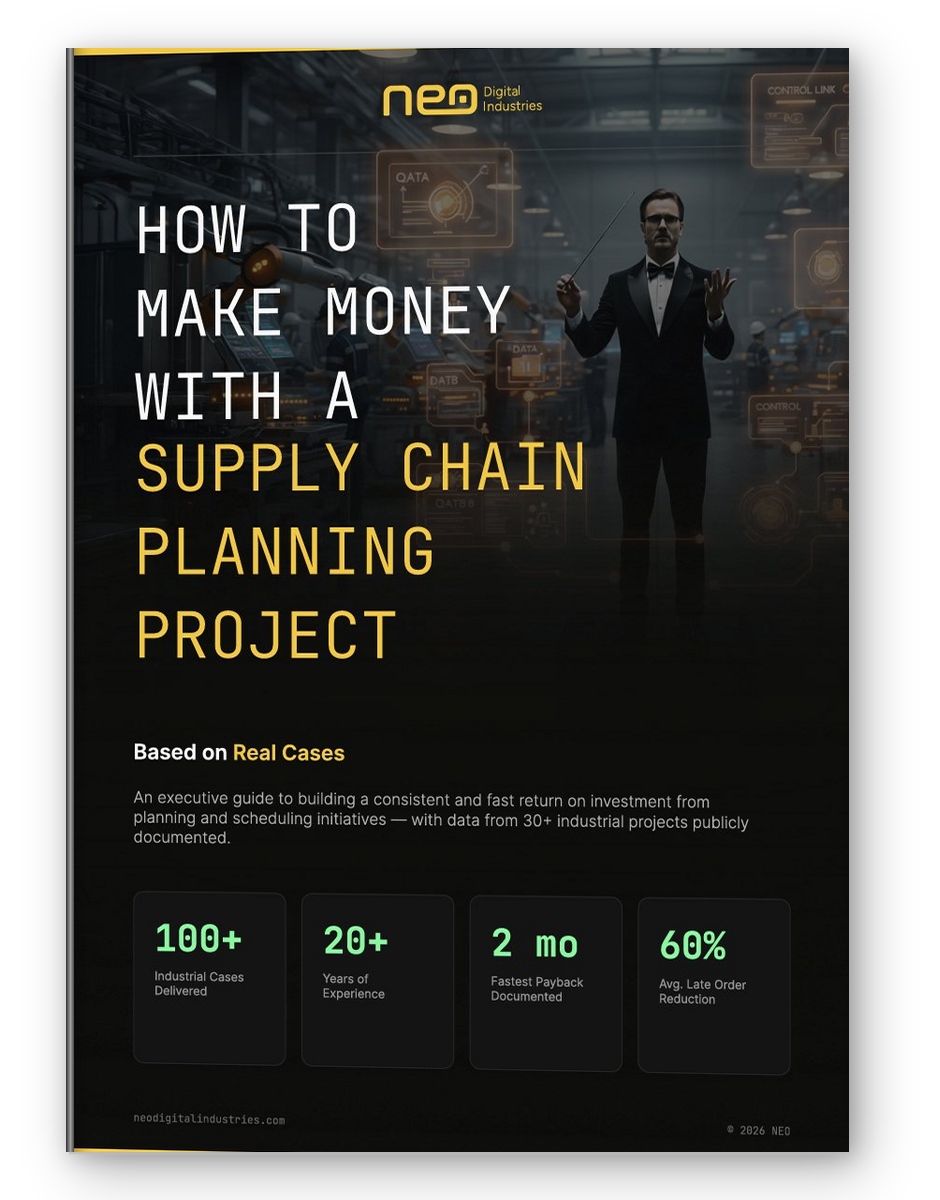
Free Ebook: How to Make Money With a Supply Chain Planning Project
Executive guide featuring data from over 30 documented projects. Discover the three sources of ROI, how to build a solid business case, and a step-by-step payback formula you can apply today.

Talk to one of our APS experts
Get a personalized assessment of your operations from APICS CPIM certified consultants. We will help you identify opportunities for improvement and estimate the return on your project.