Supply Chain Planning and Advanced Scheduling (APS) for Manufacturers
NEO is a consulting firm specializing in Supply Chain Planning (SCP) and Advanced Planning & Scheduling (APS) for manufacturers. As one of Siemens' largest global Opcenter APS partners, we bring together deep implementation expertise and AI-powered planning tools — and we only take on projects where we can commit to measurable results.
"This project was a milestone for our company. We were extremely satisfied with both the tool and NEO's implementation team. Our expectations were fully met with APS: we drastically reduced the time needed for production planning, improved sequencing quality, and as a result, achieved significant productivity gains."
Hugo Costa
PMO Manager
"NEO not only met all our requirements but also added new elements that enhanced the project, such as integration with our MES. The subsequent consulting and support service is a benchmark for quality for us."
Josete Grigorio
IT Manager
"NEO's support ensured the tool worked to meet our specific needs, developing rules that simplify daily operations without impacting what was already functioning. The partnership between NEO and Peccin is crucial for the tool's ongoing support. Today, we get quick and productive responses."
Jades Romano Costa
Production Planning and Control Specialist
Thiago Ernandes Otto
Coordenador de PPCP
Marcelo Trindade
Gerente de Supply Chain
Graciano Bonetti
Gerente de logística de abastecimento
Antenor Carvalho Neto
Gerente de PCP
Market assessment
Companies come to us with these challenges. Sound familiar?
74,7%
Want more supply chain visibility.
30,1%
Companies want to better balance their resources across the supply chain.
46%
Companies want to synchronize Purchasing, Production, and Distribution.
74,4%
Companies want to meet their delivery date promises.
Fonte: Formulário de Mapeamento Neo para Supply Chain Planning / n = 168, Maio de 2026.
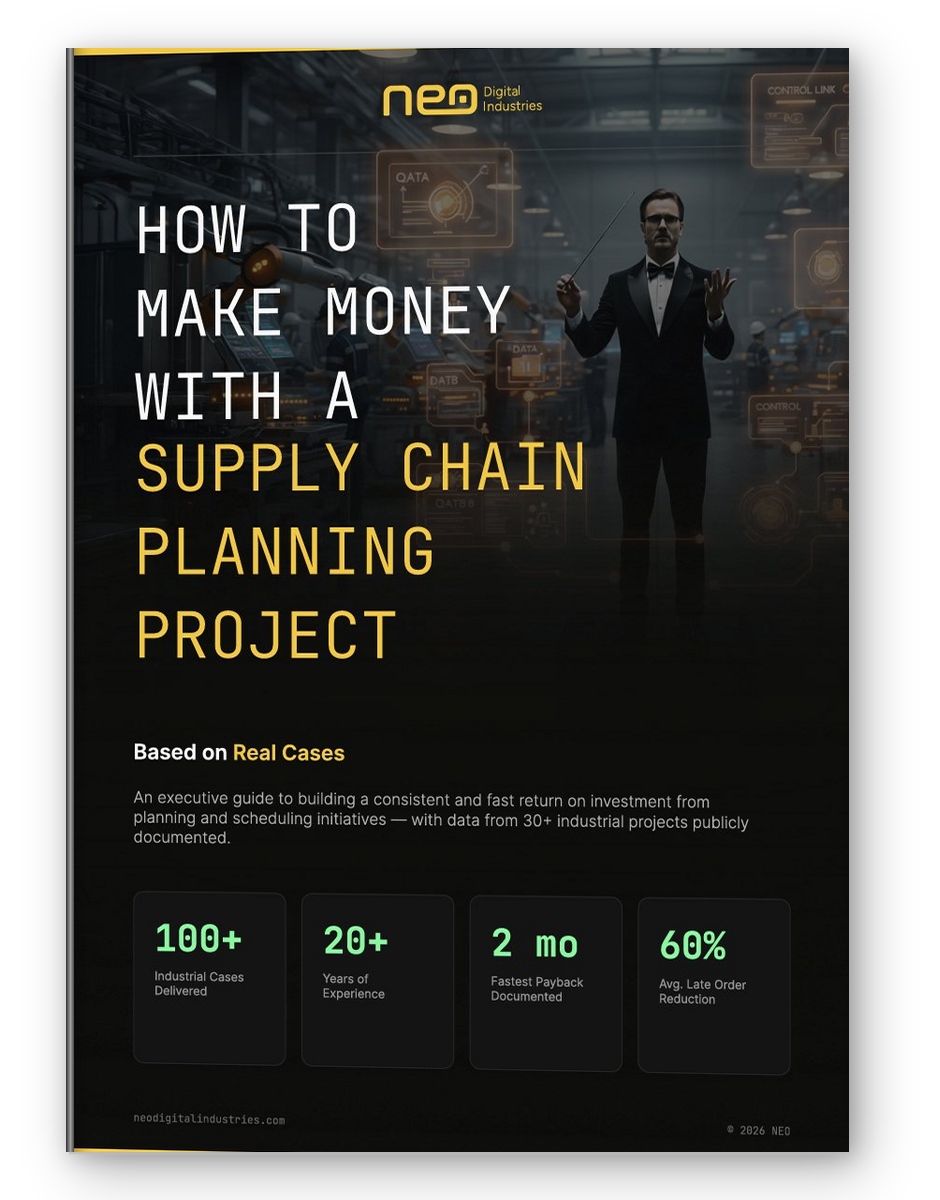
Free Ebook: How to Make Money with a Supply Chain Planning Project
Executive guide with data from over 30 documented projects. Learn about the three sources of ROI, how to build a solid business case, and a step-by-step payback formula you can apply today.
Get a personalized assessment of your operations with APICS CPIM certified consultants. We will help you identify improvement opportunities and estimate your project's return.
THANK YOU FOR GETTING IN TOUCH! ONE OF OUR SPECIALISTS WILL CONTACT YOU SHORTLY.
Oops! Something went wrong. Please try again.
THANK YOU FOR YOUR SUBMISSION! A SPECIALIST WILL CONTACT YOU SHORTLY.
Oops! Something went wrong. Please try again.
Compare the SOLUTIONS
S&OP, MPS, APS, and MES: the four layers of industrial planning
Each discipline covers a different horizon and level of detail. Understanding where each one operates helps design a planning and execution architecture that makes sense for your operation.
S&OP
Sales & Operations Planning
Purpose
Balance demand, supply, inventory, and finances at the tactical-strategic level.
Horizon
12 to 18 months, with monthly review.
Users
Sales leadership, supply chain, finance, and operations.
ERP Integration
Aggregate decisions feed the ERP's goals and budgets.
MPS
Master Production Schedule
Purpose
Define the master plan: which final products to produce and at what rate.
Horizon
3 to 12 months, with weekly or monthly review.
Users
Master Planning and Production Control.
ERP Integration
Receives demand from the ERP and generates the MPS, which then becomes orders.
APS
Advanced Planning & Scheduling
Purpose
To sequence production, respecting finite capacity and real factory constraints.
Horizon
Hours to weeks, with daily or continuous review.
Users
Production planners and schedulers.
ERP Integration
Receives orders from ERP/MRP and returns a viable sequence for execution.
MES
Manufacturing Execution System
Purpose
Execute, monitor, and collect real-time production data on the shop floor.
Horizon
Real-time, on a scale of seconds to hours.
Users
Operators, team leaders, and shop floor supervisors.
ERP Integration
Receives orders from APS/ERP and returns actual production data to the ERP.
The End-to-End Solution for Supply Chain Planning.
Integrating sales and operations, balancing supply and demand while coordinating a series of internal processes between these and other company departments, is a significant challenge. Having access to solid consulting on the subject and technologies that enhance synergy between areas is the advantage you'll gain by working with Neo and its partners.
Inventory is a costly asset for operations and needs to be well-planned. Rely on Neo's consulting and technology to improve your inventory health, integrating your planning with demand and capacity management, and developing strategies with specific inventory policies for each product and material profile you have.
It's not enough to just produce efficiently; we need to have products available in the right places at the right time. Defining an inventory plan for different logistics centers, as well as daily transfers between factories and distribution centers, is part of Neo's solutions. These solutions consider logistical and storage capacity constraints, as well as the ideal fairshare for your operation.
While S&OP allows for simplifications, the Master Production Plan (MPP or MPS) needs to be accurate for plants to actually execute it. Neo's Production Planning solutions achieve this masterfully, creating SKU-level plans with finite capacity, respecting service and inventory policies, and seamlessly connecting with production scheduling by generating and releasing precise production orders.
Production scheduling is where reality sets in: the only certainty is that demand won't follow your initial plan. Therefore, agility is essential to schedule your production as quickly as possible while also striving for efficient plans.
As a market leader in Latin America, Neo offers the best sequencing solution, enabling you to reduce waiting times and waste, and increase service levels through a highly agile and responsive process.
Production control is crucial for diagnosing what's happening on the factory floor, but managing distinct processes with various machines and centers can be more challenging than it seems.
Neo partners with various companies to find the ideal solution for your business, considering the level of automation required for your current stage in your digitalization journey.
The End-to-End Solution for Your Supply Chain Planning.
Integrated Planning (S&OP/IBP)
Integrating sales and operations, balancing demand and supply while coordinating a series of internal processes between these and other company departments, is a significant challenge. Having access to solid consulting expertise and technologies that enhance synergy between departments is the key advantage you'll gain by working with Neo and its partners.
Inventory is a costly asset for operations and needs to be well-planned. Rely on Neo's consulting and technology to improve your inventory health, integrating your planning with demand and capacity management, and developing strategies with specific inventory policies for each product and material profile you have.
It's not enough to just produce efficiently; we need to have products available in the right places at the right time. Defining an inventory plan for different logistics centers, as well as daily transfers between factories and distribution centers, is part of Neo's solutions. These solutions consider logistics and storage capacity constraints, as well as the ideal fairshare for your operation.
While S&OP allows for simplifications, the Master Production Plan (MPP or MPS) needs to be accurate for plants to actually execute it. Neo's Production Planning solutions achieve this masterfully, creating SKU-level plans with finite capacity, respecting service and inventory policies, and seamlessly connecting with production scheduling by generating and releasing assertive production orders.
Production scheduling is where reality sets in: the only certainty is that demand will not follow your initial plan. Therefore, agility is essential to schedule your production as quickly as possible while also seeking efficient plans. As a market leader in Latin America, Neo offers the best sequencing solution, enabling you to reduce waiting times and waste, and increase service levels through a highly agile and responsive process.
Production control is crucial for diagnosing what's happening in the factory, but managing distinct processes with various machines and centers can be more challenging than it seems.
Neo partners with various companies to find the ideal solution for your business, considering the level of automation required for your current stage in your digitalization journey.
Everything you need to know about planning and APS
Concepts, differences, and results seen in Supply Chain Planning and Advanced Planning & Scheduling projects.
What is APS (Advanced Planning & Scheduling)?
APS stands for Advanced Planning & Scheduling. It is the operational intelligence layer that generates plans and schedules based on real shop floor constraints: finite capacity, setups, calendars, materials, routings, and committed delivery dates. Unlike spreadsheets and traditional MRP, APS sequences work orders around what the operation can actually execute — and lets planners simulate scenarios before locking in a schedule.
What is the difference between MRP and APS?
MRP plans with infinite capacity: it explodes demand into production and purchase orders without considering bottlenecks, setups, or execution sequence. APS plans with finite capacity: it starts with real constraints — machines, labor, materials, sequence-dependent setups — and generates an executable schedule. In practice, MRP answers "what to produce"; APS answers "when, in what order, and with what resources." Most manufacturers keep MRP within their ERP and layer APS on top to make plans feasible.
What is S&OP (Sales & Operations Planning)?
S&OP is a monthly alignment process between sales, planning, production, supply, and finance that consolidates demand, capacity, and inventory into a single medium-term plan (typically 12 to 18 months). The objective is to balance customer service, cost, and working capital with decisions made by leadership. When the process evolves to include financial scenario simulation and integrated governance, it becomes known as IBP (Integrated Business Planning).
What is Supply Chain Planning (SCP)?
Supply Chain Planning is the set of processes and decisions that define what to sell, what to produce, when to produce, with what resources, with what materials, and at what inventory and service levels. It encompasses demand forecasting, S&OP/IBP, capacity planning, MPS (Master Production Schedule), inventory policies, and detailed scheduling (APS). It is the intelligence layer that connects sales, manufacturing operations, and procurement into a single executable plan.
What is Siemens Opcenter APS?
Siemens Opcenter APS is the market-leading platform for Advanced Planning and Scheduling, part of the Siemens Digital Industries portfolio (successor to the Preactor APS line). It allows users to create scenarios, schedule with finite capacity, simulate the impact of breakdowns and demand changes, and visualize the plan in Gantt charts. NEO Digital Industries is one of the leading authorities in the Americas for Opcenter APS implementation, having served over 120 clients.
When is it worthwhile to implement APS in my industry?
It's worthwhile when operations involve a high variety of SKUs, complex routings, significant bottlenecks, sequence-dependent setups, critical materials, or pressure for OTIF (On-Time, In-Full) and promised delivery dates. Typical signs include: Excel-dependent scheduling, daily re-planning, low plan adherence, recurring delays, conflicts between sales and production, and high inventory without guaranteed fulfillment. If your monthly plan "doesn't hold up" during execution, it's a strong indicator that APS is missing from your planning layer.
What results can I expect from an APS/SCP project with NEO?
While gains vary by context, public cases from NEO show consistent returns on three fronts: increased revenue (higher service levels and availability), cost reduction (less inventory, fewer unnecessary setups, productivity gains), and risk mitigation (fewer delays, greater predictability). Documented examples include: 98% reduction in order generation time (Induscabos), 60% increase in sewing productivity (Cia Hering), 50% inventory reduction (Tigre), ROI in 2 months (Salus/Grupo Avril).
Why does ERP MRP need APS to generate executable production plans?
O MRP (Material Requirements Planning) é a base do planejamento de produção em praticamente todos os ERPs, mas planeja com capacidade infinita: explode a demanda em ordens sem considerar gargalos reais, setups dependentes de sequência ou disponibilidade de recursos críticos. O APS (Advanced Planning and Scheduling) é uma camada acima do MRP que recebe o plano-base do ERP e o transforma em um cronograma viável, respeitando capacidade finita, setups, materiais críticos e prazos prometidos. É essa combinação MRP + APS que evolui o PCP tradicional para PPCP — Planejamento, Programação e Controle da Produção que de fato roda no chão de fábrica, com mais aderência ao plano, mais OTIF e melhor uso da capacidade instalada.
By clicking “Accept”, you agree to the storing of cookies on your device to enhance site navigation, analyze site usage, and assist in our marketing efforts. See our Privacy Policy for more information.



























.avif)
.avif)
.avif)
.avif)






.png)

