

Why invest in the APS Solution?
Why invest in an APS solution? Discover the motivations that lead industries across sectors to adopt APS and the gains it delivers to production.
Just like any decision you make in your personal life, an APS Solution also needs a clear reason to exist. Implementing software takes real effort, and thateffort requires genuine motivation. Depending on the area and position of the applicant—whether in pipes and fittings, plastic packaging, food orsimilar industries — the motivations vary, but they all converge on the same goal: stronger profitability.
COST REDUCTION AND REVENUE INCREASE
From the perspective of executive positions in industries, cost reduction and revenue increase are the main motivators in the search for an APS. Some executives have a sharp instinct for recognizing the importance of production planning and its challenges — and become early champions of these initiatives. But that's not always the case. Executive roles tend to span many functions and concerns, making it hard to proactively drive solutions for specific operational problems. More often, the push comes from management, which needs to find ways to hit business targets. The challenges they face span Supply Chain, Operations, and IT: service levelshurt by late deliveries and stockouts; productivity losses from long setuptimes, excessive wait times, long lead times, and high inventory across raw materials, work-in-process, and finished goods. Every company experiences losses in these areas — the question is how much and where. Many see better production planning and scheduling as the path to improvement. In practice, though, the most common source of initiative is the people who live with these limitations every day: analysts and coordinators in Production Planning and Control. They see the losses first hand, they understand the oversimplifications baked into their tools and processes, and they carry accountability for results they often have little real power to change.
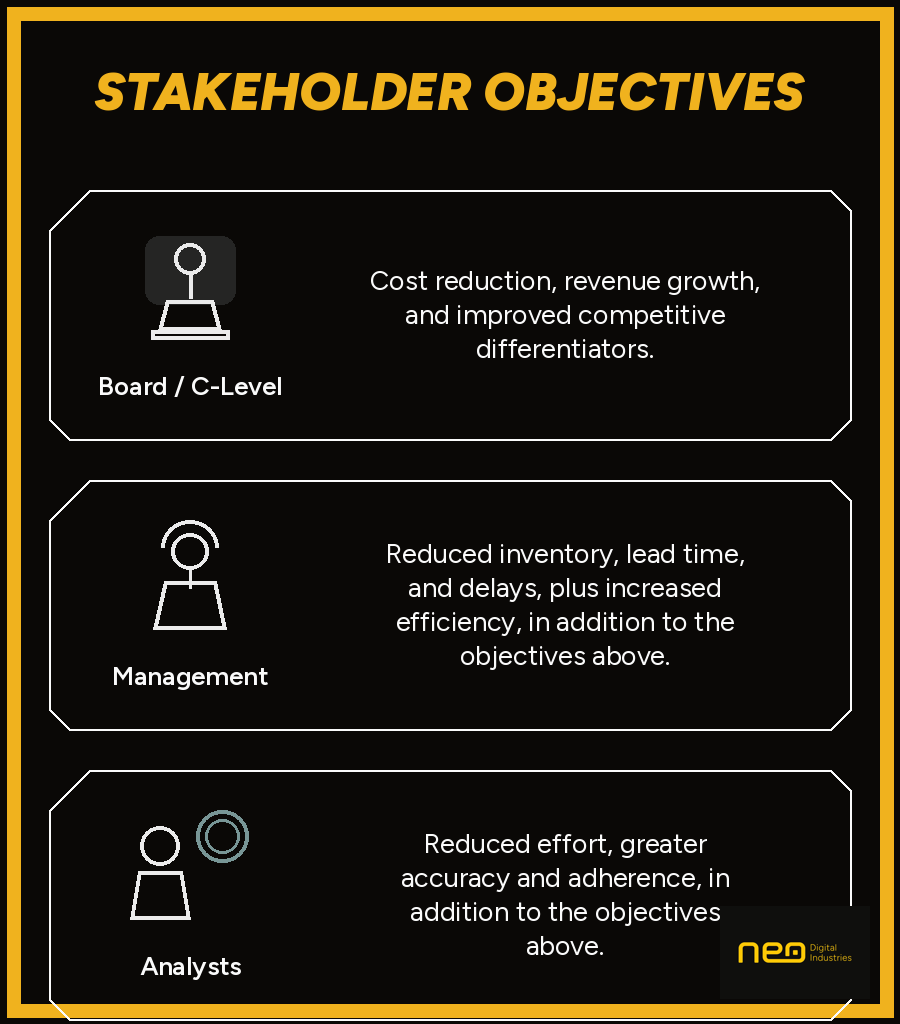
It doesn't take long to see the connection: decisions about what to produce, when, and how — the core function of Production Planning and Control — directly affect every one of the outcomes described above. The limitations of traditional MRP/MRPII solutions highlight a clear set of gaps that better planning can close. So how does APS actually deliver results against these objectives? The gains span multiple areas and reinforce one another. We'll walk through the planning-level benefits first, then the scheduling-level benefits. We will see below that the gains reach several areas, influencing each other. We will address the gains in improving the Planning processes and then the Scheduling processes, in order to make the approaches clearer.
GAINS THROUGH BETTER PRODUCTION PLANNING
At the planning level, knowing clearly whatcan and cannot be produced in a given period — given real capacity constraints— is what prevents both overstock and stockouts. Without rigorous capacityanalysis, you end up with too much of some products and not enough of others.APS accounts for actual capacity, which leads to healthier inventory levels andlower carrying costs, while also reducing lost sales from stockouts — a costthat's often impossible to measure precisely. Beyond the immediate period, APS supportsmedium- and long-term capacity decisions too. A 20% increase in demand doesn'tautomatically require 20% more capacity. Understanding how demand and capacityinteract over time — accounting for seasonality, product mix shifts, holidays,shift structures, and process changes — can change major investment decisions.It might mean the difference between buying a machine that sits idle and makinga targeted investment that actually meets demand. In short, bettercapacity-aware planning drives both cost reduction and stronger deliveryperformance.
GAINS THROUGH BETTER PRODUCTION SCHEDULING
At the scheduling level, advanced sequencing rules reduce setup and wait times, which directly improves productivity (see the Bartira and Credeal case studies as examples), and also shortens production lead times and reduces work-in-process inventory through better synchronization between operations (see the Lunelli case study as an example). Shorter lead times, in turn, reduce finished goods inventory levels (see the Tigre case study as an example). As a general benchmark, a 30% reduction in leadtime typically translates to a 15–22% reduction in safety stock requirements, depending on the inventory policy used. The logic is straight forward: faster replenishment means you can carry less buffer. APS also provides forward visibility into planned production over a horizon of weeks to months, with meaningful accuracy. That visibility lets you spot not just which orders are already late, but which ones are heading toward a delay — giving you time to intervene before the problem becomes a crisis. APS sequencing also tells you precisely when each operation should start, and therefore when raw materials need to be available. Unlike MRP/MRPII, which assumes fixed and equal leadtimes, APS works with actual operation dates — which means purchasing can be timed much more precisely to actual production needs, improving cash flow and reducing excess material on hand. Contrary to what MRP/MRPII assumes, production lead times are not always fixed and equal; therefore, knowing the actual dates of raw material need dates allows purchasing to time replenishments much more closely to actual production requirements, improving the company's cash flow .
APS GAINS LINKED TO LEAN LOSSES
To frame this in terms most manufacturerswill recognize: of the seven wastes of Lean Manufacturing, APS directlyaddresses five of them in a meaningful way:
- Overproduction;
- Stocks;
- Transport;
- Processing;
- Wait.
Ultimately, the ability to plan againstreal capacity constraints and properly synchronize operations producesschedules that are credible and executable — which leads to better decisions,greater confidence, and stronger business results.
Want to know how to measure these gains and loss reductions to understand how an APS project brings financial returns to your company? Keep an eye on the NEO Blog, as we'll talk more about it. You can also subscribe to our newsletter and get relevant content by email. Get in touch with us for a case assessment.[noptin-form id=2822]
Table of Contents
Talk to an expert
Speak with our experts and discover how NEO can transform your planning.
Book a demoDownload the ebook
Deepen your knowledge with our exclusive resources—practical content you can apply directly to your operations.
Download ebook