

How APS software raised the overall service level at Incepa by 81%
Discover how Incepa chose to work with Siemens Opcenter software, deployed by NEO Engenharia de Producao, to improve integration across processes and systems and reduce costs.


Meet Incepa, which since 2021 has been part of the Mexican group Lamosa – the world's second-largest manufacturer of ceramic tiles
About us
Incepa is recognized for its constant innovation and quality in every aspect of its products. Founded in 1952 in the city of Campo Largo, Paraná, by the Swiss brand Laufen, the company began its journey as a manufacturer of ceramic floor tiles, and in 1976 it incorporated the manufacture of sanitary ware. In 1999, it was acquired by the Spanish group Roca, and today, with more than 70 years of experience, it is a benchmark among the world's largest manufacturers of ceramic tiles, through its Roca Cerâmica and Incepa brands.
Since 2021, the company has been part of the Lamosa Group, a Mexican organization with global reach, specialized in the production and sale of ceramic tiles and adhesives.
Today, the Lamosa Group is a leader in the markets in which it operates, being the world's second-largest manufacturer of ceramic tiles, with an annual capacity of more than 225 million m².
The challenge
Although ceramic production is an age-old activity, today the entire process is automated, from mixing the liquid slip (slurry) through to packaging and palletizing. This automation made balancing between production centers one of Incepa's main challenges. In addition, flexibility to absorb variations in demand, while maintaining customer service levels and the productivity of production centers, are critical objectives for the company. The production process begins with the grinding and atomization of raw materials to form the granular body. Up to this process, the number of SKUs is small, and they operate in a condition pulled by the scheduling of the tiles. This body is then compressed during the pressing process until it reaches the required rigidity. After pressing, the pieces undergo a glazing process to acquire the desired colors and/or designs. The pieces are then taken to the kilns for the firing stage, becoming rigid and almost finished.
Some pieces still go through the polishing process, using abrasives to give a more refined finish. There is also a rectifying machine, which adjusts the edges of the ceramic pieces so that they are perpendicular, resulting in a more precise finish. In this scenario, the greatest constraint on production lay in the kilns. It is they that set the pace of production, both pulling the glazed ceramics and pushing the subsequent polishing and rectifying processes. Even so, depending on the product mix, this bottleneck can shift location. One can therefore see the importance of synchronization between all processes.
As if the internal challenges were not enough, Incepa was going through a period of very high demand, from both the domestic and foreign markets. In the latter, its main customer is ROCA in the United States, which has 5 distribution centers in the North American country and a high complexity of service due to the diversity of products and geographic breadth. There was a need to improve this international distribution process and among the American centers, as well as to connect U.S. demand with production in Brazil and rapidly gain capacity to meet this demand peak.
In other words, a far from simple challenge. At that point, after evaluating the market options, Incepa chose to work with Siemens' Opcenter software through implementation by NEO Engenharia de Produção, owing to its prior knowledge of the sector.
The solution
The solution developed for Incepa was made up of three products/modules and eight key scopes.
Opcenter Planning – Distribution (DRP): Demand Planning, Inventory Policies and Distribution; Opcenter Planning – Production (MPS): Inventory Policy, Planning and Order Generation; Opcenter Scheduling (APS): Fine Sequencing of Orders and Generation of Raw Material Purchase Requisitions.
The first DRP module performs not only distribution planning but also demand planning, carrying out the forecast based on multiple statistical methods, opting for the one with the lowest error in its prediction. This demand is managed in various ways, from the treatment of outliers, collaboration of the sales teams, evaluation of equivalent materials for new products and segmentation of products to identify critical items. Inventory policies are then defined for each type of product, based on its sales volume and frequency.
Finally, the needs identified for each U.S. DC are processed by a centralized algorithm that will generate Purchase Orders for the Brazilian factories, as well as transfers between the American DCs to better serve each distribution zone. This distribution will take into account transports in progress, inventory, physical space available in each DC as a limiting factor, in addition to fair share policies that will define fulfillment in the event of restrictive inventory.
Now, with demand from the U.S. and from the other Brazilian channels, Incepa uses MPS to initially define Brazil's inventory policies. As in the U.S., the solution prioritizes the production of products with the highest sales frequency and volume, in addition to evaluating the current inventory level, with the aim of prioritizing the production of high-value, low-coverage products.
In this process, finite capacity analysis of production is used to allocate products to the kilns and project weekly production, weighing several indicators to arrive at a result that makes the most sense for Incepa's situation. Once the ideal production mix for each week has been defined, the solution connects to Incepa's ERP and generates the orders at various levels of the product structure needed to carry out the planned production.
The production orders are sent from Opcenter for creation in the ERP, which in turn are imported into the last solution, the APS. The objective is to sequence the production orders so as to avoid setups for changes of format, type of relief, type of surface and other mapped attributes. Opcenter also has the Raw Material Purchase Requisition Generation functionality, which, based on the planned production dates, sends purchase requisitions to the procurement area, taking into account parameters such as minimum lot, multiple lot and safety stock. With the solution, Incepa is able to see more clearly the utilization of production resources and optimize production, reducing setups, improving efficiency and reducing costs.
The entire implementation, considering the solutions for Brazil and the U.S., took approximately one year to implement, which was very positive for the speed Incepa expected in order to meet its needs.
The results
After implementing the solution, Incepa has already achieved some significant results. Among the indicators measured continuously, it was possible to observe a 9% increase in the productivity of one of its factories, as well as an 81% increase in the overall service level.
In addition to these tangible results, the solution brought other benefits, such as greater reliability in the deadlines reported to the sales area, a reduction in the effort of the PPCP area, a shift in focus from mechanical activities to analytical activities, greater preparedness for variations in demand and standardization of production orders, with greater accuracy in costs.
Future outlook
With several other improvements planned for future implementations, the solution becomes even more complete and suited to Incepa's needs. Among the future prospects, the company still aims to expand the integrated horizon of the solutions, in addition to generating a statistical forecast to complement Demand Planning and S&OP, and also to generate purchase requisitions automatically for Brazilian production. For all these objectives, Incepa can count on the full consulting and technical support of NEO Engenharia de Produção.
SEE MORE RESULTS LIKE THIS AND LEARN HOW TO PROJECT THE ROI FOR A SUPPLY CHAIN PLANNING PROJECT IN YOUR INDUSTRY:
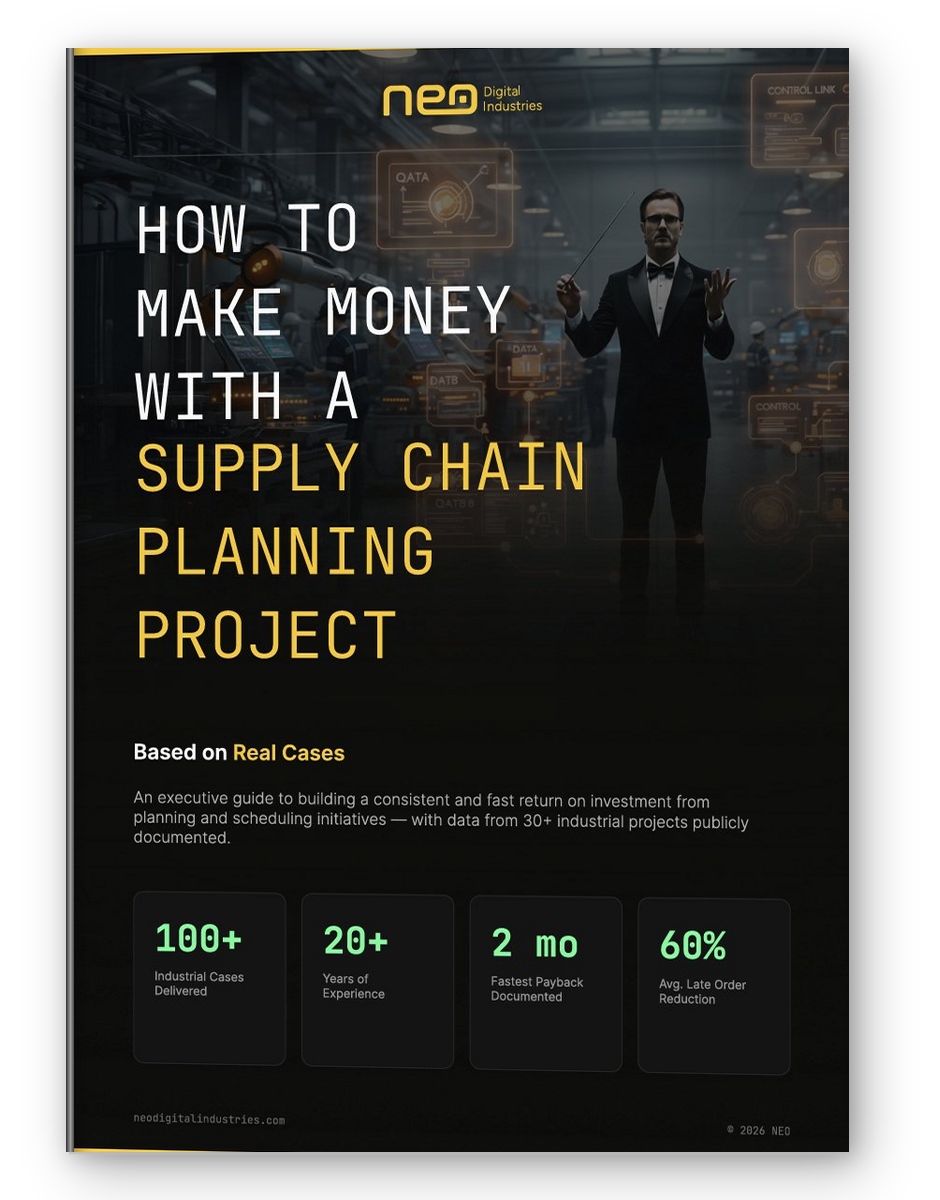
Free Ebook: How to Make Money With a Supply Chain Planning Project
Executive guide featuring data from over 30 documented projects. Discover the three sources of ROI, how to build a solid business case, and a step-by-step payback formula you can apply today.
Talk to one of our APS experts
Get a personalized assessment of your operations from APICS CPIM certified consultants. We will help you identify opportunities for improvement and estimate the return on your project.