

How ArcelorMittal Gonvarri Brazil boosted production efficiency, reduced inventory, and improved on-time delivery with Opcenter APS
Discover how AMG Hortolândia, a benchmark in the flat-steel sector and part of a global joint venture, implemented Siemens Opcenter APS in partnership with NEO to overcome operational challenges and achieve significant results in the automotive sector.


Meet ArcelorMittal Gonvarri Brasil, a world reference in the flat steel sector born from the merger of two industry giants
About us
A world reference in the flat steel sector, ArcelorMittal Gonvarri Brasil (AMG) was established in 2008, following the formation of a joint venture between ArcelorMittal, the world leader in steel mining and production, and Gonvarri Industries, the world leader in steel and aluminum processing. The strategic partnership between these two industry giants was an important step in strengthening the companies in Brazil, aiming to develop existing synergies and paving the way for new partnerships and opportunities.
Among the three processing units in the country, located in Araucária (PR), Hortolândia (SP), and Glorinha (RS), the Hortolândia plant stands out for its installed capacity of 800,000 tons per year and its strategic location, close to the main highways and the railway network. In operation since 2002, the unit offers pickling and slitting services for hot-rolled coils, as well as slitting of cold-rolled, galvanized, galvalume, and galvannealed products. The plant produces sheets, slitters, and other parts for applications in different industrial segments, with an emphasis on the automotive sector.
Over the years, AMG has reinforced its commitment to providing steel solutions that promote a better and more sustainable future, focusing on total quality, trust, transparency, and rigor in compliance with standards. The company thus seeks to ensure a solid supply chain and create more robust business opportunities. This commitment is backed by the certifications the company has earned, such as ISO 14001:2015, which certifies its Environmental Management System, and ISO 9001:2015, which certifies its Quality Management System.
The challenge
ArcelorMittal Gonvarri's Hortolândia unit faced complex challenges in managing its production chain, mainly due to demand variability and the need to optimize raw material usage. In this context, one of the main challenges in the automotive segment is balancing tight and strict delivery deadlines with the efficient use of resources and materials, in order to reduce delays and waste. In addition, the volatility of order books required agile and flexible planning, capable of adapting to changes without compromising operational efficiency.
Another critical challenge for AMG was inventory control, which resulted in frequent production line stoppages due to excess finished goods and the long dwell time (age) of raw material in inventory. A more precise balance between the availability of inputs and production demands was needed, in order to reduce inventory levels without compromising delivery reliability. This balance is especially important in steel processing, where efficient management of coils and sheets has a direct impact on the profitability of the operation.
Production efficiency also represented an important challenge, since inadequate sequencing of operations resulted in frequent stoppages, long setup times, and low equipment utilization, which led to the underuse of production capacity. In addition, ensuring high service levels in a make-to-order production environment required precise synchronization between planning and execution. Meeting the delivery dates agreed with customers depends on a clear view of production capacity and a prioritization of production orders compatible with the company's strategy, without compromising operational efficiency.
Aware of these difficulties, AMG sought a solution on the market to enhance and optimize its production scheduling and chose NEO Digital Industries and Siemens as strategic partners. NEO was responsible for the specification, development, and implementation of the solution, while Siemens was the supplier of the software to be implemented, Opcenter APS.
The solution
To deal with the production complexity of the Hortolândia plant, planners spent hours trying to reconcile several variables, such as delivery dates, labor constraints, tooling, and setups. With sequencing being performed manually in the SAP ERP and with the support of Excel spreadsheets, in addition to the high volume of variables to be considered, it was not possible to have a clear view of the impact of each decision in the short, medium, and long term.
With the solution developed in partnership with NEO, the Opcenter APS software began to automatically process all the factory's information, such as production orders, routings, records, and technical data sheets, through integration with the SAP ERP. With this data, Opcenter APS is able to generate, in a matter of seconds, the ideal scenario for production scheduling, taking into account the optimization parameters and criteria defined by the company. This brought more agility and precision to planning, facilitating decision-making and improving operational efficiency.
However, the true differentiator lies in the intelligence applied to planning. With the support of the PPAC team and the production supervisors, business rules customized for the context of AMG Hortolândia were specified and developed. The objective was to optimize the production mix and ensure a strategic allocation of resources, maximizing productivity and aligning operations with the specific needs of the plant.
The solution also considers various details, such as material thickness, packaging types, coil weights, and the additional times needed to change pallets, in addition to many other specific attributes. This ensures scheduling that accurately reflects the reality of the operation.
These business rules were essential to ensure the effectiveness of the final solution, allowing the generation of scheduling aligned with the company's objectives and needs. With the solution implemented, users are able to schedule and reschedule all production orders in a matter of seconds, quickly generating different scenarios. This enables them to track changes in demand and make critical and urgent short-term decisions without losing sight of the long term.
In addition, the data compiled by the software is also used for technical and managerial analyses through customized reports. These reports include, among others, monitoring adherence to the schedule, evaluating it based on different metrics; the comparison of different scenarios; and the analysis of actual process times compared to estimated times. The project developed at ArcelorMittal Gonvarri was not limited to the implementation of a new system; it introduced a more agile, intelligent, and strategic approach to the way production is scheduled.
The results
For strategic reasons, the first line selected for the implementation of the Opcenter APS software was a cut-to-length line. Since its adoption in May 2024, significant gains have been achieved related to better control of overall inventory levels, increased production efficiency, and improved service levels.
In the first months of using the solution, there was a significant reduction in stoppages caused by excess finished goods (FG) in inventory, which had been one of the company's biggest challenges in 2022 and 2023. In 2023, the monthly average of hours stopped due to excess FG was around 11 hours. With the implementation of the Opcenter APS software in 2024, the process became more stable, reducing this average by approximately 6 hours, which represents a 45% reduction. In terms of production, machine stoppages in 2023 resulted in the loss of 3.6 KTs (thousand tons), while in 2024 this loss was 1.7 KTs, evidencing a 53% reduction in production losses.
Another important gain was achieved in reducing inventory coverage, an objective that ArcelorMittal Gonvarri has pursued over the last few years. In 2023, the average coverage was 5.08 days, while in 2024 this value fell to 4.6 days, resulting in a 9% reduction. When comparing the period after the implementation of the APS system (June to December 2024) with the same period in 2023, a decrease in average coverage from 5.24 days to 4.49 days was observed, which represents a 14% drop. This improvement contributed directly to the company's alignment in complying with its inventory policy.
In addition, an important additional benefit of the project was the strengthening of Opcenter APS as a tool for controlling the quality of information and internal procedures. This raised the maturity of AMG's data to a new level. Through a detailed analysis of processes and records carried out by the quality department, the company was able to improve the accuracy of information in about 19% of products, especially in relation to routings and technical data sheets, which had a positive impact on cost calculations. With more reliable data, AMG not only improved its operational performance but also strengthened its ability to plan and execute its strategies with greater precision and confidence.
"With the implementation of APS, it became easier to see the real capacity of the line, which allowed for better management of critical production items and more visibility for negotiating shipment dates with customers."— José Henrique Teixeira, PPCP analyst
Future outlook
The implementation of the Opcenter APS software on the cut-to-length line at ArcelorMittal Gonvarri's Hortolândia unit resulted in significant gains in various aspects, such as deadline compliance, production efficiency, inventory levels, and operational stability. These results were only achieved thanks to the commitment of the NEO and AMG teams, whose partnership and technical expertise were essential to overcoming the challenges inherent in a transformation of this magnitude. Together, the teams worked to adjust the developed solution to the complexities and specific demands of the production process.
The next steps consist of expanding the use of the solution to all production lines, creating a global synchronization that will further enhance the gains already achieved. Although new challenges may arise, as occurs in any process of change and evolution, the significant results obtained in just a few months demonstrate the great potential of the solution. With dedication, expertise, and a constant focus on improvement, the AMG team demonstrates that excellence is not just a goal, but a daily commitment, which makes the company a world reference.
"We expect APS (Opcenter APS) to continue increasing productivity, reducing costs, and optimizing resources. With more precise planning, we will have more efficiency, less waste, and greater competitiveness."— Cleber dos Reis, PPCP coordinator
SEE MORE RESULTS LIKE THIS AND LEARN HOW TO PROJECT THE ROI FOR A SUPPLY CHAIN PLANNING PROJECT IN YOUR INDUSTRY:
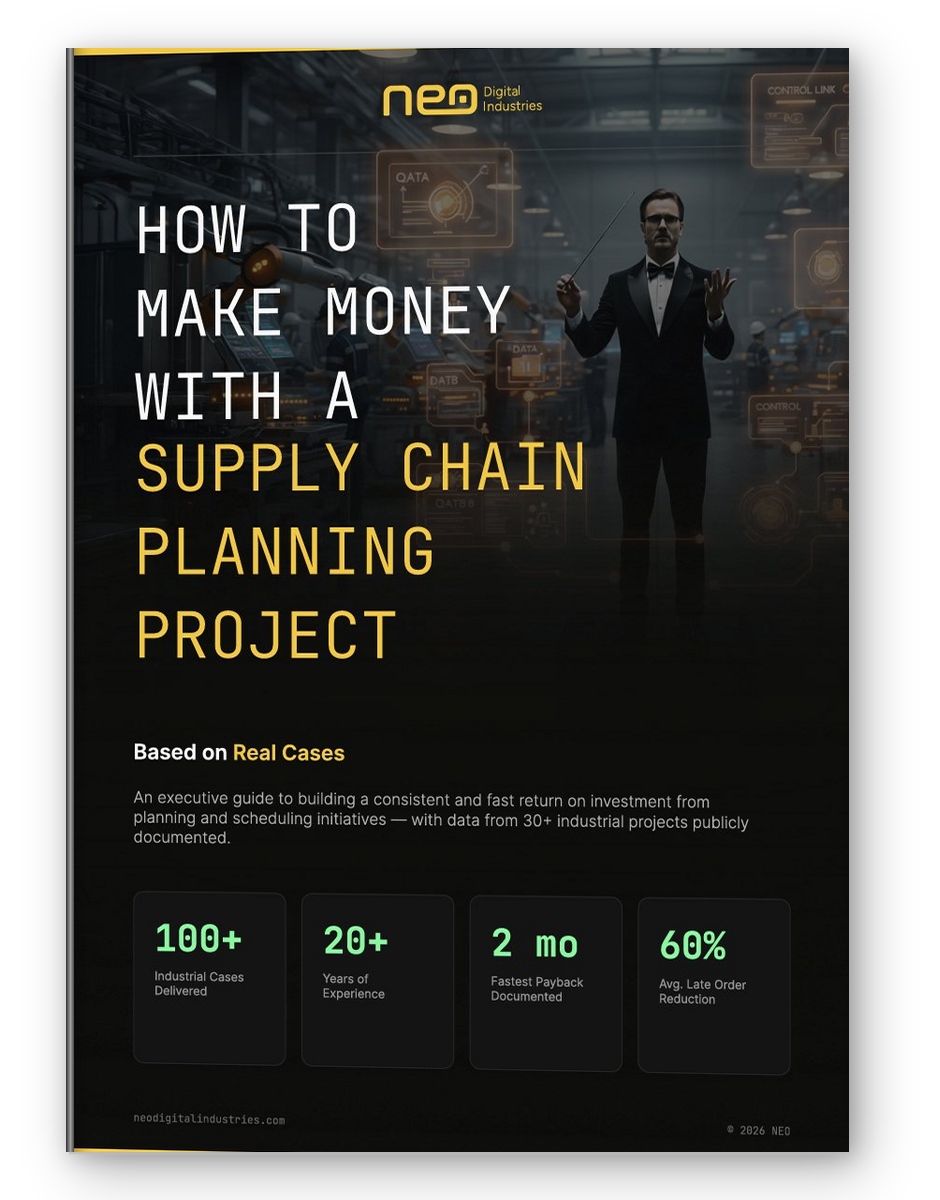
Free Ebook: How to Make Money With a Supply Chain Planning Project
Executive guide featuring data from over 30 documented projects. Discover the three sources of ROI, how to build a solid business case, and a step-by-step payback formula you can apply today.
Talk to one of our APS experts
Get a personalized assessment of your operations from APICS CPIM certified consultants. We will help you identify opportunities for improvement and estimate the return on your project.