

How Cia Hering transformed PPC with Opcenter APS and NEO: 60% productivity gain with scheduling 10x more agile
Discover how Cia Hering — one of Brazil's largest and most traditional fashion brands — digitized production planning and scheduling with Siemens Opcenter APS and NEO's expertise, reducing lead times, gaining efficiency, and strengthening its operation in the fast-paced fashion industry.
.png)

Meet Cia. Hering, one of Brazil's leading manufacturers of basic apparel, with a broad portfolio of innovative solutions for the casual and affordable fashion market.
About us
Founded in 1880 in Blumenau, Santa Catarina, Cia Hering is one of the most traditional companies in Brazil's textile sector. With over 145 years of history, it has established itself as a benchmark in the manufacturing and sale of apparel, recognized for its iconic brand and the quality of its products. Over the decades, Hering expanded its operations, adopting an efficient production model and a broad distribution network, with a presence in both physical retail and e-commerce.
In the early 2000s, the company experienced a period of strong growth, becoming one of the largest in the sector in Brazil. In 2021, Cia Hering was acquired by Grupo Soma, a strategic move to strengthen its position in the fashion market. More recently, in 2024, Grupo Soma announced a merger with Arezzo&Co, consolidating one of the country's largest fashion conglomerates and further expanding the reach and relevance of the Hering brand on the national stage, through the holding company now called Azzas 2154.
The challenge
Cia Hering's PPCP challenge has a peculiar complexity, since the company has plants in several Brazilian states, some of them with more than one factory, more than 300 third parties that carry out sewing processes, a huge retail network in Brazil, as well as a set of more than 5 manufacturing systems in the areas where a PPCP solution would operate. In other words, both the physical flow and the data flow were quite a challenge.
Cia Hering is a vertically integrated manufacturer that produces everything from raw knit fabric made on looms, through textile finishing processes, in which color and the expected physical and chemical properties are applied, and finally garment making, in which the fabrics are cut, embroidered, sewn and receive the finishes for the final pieces that will be sold at retail. While the initial and intermediate processes are heavily carried out internally at its facilities, the final sewing processes are performed for the most part by third parties spread across Brazil. As a result, the company's production lead time tends to be very long, making synchronization between these stages very difficult, which impacts work-in-process inventory, delays, stockouts and surpluses. All of this is aggravated by being part of the fashion world, which demands product diversity and dynamism. There are 4 collections per year, each lasting between 3 and 4 months, each with an average of 500 finished product items that unfold into up to 10 thousand SKUs (considering sizes and colors), which makes demand naturally unpredictable and forces the industry to be extremely responsive.
In this context, the company then decided to deepen its understanding of the level of readiness it had in terms of PPCP technologically, as well as the action plan it should put together to improve the results it was seeking, such as better inventory health, efficiency and a reduction in production lead time and the time spent by PPCP on activities. The partnership with NEO became strategic due to its vast experience in the textile and apparel sector. Together, the companies carried out assessments of the needs for information, systems and processes and planned a journey with different stages for the digitalization of PPCP. Given the complexity of the situation it was in, the company decided to start with phases in which information availability was more accessible and in which the reduction of the PPCP team's effort was greater.
"Opcenter APS is already proving its strength with impressive results in order generation, but our outlook goes further. We are convinced that, together with NEO, this solution will not be merely an evolution — it will be a revolution. A true game changer that will redefine the standards of Full planning and sequencing, paving the way for a new level of intelligence and performance."— Tiago Otto, PPCP Coordinator
The solution
The first step of the structured plan for Cia Hering's digital transformation was a detailed analysis of the existing processes, identifying bottlenecks and opportunities with potential for quicker gains. Based on this diagnosis, an implementation roadmap divided into phases was defined, prioritizing stages with the greatest impact and ease of integration.
The first phase consisted of replacing a legacy order-generation solution, preparing the ground for future fine-sequencing solutions. This stage focused primarily on implementing a routine for generating manufacturing orders, establishing consistent and configurable production batches, optimizing the production flow and resource management. All of this in an agile manner and responsive to the demand for replenishments and production disruptions.
After the first stage, the focus turned to implementation in the most critical sector: sewing. At this stage, it was essential to create a relationship with the preceding sectors and to ensure the efficient supply of the sewing cells, both internal and external. The system also began to generate the picking (the material-collection process) for the truck shipments that supply the outsourced sewing operations, providing greater agility and accuracy in logistics operations.
Next, APS was implemented in the cutting, embroidery, printing and finishing processes. With this stage, the sewing sector gained greater reliability regarding which orders would be available, facilitating the planning and execution of activities. In addition to ensuring more accurate scheduling for these sectors, since the software was able to introduce a pull-flow strategy, in which sewing played the role of the drum of the production system and the preceding sectors complied with that demand. Combined with this improved synchronization between the processes, opportunities for operational efficiency gains could also be seen by reducing setups in these production processes.
In the finishing sectors, the software provided predictability and agility for the entire company. Additionally, products with stockouts were automatically identified and prioritized, increasing revenue and reducing the fulfillment lead time for the customer.
All of the developments above relied on the support of the business areas and also of IT, which are essential in an environment like that of Cia Hering, which has a complex scenario in the supply chain and communication between various systems, so that everything works as smoothly as possible.
The results
The results obtained from the project's implementation were significant and quickly noticeable. In less than 12 months after the completion of the first phase, Cia Hering recorded a 63% reduction in the time to generate production orders, allowing PPCP to direct its efforts toward more analytical and strategic activities. In addition, the order-issuing process became more flexible, accurate and aligned with operational assumptions, eliminating distortions that previously affected areas adjacent to the production process.
Before the implementation of Opcenter APS, the scheduling of sewing and the other internal sectors — such as embroidery, printing and finishing — was carried out manually, in a decentralized way and based on parallel controls, spreadsheets and informal communication between the areas. This model required high operational effort, strong dependence on the individual knowledge of the schedulers and resulted in rework, information inconsistencies and delays in decisions. The low visibility of production bottlenecks, combined with the difficulty of rapid rescheduling and the absence of real-time information, compromised the reliability of the promised dates and the company's service level.
With the arrival of Opcenter APS, scheduling became centralized, standardized and integrated, providing greater control of production capacity, better sequencing of operations and broad visibility of the order portfolio. The system enabled agile rescheduling in the face of unforeseen events, such as material unavailability or changes in priority, and significantly reduced the time devoted to preparing and maintaining the schedule, which dropped from 10 days to just 1 day. This gain freed the team to act more strategically, focusing on data analysis and decision-making.
In addition, the quality of the information made available to the sectors evolved significantly, driven by the tool's features and by the greater agility in building and updating the data. This new level of information enabled the creation of weekly rituals with all the areas involved, focused on monitoring deliveries, identifying bottlenecks and defining action plans, strengthening the collaborative management of the production process.
As a result of this greater control and integration between the sectors, the company recorded, in the most recent year of 2025, an improvement of 24 percentage points in the global service level, a direct reflection of the improvement in schedule management and operational predictability.
Another relevant highlight was the increase in productivity in sewing. Between 2022 and 2025, productivity per workstation grew by approximately 60%, which resulted in estimated savings of at least R$ 8 million, considering investments that were no longer necessary in training and the acquisition of machinery for new workstations.
With the success achieved, Cia Hering consolidated PPCP as a strategic area, capable of driving the company's competitiveness in a sector as dynamic as fashion. The partnership with Neo demonstrated the potential of innovation applied to industrial processes, paving the way for new digitalization initiatives and sustainable operational efficiency gains.
SEE MORE RESULTS LIKE THIS AND LEARN HOW TO PROJECT THE ROI FOR A SUPPLY CHAIN PLANNING PROJECT IN YOUR INDUSTRY:
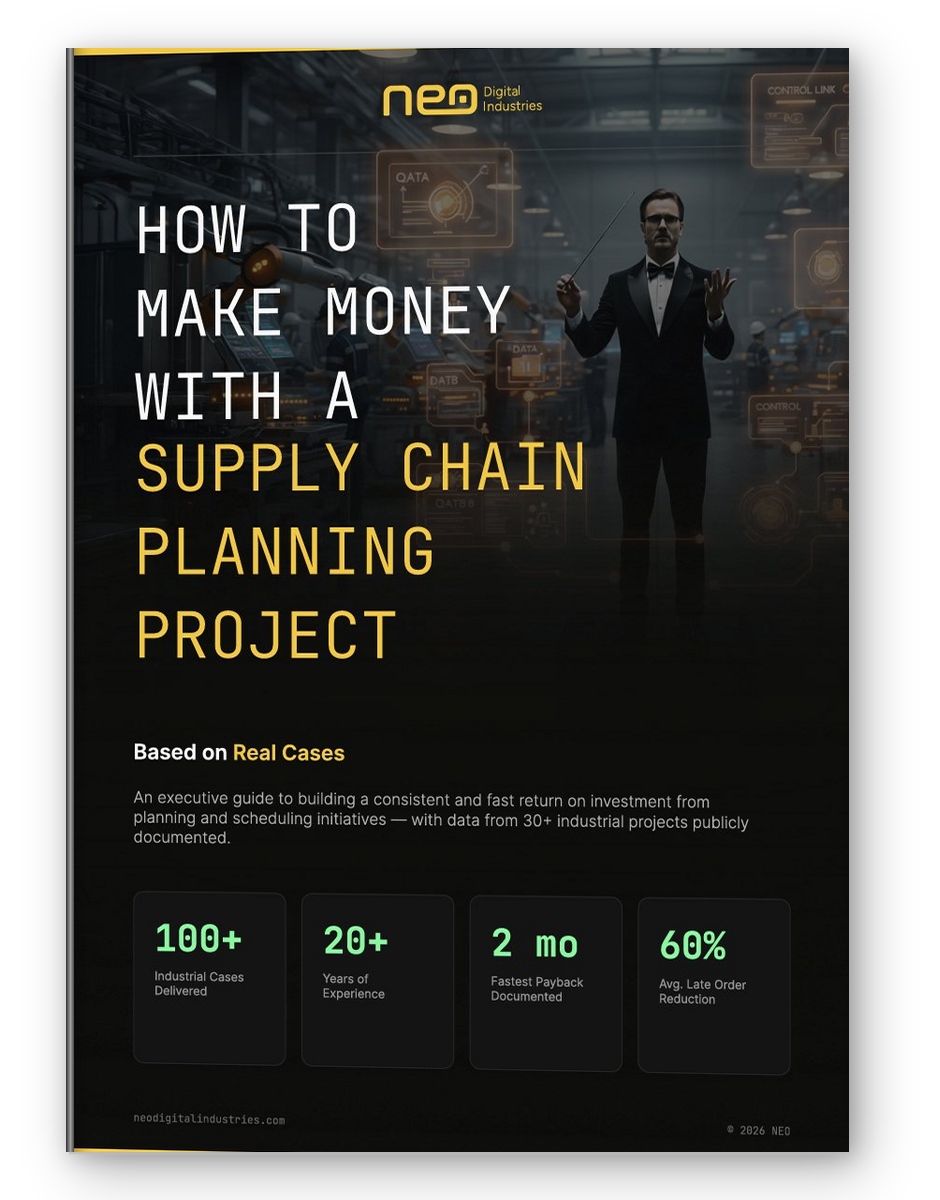
Free Ebook: How to Make Money With a Supply Chain Planning Project
Executive guide featuring data from over 30 documented projects. Discover the three sources of ROI, how to build a solid business case, and a step-by-step payback formula you can apply today.
Talk to one of our APS experts
Get a personalized assessment of your operations from APICS CPIM certified consultants. We will help you identify opportunities for improvement and estimate the return on your project.