

How Dauper brought more agility to PPC
Discover how Dauper significantly cut the time spent on production scheduling, improved sales and shipping management, and increased efficiency in purchasing and its ability to anticipate actions to meet production demand.


Meet Dauper, a benchmark in the market's outsourcing segment for cookies, filled bars, and granolas.
About us
Dauper, a company in the food sector, carried out the Advanced Production Sequencing project in partnership with NEO using Siemens' Preactor APS. Dauper's operations began in mid-1988, when its first plant was inaugurated in Canela – RS. From 1990 onwards, Dauper was approved as a cookie supplier for McDonald's and, as a result, the plant expanded year after year.
Today, Dauper supplies major retail brands such as Nestlé, Mondelez, Unilever, Kellogg's, Hershey's, among others. Aiming for continuous growth, over the coming months the company plans to increase its production capacity by 35%. Dauper is one of the leading benchmarks in the market's outsourcing segment for cookies, specialty cookies, filled bars, and granolas.
The challenge
In Dauper's case, production follows an MTO (Make to Order) orientation. In this context, the PPCP department needs to obtain quick answers about the progress of orders, as well as have visibility of the plant in the short, medium, and long term.
Since the setup times of the lines can vary greatly from product to product, the production sequence must always seek combinations that do not generate high times, so that productivity is greater. In addition to all the possible combinations, the products have several different inputs in their structures (bills of materials), because each customer has its own raw material specifications. With all these variables, the PPCP team had an arduous task to draw up the production sequence in an optimized way, with the help of electronic spreadsheets.
Another critical factor was the time spent changing a product's sequence, where the entire schedule had to be manually readjusted. Furthermore, it was not possible to quickly and practically observe the impacts of this rescheduling.
With all the challenges mentioned, Dauper and NEO Engenharia de Produção formed an alliance to implement Preactor AS (Advanced Scheduling). With NEO's expertise in production management technology, the project focused on the following objectives: reducing sequencing time; optimizing line changeover (setup) times; visual management of the raw material status of each product; sequencing simulations of future commercial forecasts; and preparation of customized reports and views.
The solution
The solution was built with constant interactions between Dauper and NEO, aiming to generate reliable, optimized, and fast sequencing. The solution's interface allows the user to simulate distinct sequencing scenarios considering variable scheduling criteria. One of these criteria aims to optimize scheduling according to the shortest possible setup time. Consequently, order scheduling can be done instantly, as well as capacity analysis of the production lines according to the different shifts used within the company.
Through Preactor, visual management of inputs (raw materials) also became feasible, according to an intelligent color signal. This visualization shows which orders have stock, stock and purchase orders, only purchase orders, or whether they lack some input. As a result, Preactor became an ally to support decision-making at the different levels of the company. Furthermore, several customized reports were created to facilitate the day-to-day management of scheduling in PPCP. All production line stoppages, tests, and other events that cause the interruption of a production order are included in the scheduling report that is made available to the entire company.
The results
One of the most notable results of the solution was the considerable increase in the speed at which scheduling is generated compared to the previous method. Before the project, sequencing a month's production took around 2 to 5 days to complete. With Preactor, the result is generated in approximately 10 minutes, making the analytical side of PPCP much stronger than the operational one.
The commercial and shipping departments also benefited from the tool's results, as they can easily see how much of each item is being produced per day, facilitating management with customers as well as the shipping of loads.
Another sector directly favored was supply (purchasing), which can obtain the exact dates of the needs for each raw material according to the production sequence. Furthermore, with the scheduling of future commercial forecasts, Dauper can analyze line capacity in advance and anticipate the actions needed for the production mix to be successfully met.
SEE MORE RESULTS LIKE THIS AND LEARN HOW TO PROJECT THE ROI FOR A SUPPLY CHAIN PLANNING PROJECT IN YOUR INDUSTRY:
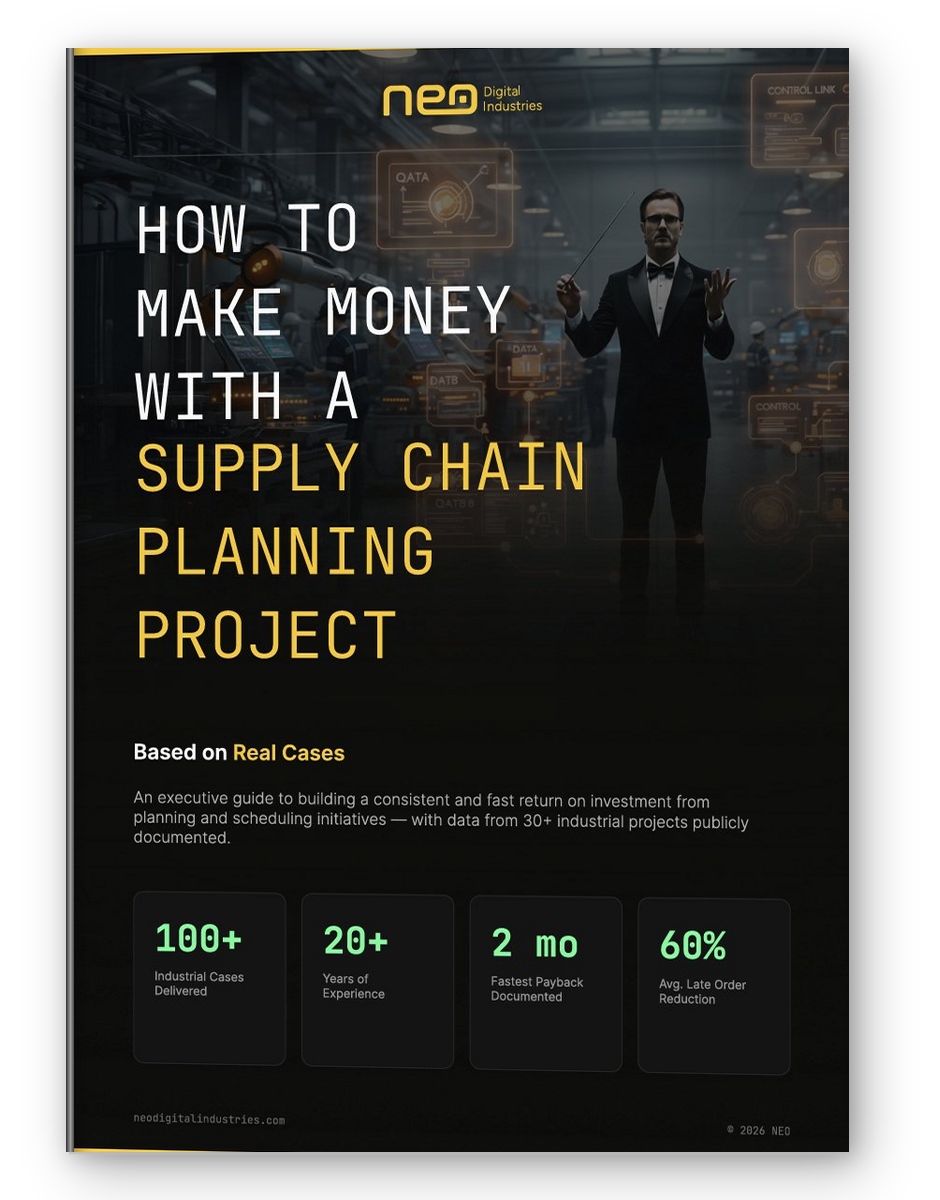
Free Ebook: How to Make Money With a Supply Chain Planning Project
Executive guide featuring data from over 30 documented projects. Discover the three sources of ROI, how to build a solid business case, and a step-by-step payback formula you can apply today.
Talk to one of our APS experts
Get a personalized assessment of your operations from APICS CPIM certified consultants. We will help you identify opportunities for improvement and estimate the return on your project.