

How Grupo Malwee revolutionized materials control with Opcenter APS and NEO: more agility, fewer stockouts, and optimized inventories
Discover how Grupo Malwee, a national benchmark in fashion and the textile industry, used Siemens Opcenter APS with NEO's support to turn the control of raw materials, semi-finished textiles, and finished-goods inventories into a strategic business lever.


Meet Grupo Malwee, one of the largest textile and fashion manufacturers in Brazil, with annual output of more than 40 million garments and a strong commitment to sustainability.
About us
With more than five decades of history, Grupo Malwee has established itself as one of the leading names in the textile and fashion industry in Brazil. Founded in 1968 in Jaraguá do Sul (SC), the group brings together nationally recognized brands such as Malwee, Enfim, Malwee Kids, Carinhoso, Basico.com and Basicamente, which together make up a broad portfolio aimed at different consumer profiles.
The company operates in a highly vertically integrated manner, connecting the manufacturing of knit fabrics to the making of garments, which ensures efficiency, quality and agility throughout the entire chain. It currently produces more than 40 million garments per year and maintains a presence in more than 76% of the national territory. In addition to its industrial impact, Malwee stands out for its commitment to sustainable practices, continuously investing in technologies and processes that reduce the consumption of natural resources, expand the use of recycled raw materials and strengthen the circular economy, reinforcing its purpose of making fashion a positive force for society and the planet.
The challenge
Grupo Malwee faced significant challenges in the integrated management of its material planning and allocation processes. On one side, there was the complexity of controlling purchased raw materials, used across the most varied processes of the chain, in addition to the semi-finished textiles that fed the garment-making operation. On the other, the need to optimize the allocation of finished products to sales orders, ensuring a balance between availability, commercial priority and production capacity.
These activities were previously carried out within the SAP ERP, but the existing model no longer offered the agility and visibility required for the level of integration the group was seeking. Faced with this scenario, Malwee identified the opportunity to enhance its management by connecting the allocation of materials and products directly to the production sequencing of Opcenter APS.
The goal was to ensure efficient sequencing of production orders, avoiding stoppages due to a lack of raw materials and ensuring that available materials are directed strategically, balancing the availability of inputs and the correct prioritization of customer orders, while keeping the production flow continuous and aligned with commercial needs.
The partnership with NEO Digital Industries, which had already delivered significant results in the implementation of Opcenter APS across Grupo Malwee's entire production chain, once again proved essential to overcoming the identified challenges. To meet the project's needs, four distinct workstreams were structured: the first, focused on the allocation of purchased raw materials; the second, on the allocation of knit fabrics destined for garment-making; the third, focused on the allocation of work-in-process materials within Textile sequencing; and finally, a solution focused on the allocation of finished products to sales orders, ensuring better use of inventory and improving customer service.
The solution
The first solution, focused on the allocation of purchased raw materials, was developed to ensure the efficient use of acquired inputs, guaranteeing that each material — such as yarns, trims and fabrics — is correctly reserved and directed to the production orders that depend on it. In a fashion industry, this logic is essential to avoid material shortages during the process, preventing machine stoppages in critical sectors such as sewing and maintaining balanced inventory, without generating surpluses or shortages between collections. The goal of this allocation is not only to enable high-performance sequencing in Opcenter, but also to sustain a continuous and reliable supply. For its implementation, the central premise adopted was respect for the primary and alternative warehouse constraints defined for each material, ensuring that consumption follows exactly the operational rules of the chain.
"With the new allocation logic, we raised the level of precision of our planning by considering all warehouses available in the MRP, and not just the stockroom. The system began to identify raw material shortages in advance, assessing orders, requisitions and supply lead times, which ensures a much more reliable supply. This evolution brought more security to sequencing, avoiding orders without material and reinforcing operational efficiency. The result is a more intelligent, dynamic process aligned with the needs of our production chain."— Ademiro Volkmann, Project Manager
The second solution, focused on the allocation of knit fabrics produced by the textile operation, aims to ensure the continuous supply of the Garment-making production stages, connecting Textile planning to the daily needs of the sewing lines. The knit-fabric allocation function is fundamental to integrating finishing, cutting and sewing, ensuring that no production order is sequenced without confirmation of available material. This logic ensures that cutting orders are scheduled according to the actual availability of knit fabrics, avoiding stoppages due to a lack of inputs and preserving the stability of the process.
In addition, the knit fabrics to be produced are now prioritized according to the effective demand of the sewing lines, promoting full synchronization between sectors and avoiding misalignments between production and consumption. As a result, the production flow occurs in a balanced and continuous manner, with better use of resources and machine time. Finally, the solution provides complete visibility into the consumption and availability of knit fabrics at each stage, directly supporting textile planning and strengthening production control.
The third solution, focused on the allocation of internally produced materials in the textile operation, aims to ensure the balance between the generation and consumption of inputs produced within the company itself, such as flat-knit pieces, drawstrings and intermediate knit fabrics, while providing visibility into the inputs used by the internal materials, such as chemicals and yarns for the knitting of products. Integrated directly into production planning and sequencing, this function ensures that these internal materials are allocated according to the actual need of the sewing orders, avoiding deviations between what is produced and what is effectively demanded. This logic is essential to ensure that subsequent stages, such as cutting and sewing, receive the inputs at the exact moment, preventing bottlenecks and stoppages resulting from a lack of material.
The tool promotes consistent synchronization among all production sectors — Knitting, Dyeing, Printing and Finishing — ensuring that the internal flow of materials keeps pace with sequencing and execution. As a result, the operation avoids both excesses and shortages of critical items, optimizes the use of internal resources and ensures greater fluidity throughout the entire textile chain.
"The project culminated in excellent results, with resource allocation acting as a strategic agent for factory optimization. We managed to direct materials more efficiently, at the right time, and establish the best sequencing synchronization based on predefined parameters. The foundation of this success lies in the defined parameters that guide the decision and establish the best alternative for the use of resources."— Matheus Martini, Textile PCP Coordinator
The fourth and final solution, focused on the allocation of Sales Orders, is a function with one main strategic objective: to ensure that available materials are distributed efficiently to meet commercial demands, while also contributing to increased productivity in the Shipping department, responsible for sending materials to customers. In addition, sales order allocation provides visibility to the Sales, PCP (Production Planning and Control) and shipping areas, enabling dynamic and rapid adjustments in the event of changes to orders, deadlines or priorities.
This modeling, considered the most complex development among the four workstreams, required the handling of a large volume of data on open orders by SKU and by customer, in order to ensure the correct prioritization of these demands. At this stage, the allocation logic had to respect a set of essential premises, including the prioritization of orders according to parameters configurable by the user, fully aligned with the company's commercial strategy; preferential service to critical and special customers, who have greater strategic relevance or cancellation restrictions; and the pursuit of complete order allocations before considering partial alternatives, ensuring that all items of the same order were fulfilled simultaneously whenever possible. This combination of rules made it possible to structure a robust allocation, consistent with business priorities and adherent to the actual availability of finished products.
The results
The results of implementing the material allocation rules through Opcenter APS across Grupo Malwee's entire production chain were significant from the very first rounds of use in a production environment. Precise visibility into material availability — whether raw materials, semi-finished goods or finished products — enabled a much more intelligent prioritization and release of orders, providing a complete view of the supply chain. This resulted in more efficient management of components and, consequently, in an optimized and more accurate production sequencing.
The purchased-material allocation solution had a direct impact by replacing the previous logic, which considered only the stockroom warehouse. With the new approach, it was possible to reduce approximately R$ 184,000.00 in improper annual purchases, ensuring a significantly more efficient and economical supply process. Meanwhile, the logic implemented for the allocation of knit fabrics destined for cutting raised the performance of the complete model — scheduling all colors of the same product — to an average of 72%, ensuring a continuous production flow and better service to the demands of the textile chain and Garment-making. This evolution significantly reduced the number of setups, eliminated the need to repeat spreading and cutting of the same material, and reduced rework, energy consumption, paper and plastic. In addition, it enabled the creation of a new management report that replaced a manual process that consumed two hours a day of an analyst's time, now being carried out in less than five minutes.
The solution focused on the allocation of Sales Orders delivered even more significant gains, surpassing the SAP system in both indicators monitored by Grupo Malwee. In a single sales period, there was an increase of R$ 3.33 million in allocated value and of 134.5 thousand garments directed to billing. The level of complete order allocation — when all items of the same order are fulfilled simultaneously — also showed growth of more than 5% in value and close to 9% in volume. This performance was reinforced by the ability to prioritize critical customers, who have no possibility of refusal, generating a gain of R$ 61.4 thousand and 3.4 thousand garments, tripling the rate of fully fulfilled orders. For the other special customers, the results were also consistent, with gains of R$ 391.1 thousand and 18.8 thousand garments, doubling the proportion of fully fulfilled orders.
"I would like to share a perspective on the concrete results we achieved with the implementation of the new order allocation policy, specifically the one that prioritizes our Special Customers with Zero Refusal. This strategy is not merely an operational improvement; the main gains from this decision were: 1) Reinforced Loyalty and Trust; 2) Revenue Security and Financial Predictability; 3) Strategic Optimization of Resources. Prioritizing special customers with zero tolerance for refusal proved to be a sound strategic decision. It is not a matter of favoritism, but of aligning resources with the strategic value of the customer. The results are clear: greater customer satisfaction, revenue security and a more disciplined and focused operation."— Liliane Soares, Garment-making PCP Coordinator
Future outlook
The next step in Grupo Malwee's digitalization journey is the implementation of nPlan, the Production Planning solution developed by NEO Digital Industries. nPlan makes it possible to generate planning scenarios in an agile and collaborative way, using resources such as finite capacity, customized business rules and heuristic simulations to optimize production plans, seeking to minimize costs, reduce lead times and control inventory.
"With the adoption of the allocations, we transformed the way we plan and execute production. With the support of NEO's solution, we began to sequence with greater precision, reduce shortages and increase the reliability of the plan. The results are visible on the shop floor, in inventory and in customer service. Today, we operate with much more predictability, agility and accuracy in decisions, reducing rework, improving machine utilization and increasing precision in order fulfillment."— Graciano José Bonetti, Supply Chain Manager
SEE MORE RESULTS LIKE THIS AND LEARN HOW TO PROJECT THE ROI FOR A SUPPLY CHAIN PLANNING PROJECT IN YOUR INDUSTRY:
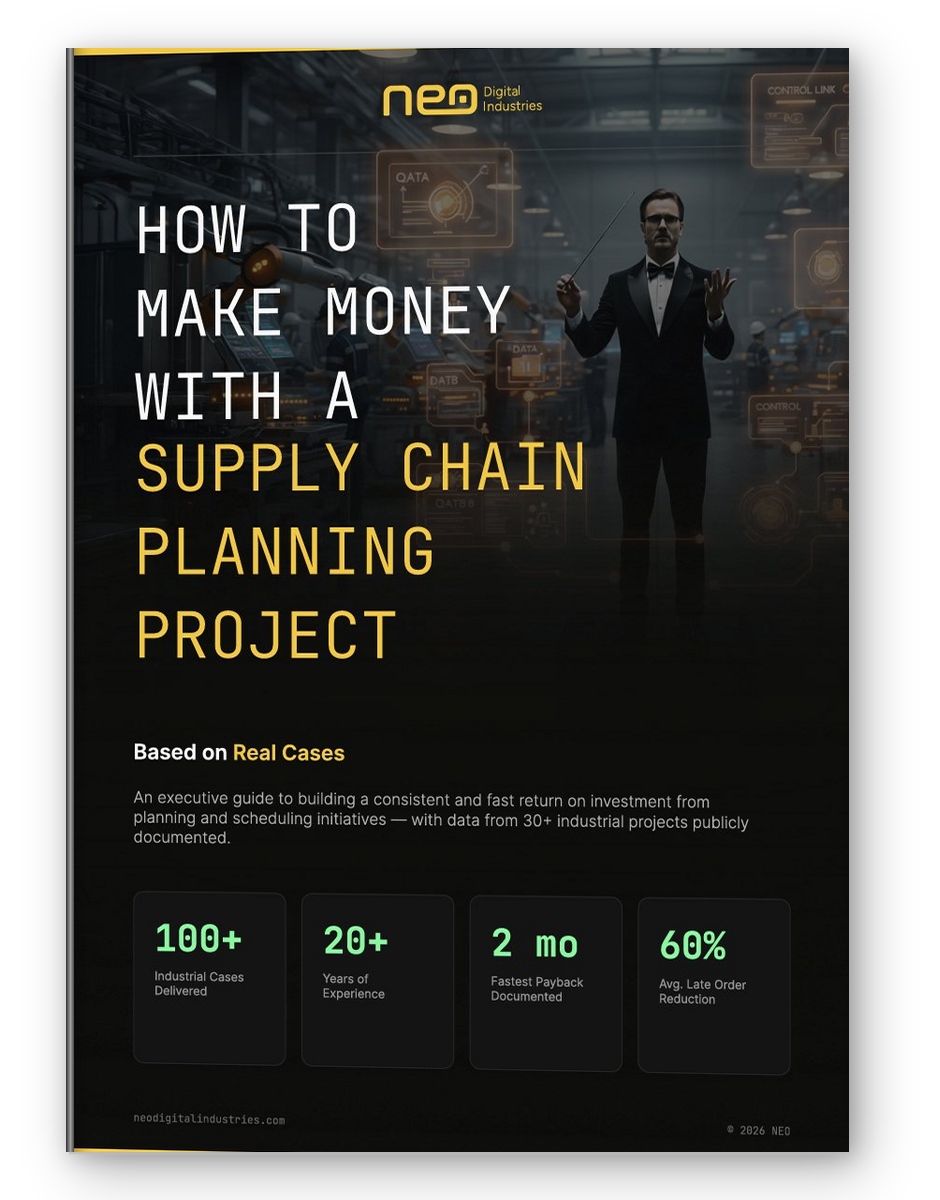
Free Ebook: How to Make Money With a Supply Chain Planning Project
Executive guide featuring data from over 30 documented projects. Discover the three sources of ROI, how to build a solid business case, and a step-by-step payback formula you can apply today.

Talk to one of our APS experts
Get a personalized assessment of your operations from APICS CPIM certified consultants. We will help you identify opportunities for improvement and estimate the return on your project.