

How Karsten serves its customers faster and more effectively with Opcenter APS
Meet Karsten, the company that deployed Siemens Opcenter APS in partnership with NEO to optimize its textile production. With the solution, Karsten achieved a significant reduction in planning time, a 30% increase in industrial efficiency, and improvements in visibility and cross-team alignment — moving toward more agile and effective management.


Meet Karsten, a Brazilian textile manufacturer of bed, table, bath and home décor fabrics
About us
Karsten, one of Brazil's leading textile brands, was founded in 1882 in Blumenau (SC) and today has 138 years of experience and dedication to developing top-quality bed, table, bath and home décor products. It is also the sixth oldest company in Brazil and one of the largest in the segment, a benchmark for quality and innovation.
Karsten products are sold in more than seven thousand points of sale across Brazil, and the company is one of Brazil's largest exporters of textile goods, in addition to owning one of the most modern manufacturing complexes in the country.
Among the brand's main differentiators are its genuine design, the variety of fabrics and, above all, the durability and versatility of its combinations. That is why Karsten carried out, in partnership with NEO, the Advanced Production Scheduling project using Siemens' Opcenter APS, trusting in the robustness of the software and NEO's implementation experience as its next step toward serving its customers even more efficiently.
The challenge
Prior to implementing Opcenter APS (formerly Preactor), Karsten had already been structuring an integrated sales and operations planning process, but one supported entirely by spreadsheets. Given the high industrial complexity of a process involving hundreds of resources across 5 interconnected plants, in a hybrid make-to-order and make-to-stock production system, and with a mix of tens of thousands of items, dozens of spreadsheets and a great deal of manual work were required for any simulation — it was common for the planning work to take more than 1 week and, occasionally, to start all over again to simulate any change.
Having chosen Opcenter as the ideal solution and NEO as its consulting partner, Karsten assembled a team involving professionals from the demand planning, production scheduling, engineering, purchasing and finance areas. The digitalization journey began with the implementation of Opcenter Scheduling (formerly Preactor AS) and, later, Opcenter Planning (formerly Preactor AP).
The solution
Opcenter Scheduling — With the challenge of synchronizing a highly vertically integrated supply chain, the project began with Detailed Scheduling in the Spinning area, the start of the chain. With production orders for large batches aimed at feeding a planned yarn stock, the solution brought a synchronized view across processes, considering alternative resources and balancing production, with a finite capacity horizon to ensure the yarn service level.
Next, it advanced to Weaving, sequencing more than 220 looms of different technologies, speeds and constraints, balancing the load and minimizing setups. The integration with Loomdata (MES) was tightened to enable fast rescheduling, updating both the scheduling of orders and the material relationships through allocation logic (Dynamic Pegging). In Finishing, in addition to balancing resources shared by distinct products (terry and flat), dyeing orders were generated (a batch process), respecting specific synchronizations such as waiting times and maximum limits between operations.
The stock between Finishing and Making-up is limited and the synchronization is delicate, requiring detailed scheduling to avoid shortages. Making-up, with many labor constraints, is scheduled by balancing the load between manual and automatic resources, focusing on serving the planned stocks of finished products.
Opcenter Planning — AP was configured to run fully integrated with Karsten's proprietary systems, with no duplicate registration: the unconstrained demand forecast comes from Demand Planning, the routing, structure and resource records come from the ERP, and the production reporting through the interface with the MES, with the result of the unconstrained production and purchasing plan integrated back into the ERP.
The main areas of action were: automatic inventory policy, with volume and frequency classification, safety stock calculation and policy definition performed automatically; flexible planning horizon and frequency, enabling S&OE in the short term, a weekly master plan over a 4-month horizon and long-term plans (over 1 year) for dynamic budgeting; and a finite master plan with synchronization, respecting the real capacity of all resources and also planning purchased materials.
The solution also includes advanced constraints for storage, operators and tools; outsourcing, considering the availability of subcontractors and allocation priority according to costs and deadlines; product life cycle, blocking the planning of end-of-life items and simulating launches by analogy; and the interface with the preventive maintenance system, ensuring that planned stoppages are taken into account.
The results
The implementation of Opcenter has already delivered excellent results, including a significant improvement in the tangibility of schedules and greater alignment of PPCP with the production areas. A 5-day reduction in throughput time was achieved, along with a reduction in average lead time, greater accuracy in production plans and a 30% increase in the efficiency of industrial processes. Planning, which before AP took about 7 days per scenario, now generates a plan in 4.5 hours at the SKU level for all materials. There was also an improvement in delivery (OTIF and TTM) and the integration of production planning with financial management, with scenario simulations.
Future outlook
Even with these benefits, Karsten continues to seek new challenges to improve the production management of its factory, counting on NEO's support to become increasingly digital, agile and efficient.
SEE MORE RESULTS LIKE THIS AND LEARN HOW TO PROJECT THE ROI FOR A SUPPLY CHAIN PLANNING PROJECT IN YOUR INDUSTRY:
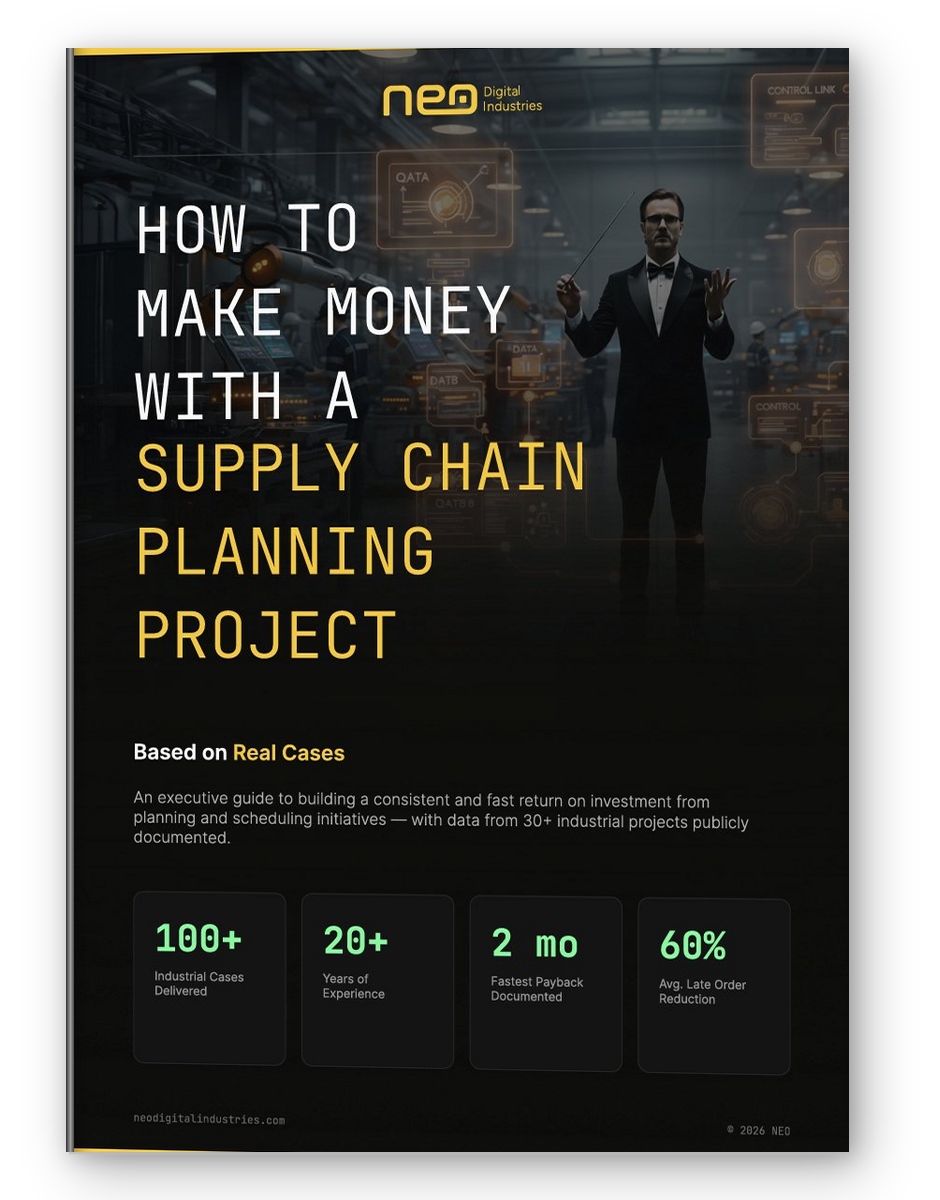
Free Ebook: How to Make Money With a Supply Chain Planning Project
Executive guide featuring data from over 30 documented projects. Discover the three sources of ROI, how to build a solid business case, and a step-by-step payback formula you can apply today.
Talk to one of our APS experts
Get a personalized assessment of your operations from APICS CPIM certified consultants. We will help you identify opportunities for improvement and estimate the return on your project.