

How the Opcenter APS solution cut PC effort by 60% at Induscabos
See how Induscabos, one of Brazil's largest manufacturers of high-, medium-, and low-voltage electrical wires and cables, deployed Siemens Opcenter APS in partnership with NEO to optimize production and tackle the challenges of the electrical-cable industry.
.png)

Meet Induscabos, one of the largest manufacturers in Brazil of high, medium and low voltage electrical wires and cables
About us
Induscabos Condutores Elétricos is one of the largest manufacturers in Brazil of high, medium and low voltage electrical wires and cables. With a broad product portfolio, exporting to more than 15 countries, Induscabos stands out for its presence in the Energy, Oil and Gas, Mining, Steelmaking, Agroindustrial and Civil Construction segments, among many others. Its manufacturing site is located on an area of approximately 80,000 m² in Poá, in the state of São Paulo, with 4 production units and 2 laboratory units equipped with state-of-the-art technology. To ensure the quality of its products in an increasingly demanding market, Induscabos maintains an ongoing training program for its technical team, as well as a rigorous selection of suppliers in addition to full control of its processes.
The challenge
Production scheduling in the electrical cable industry is shaped by the complexity of synchronizing its operations, from wire drawing, twisting and extrusion through to the final assembly of the cables into the finished product. This difficulty was evident at Induscabos considering its more than 10,000 SKUs and more than 70 production lines. The cables and wires are transported and stored in the factory on reels, and the limited space available to store these reels was a significant challenge. The PPCP struggled to account for this constraint in its planning, resulting in low adherence of the factory to the schedule.
Due to the sector's high processing times, medium and long-term visibility becomes necessary, as does the ability to simulate future demand over a time horizon to provide greater confidence and predictability throughout the S&OP cycle. Induscabos had accurate visibility only in the short term.
Additionally, due to the number of SKUs with differences in diameter, length, pigmentation, etc., many long setups were generated and, as a result, the total setup time took up a large part of the factory's available capacity, which further increased the makespan of the products. In this regard, the company saw it as essential to use a system capable of addressing all the constraints, resources and characteristics of its operations in order to deliver optimized production scheduling scenarios quickly. In addition, the system had to be able to integrate with the other systems in use at the factory, such as MES and ERP.
The solution
When benchmarking against companies from different segments, Siemens' APS software and NEO's implementation service delivered the most concrete results and were the most aligned with Induscabos' expectations.
"When looking for a solution on the market, we had a list of requirements. NEO not only met all of them, but also added new elements that ended up adding value to the project, such as the dynamic and accurate integration with our MES, with a view to evolving toward Industry 4.0 in the future."— Josete Grigorio, IT Manager at Induscabos
OPCENTER APS is used at Induscabos to perform Advanced Scheduling. In a matter of seconds, the sequencing performed by the system synchronizes the wire drawing operations, compound extrusions and the assembly of the cores to form the finished product. This synchronization minimizes the volume of reels during the process.
In addition to ensuring synchronization between the numerous operations of a production order, the solution ensures setup optimization across the factory by reducing changeovers such as die changes on the drawing machines and color changes on the extruders. As a result, minimizing the time and number of changeovers reduces the makespan of the finished products and makes better use of the factory's capacity.
All the optimization generated in the fine sequencing by OPCENTER APS takes into account the constraints of intermediate products and raw material, in addition to the die and intermediate constraints. The system integrates with PcFactory and Protheus (MES and ERP, respectively). With these integrations it is possible to quickly replan and resequence production, updating all systems almost in real time. The integration between Protheus and Opcenter APS enables the mass generation of inquiry orders (to promise future delivery dates) and simulations of future demand vs. capacity.
The results
Before the implementation of Opcenter, the 70 production lines were scheduled manually by the PPCP team. As a result, the team was able to produce a schedule for only 1 day, with no possibility of simulating different scenarios. With the implementation of the solution, the schedule is generated in less than 10 minutes for a horizon of more than 7 days and with greater adherence. The need for rescheduling, previously daily, is now carried out once a week, when necessary. The optimization of the scheduling process, in addition to bringing greater agility and performance to the area, led to a 60% reduction in the PCP effort directed at production scheduling. As a result, the PPCP team now has more time to act in a managerial and strategic capacity.
"With the implementation of OPCENTER APS and NEO's support in developing customizations and adaptations for our production business, it is unbelievable to think how Production Planning and Control was done without this supporting software. Not using it is completely unfeasible, because when configured correctly with the essential information from the ERP, PCP and shop floor, it becomes the best ally in achieving our objectives."— Leonardo Galvão, PPCP Coordinator
The electrical conductor cable sector is one in which work in process (WIP) is one of the most important indicators for production scheduling. Before the implementation of Opcenter, Induscabos had an average WIP of 10 days, and after the implementation it was reduced to 6.5 days. In addition to WIP, overall lead times and setup times also decreased.
Future outlook
Finally, it is important to stress that the OPCENTER APS software implementation project is a living one. We continuously seek to apply improvements to the solution. According to the company, NEO's support has been very important in restructuring the Production Planning, Scheduling and Control processes, not only in the implementation of the APS software, but also in helping to manage the flows and make quick decisions.
"NEO has a consulting and support service that is a benchmark for service quality here at Induscabos. The consultants are always willing to help and quickly find effective solutions for our needs."— Josete Grigorio, IT Manager at Induscabos
SEE MORE RESULTS LIKE THIS AND LEARN HOW TO PROJECT THE ROI FOR A SUPPLY CHAIN PLANNING PROJECT IN YOUR INDUSTRY:
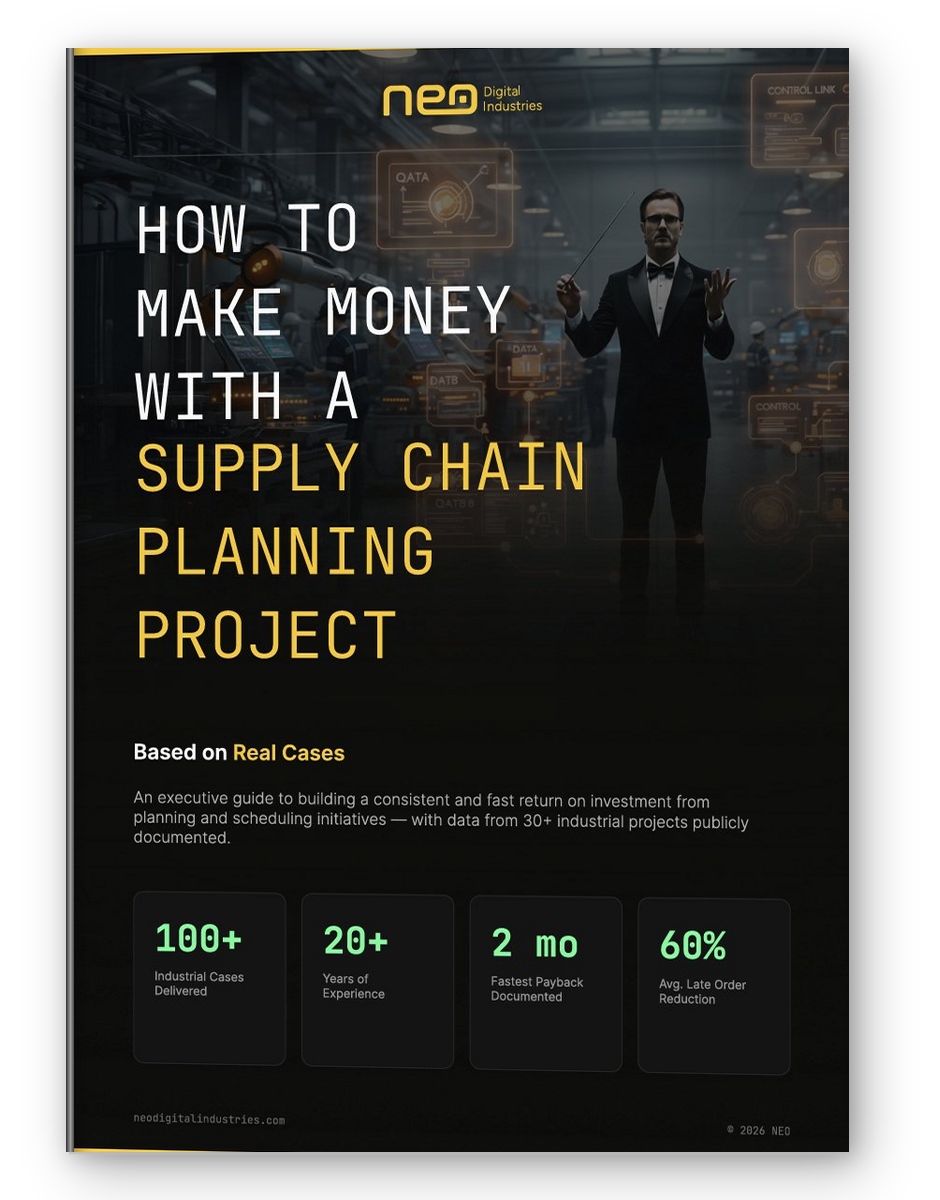
Free Ebook: How to Make Money With a Supply Chain Planning Project
Executive guide featuring data from over 30 documented projects. Discover the three sources of ROI, how to build a solid business case, and a step-by-step payback formula you can apply today.
Talk to one of our APS experts
Get a personalized assessment of your operations from APICS CPIM certified consultants. We will help you identify opportunities for improvement and estimate the return on your project.