

How to orchestrate a highly outsourced factory? The APS challenge at one of Brazil's largest fashion companies, Grupo Malwee
Meet Grupo Malwee, one of Brazil's largest fashion groups with over 55 years of activity, with products reaching 76% of the Brazilian territory.


Meet Grupo Malwee, one of the largest fashion companies in Brazil with over 55 years of operation, and present across 76% of Brazilian territory with its products.
About us
With over 55 years of operation, Grupo Malwee is one of the largest fashion companies in Brazil. It currently has around 3,500 employees and its products reach 76% of Brazilian territory. The group produces more than 35 million items per year, serving over 22,000 multi-brand stores across the country.
Founded in 1968 in the city of Jaraguá do Sul, Santa Catarina, the company began its journey with a focus on producing children's clothing. Through its considerable expansion over the years, it reached a total of six proprietary brands that today serve various market segments. With four operating units — two in Santa Catarina, one in São Paulo and one in Ceará — the company has consolidated its physical presence across different regions of the country.
Grupo Malwee also stands out for its engagement with social and environmental issues, being the first Brazilian fashion brand to sign the commitment letter for the Global Business Ambition for 1.5°C: Our Only Future campaign, launched by the UN. Over the years, Grupo Malwee has been committed to becoming a benchmark for sustainability in the textile market, introducing innovative initiatives such as FIO do Futuro, which gave rise to the first sweatshirt made from used clothing that would otherwise have been discarded, in addition to investing in recycled polyester.
The challenge
Driven by its exponential growth, in 2020 Grupo Malwee identified the need to raise its service standard and improve inventory management efficiency — crucial aspects for a business model characterized by seasonal collections. Faced with this scenario and the challenge of optimizing the production flow and minimizing the production planning and control (PPCP) effort, the company decided to look to the market for a solution that would automate these processes and help achieve meaningful gains against the difficulties identified. This is how the partnership between Grupo Malwee and NEO Digital Industries came about, through the implementation of Siemens' Opcenter APS software, the world's largest supplier of software for industry.
"The choice of NEO as a consultancy was based on its solid experience in APS implementation, a proven track record of success, deep technical knowledge and recognized delivery capability. These criteria were considered essential to meet the company's specific demands, ensuring effective support in the implementation and optimization of processes."— Ademiro Volkmann, Project Manager
One of the main difficulties faced by the fashion industry lies in ensuring the fulfillment and balancing of the Sewing area. Due to the highly manual nature of this sector, processing time tends to be high, making it a critical factor for production. In addition, the constant introduction of a wide variety of new SKUs with each collection makes the challenge even more complex, since the learning and adaptation period for manufacturing these new products directly affects production efficiency. In Grupo Malwee's specific context, ensuring the balance between internal and external (supplier) sewing stages was essential to raise the shipping service level and reduce the costs associated with the improper movement of materials. However, to solve this problem, it was necessary to group similar materials, reduce material reallocation, and ensure the repeatability of models at third parties that already had experience with the product.
Furthermore, the lack of visibility of production processes and resources in the company's production scheduling resulted in imbalances between operations and the creation of bottlenecks that were often difficult to identify, especially between the cutting and sewing sectors. This happened because sequencing was generated in a fragmented way at each operating center, without considering a comprehensive view of the impacts across the entire production chain.
The solution
The solution developed by NEO for Grupo Malwee initially focused on the Garment Manufacturing processes. Due to the complexity of the production chain and the large volume of data involved, specific solutions were created for each of the four main areas of the process: Cutting, Internal Sewing, External Sewing and Finishing. All the models developed, although independent, are interconnected and have, as their main objective, the optimization of sewing operations.
In this way, the data needed for sequencing — such as routings, production orders, technical sheets, among others — is imported from the SAP ERP into the Opcenter APS software. After the data is integrated, the Sewing schedule is generated, and its sequence determines the required dates for the preceding processes. Once these dates are defined, the sequencing of the remaining sectors is carried out.
For the sewing solutions, an advanced rule was developed to group similar products, in order to reduce machine changeover time in the sewing cell, thus avoiding setup losses. With regard to sewing carried out by third parties, the aim was to ensure optimization across similar models, paying attention to meeting the capacities contracted with suppliers, as well as transport lead times and return deadlines to the unit.
The entire sequencing process for Grupo Malwee's four models is carried out using NEO's Smart Balancing Rule, the nSBR. This rule was developed entirely by the NEO team through APIs, and it enables the prioritization of operations based on various parameters configured by the client, balancing production resources. In this particular case, the nSBR allows the sequencing dynamics to be adjusted according to the collection and the demand existing at the moment the production schedule is generated, giving the solution greater autonomy and flexibility.
In addition, since there was a need to increase visibility of production within the suppliers, during the APS project Grupo Malwee developed a mobile application to record the production carried out by third parties. In this way, the production sequencing generated by Opcenter APS also takes into account what is in production, from the exact moment it begins. Thus, the subsequent Finishing processes, carried out internally, are scheduled with an accurate forecast of when material will return from third parties.
Last but not least, the need was identified to create a customized rule for allocating knits and fabrics to Cutting orders, since the MRP process in the SAP ERP allocated these materials based on the general date map, rather than the detailed needs of the sewing queues. The business rule developed therefore looks specifically at the sewing queue, allocates inventory and generates the purchasing and/or production requirements for the missing inputs. This allocation rule is used by the reservation team, which is responsible for releasing materials to start the production process at Cutting.
"The sequencing process in the manufacturing sector today is extremely efficient and well organized. The way the stages are ordered and executed demonstrates a high level of planning and control. The precision in the sequence of operations ensures the optimization of the resources used, resulting in one of the best levels of service to the end customer. In addition, the speed and agility with which the items are produced is impressive, thereby meeting market demands satisfactorily. It is clear that the company has invested in this technology and in training its team to achieve this level of excellence in the textile manufacturing process."— Liliane Soares, Production Planning and Control Coordinator
The results
With the improvement in the management of sewing suppliers, it is possible to account for concrete results that translate into a more efficient and cost-effective operation. Among the related gains is a 44% reduction in the reallocation of orders between third parties, revealing better coordination and supply chain planning. In addition, it was possible to reduce by 89% the reallocation of orders from third parties to the company's internal sewing, significantly improving product quality and delivery times.
The business rule developed for allocating knits and fabrics led to a 10% increase in the so-called "Complete Model", so named because it groups all the orders for a single material. The percentage increase in the Complete Model ensured better supply to both internal and external sewing, in addition to reducing the setup times dedicated to material changeovers. Additionally, there is a direct impact on the early processes of the chain, increasing the average cutting batch and, consequently, reducing stoppages resulting from setup.
With the implementation of the solution developed by NEO, it was also possible to improve the identification of gaps in the sectors, as well as the identification of bottlenecks, inefficiencies and delays, enabling a more proactive approach to resolving them. The analytical and strategic view of the reports developed by the NEO team has supported the decision-making process in the planning of the areas, allowing for an accurate analysis of operations. In addition, closer and more detailed monitoring of the sewing suppliers enabled better load balancing, prioritizing a more even distribution of models among the more than 100 active suppliers.
Future outlook
As next steps, Grupo Malwee is directing its efforts toward expanding the implementation of the Opcenter APS software across the entire textile plant, including the Knitting and Finishing sectors. The initiative aims to establish a complete connection of the entire production chain, from the initial stage of knitting the fabric to the moment the product is ready to be shipped to the customer. With this expansion, it will be possible to further optimize the processes, providing more integrated and efficient management across all stages of textile production.
"As part of our constant pursuit of operational efficiency, APS is one of the main tools. The tool's usefulness ranges from strategic planning to agile decision-making. Our plan is to connect the entire textile and manufacturing chain through the sequencing system, seeking to optimize the process, reduce costs and waste, and increase delivery efficiency. With constant process updates, APS will enable us to be more adaptable to customer service needs."— Graciano José Bonetti, Supply Chain Manager
SEE MORE RESULTS LIKE THIS AND LEARN HOW TO PROJECT THE ROI FOR A SUPPLY CHAIN PLANNING PROJECT IN YOUR INDUSTRY:
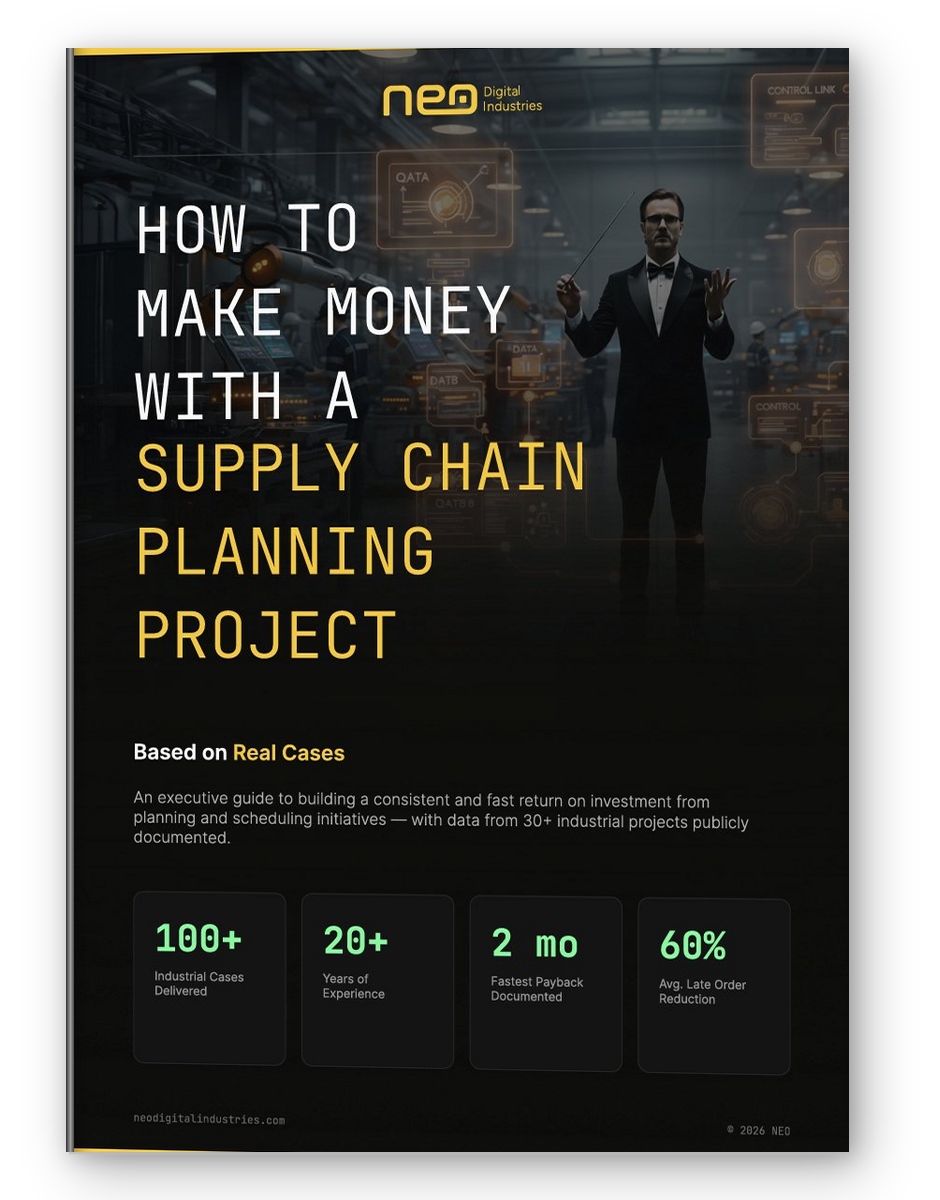
Free Ebook: How to Make Money With a Supply Chain Planning Project
Executive guide featuring data from over 30 documented projects. Discover the three sources of ROI, how to build a solid business case, and a step-by-step payback formula you can apply today.

Talk to one of our APS experts
Get a personalized assessment of your operations from APICS CPIM certified consultants. We will help you identify opportunities for improvement and estimate the return on your project.