

How Unipac transformed planning and inventory management with nPLAN and NEO: less manual effort, fewer delays, and healthier inventories
Discover how Unipac, a national reference in polymer application technologies and part of Grupo Jacto, connected forecasts, production capacity, and inventory in a single environment with nPLAN, cutting stockout materials by more than 50% and improving inventory health at its Pompeia/SP plant.
.png)

Meet Unipac, a national reference in polymer application technologies, operating across a range of industrial segments and with more than 1,000 employees
About us
Unipac shapes a sustainable future through innovative transformation in plastics and beyond plastic. Marking 50 years of history in 2026, the company is a reference in polymer application technologies and stands out for bringing together, within a single operation, six production processes: blow molding, injection molding, structural injection molding, sheet extrusion, thermoforming, and rotational molding.
With around 1,000 employees and two manufacturing units in Pompéia (SP) and Limeira (SP), in addition to three in-house operations at strategic clients, Unipac serves a range of sectors, including automotive, agribusiness, logistics, food, and industrial electric vehicles. The company is a leader in the supply of rigid plastic packaging for crop protection products and also stands out in the production of fuel tanks, urea tanks, bed liners, automotive components, food packaging, floats for solar energy, packaging for material handling, and industrial electric tow tractors.
With a customer-centric strategy, Unipac combines deep knowledge of the sectors in which it operates, long-term relationships, and intensive use of data to anticipate needs and co-create solutions. Its capabilities bring together segmented go-to-market models, complete product prototyping, and integration into customers' production chains through in-house operations and near-house structures.
Focused on innovation and sustainability, it has a modern Advanced Engineering Research Center, its own tooling shop, and Open Innovation ecosystem management. The company invests in digital transformation and in the development and operationalization of sustainable polymers and composites, expanding its scope into solutions beyond plastic.
Unipac is part of Grupo Jacto, a Brazilian multinational organization with 78 years of history, present on five continents and with businesses in the agricultural, transport, cleaning equipment, and medical solutions segments, guided by values of integrity, transparency, and innovation.
The challenge
Before the implementation of NPLAN, planning focused on the Pompeia Unit (which nevertheless encompasses units in two other cities and a total of six internal subdivisions) was conducted with a strong dependence on manual activities, parallel spreadsheets, and decentralized analyses. The process required significant operational effort to generate scenarios, review plans, and identify stockout risks, resulting in decisions that were often reactive and based on non-integrated information. The absence of a single simulation model made it difficult to forecast impacts related to variations in demand, capacity, lead times, inventory policies, production mix, and material constraints, which raised the risk of delays, excess inventory, and low accuracy in decisions.
The S&OP, MPS, and tactical planning reviews demanded long preparation cycles. The high amount of time required to obtain consolidated information made it difficult to respond quickly to commercial changes, supply disruptions, scheduled shutdowns, maintenance, or productivity variations. In addition, the company faced difficulties in simultaneously viewing the requirements for raw materials, semi-finished goods, and finished products, which compromised the management of inventory levels and the early identification of stockout or obsolescence risks.
Unipac therefore sought a solution capable of integrating forecasts, order backlog, production capacity, and inventory parameters into a single environment, with daily and automated updates. The objective was to reduce manual effort, increase accuracy, accelerate decision-making, and create a consistent framework for simulation, rapid response to change, and long-term planning. It was in this context that the partnership with NEO Digital Industries and the implementation of NPLAN at the Pompeia unit became strategic.
The solution
The implementation of NPLAN at the Unit focused on structuring an advanced planning model capable of integrating data, simulating scenarios, and generating consistent plans for the entire production chain. The solution was built on a technical model that consolidates forecasts, firm orders, inventories, inventory policies, bill of materials, capacities, resource constraints, and supply lead times, performing a precise and automated calculation of the projected balance throughout the planning horizon.
One of the technical pillars of the solution was the development of an integrated monthly plan, used as direct support for the S&OP process. The model simultaneously projects the requirement for finished products, semi-finished goods, and raw materials, taking into account inventory policy parameters, aggregate demand, and production capacity. This dynamic made it possible to replace manual analyses with an automated flow, ensuring greater accuracy in the calculations of replenishment, consumption, availability, and stockout risk.
NPLAN also began to generate planned orders to supply production, synchronizing the tactical plan with the sequencing of Opcenter APS. This technical alignment made it possible to reduce inconsistencies between planning and execution.
Another essential component was the inventory health projection, which began to calculate future inventories in units, value, and days of coverage, generating automatic alerts for relevant deviations, such as the risk of stockout, excess, obsolescence, or misalignment between the production plan and the inventory policy. The system continuously evaluates forecast accuracy, using indicators such as WMAPE, and makes it possible to visualize the impacts of different scenarios on the inventory level and on the need for production or purchasing.
The solution also incorporated multivariable simulations, making it possible to test scenarios by altering demand increments for strategic items, machine capacity, inventory policies, lot sizes, supply lead times, and constraints on critical materials. This module became fundamental in supporting decisions about plan cuts, advance orders, commercial prioritization, and negotiation with suppliers. The automatic integrations with SAP were configured to occur in short cycles — with an average integration time of a few minutes — ensuring that NPLAN always operated with up-to-date data.
Finally, the solution consolidated reports, dashboards, and operational alerts, replacing manual processes and allowing the planning team to focus on exception analysis rather than on data collection or cleansing. The result was a robust technical environment, capable of supporting everything from the S&OP review to daily execution control.
The results
The results achieved at the Pompeia Unit after the implementation of NPLAN demonstrated an impact on the reduction of effort, the increase in accuracy, and the improvement of operational performance. The automation of routines and the centralization of information substantially reduced the manual work of the planning team, allowing a process previously carried out by one person over the entire month to be performed with partial dedication over two weeks, reaching scenario simulations in minutes. As a result, there was an increase in the team's availability for strategic analyses and decision-making that were previously not possible due to the high operational workload.
"As a user and key user of the NPLAN tool, I experience on a daily basis the gains it has brought to planning and to the governance of the process. In operational use, NPLAN made the routine more organized, reliable, and agile, while, in the role of key user, it made it possible to standardize practices, support the teams, improve the quality of information, and continuously evolve the process."— Wallyson Victor Teruel Santos, Planning Analyst
The direct action on inventory health reduced materials in stockout by 58% and risk by 24%, a result of early identification and continuous demand projection. It was also possible to eliminate 53% of stagnant inventory and 56% of obsolete inventory, correcting excesses and strengthening the availability of critical items. Production balancing also advanced significantly, with a more appropriate distribution of the manufacturing load and better use of installed capacity. This efficiency gain optimized the use of resources, maximizing the utilization of both machines and labor.
The daily and automated integration of data ensured greater reliability and eliminated discrepancies that previously hindered the decision-making process. The automatic alerts directed the focus toward exceptions, reducing rework and accelerating the response to deviations. The number of simulations grew exponentially, surpassing the 1,000 scenarios generated, which enhanced the quality of tactical decisions and consistency across areas.
The historical tracking of scenarios made it possible to critically analyze annual planning against monthly execution. Dashboards specialized in comparing demands forecast in different scenarios with actual revenue, as well as expected machine use with actual production, compile the reality of the Unit over time in a clear and visual way, becoming a benchmark for executive direction, enabling evidence-based management and the rapid identification of opportunities for continuous improvement.
With NPLAN, the Pompeia Unit began to operate with greater predictability, stability in service, lower operational risk, and an expanded capacity to adapt to changes in demand, reinforcing the performance of the supply chain and consolidating a modern, analytical, and data-driven planning model.
"The deployment of NPLAN marked the evolution of UNIPAC's Supply Chain. By integrating planning, production, and inventories, the solution raised the level of decisions and brought speed, confidence, and an integrated view. The solution significantly improved inventory health, reducing excesses, freeing up working capital, and increasing the service level. With reliable data and an integrated view of the chain, NPLAN became an important piece in sustaining UNIPAC's growth and strengthening our commitment to innovation and the future."— Marcelo Trindade, Supply Chain Manager
"The digitalization of internal processes always generates expectation and a certain discomfort. However, NPLAN quickly demonstrated its ability to deliver concrete results in inventory management and significantly raised the efficiency of our S&OP cycles. More than operational gains, what really stands out is the cultural transformation that the solution promoted. We began to evolve in a more dynamic way, formulating more relevant questions and obtaining consistent answers, which provide us with insights that were previously unimaginable."— Humberto Saes Passarelli, Digital Processes Manager
Future outlook
Considering the success of the project in Pompeia, Unipac expanded the use of NPLAN to the units in Limeira, Paulínia, and Maracanaú (already in the final phase of implementation), consolidating a continuous digitalization journey conducted in partnership with NEO. The expansion made it possible to standardize processes, integrate information across plants, and raise planning maturity throughout the operation, reinforcing the company's commitment to efficiency, technology, and the sustainable evolution of the production chain.
SEE MORE RESULTS LIKE THIS AND LEARN HOW TO PROJECT THE ROI FOR A SUPPLY CHAIN PLANNING PROJECT IN YOUR INDUSTRY:
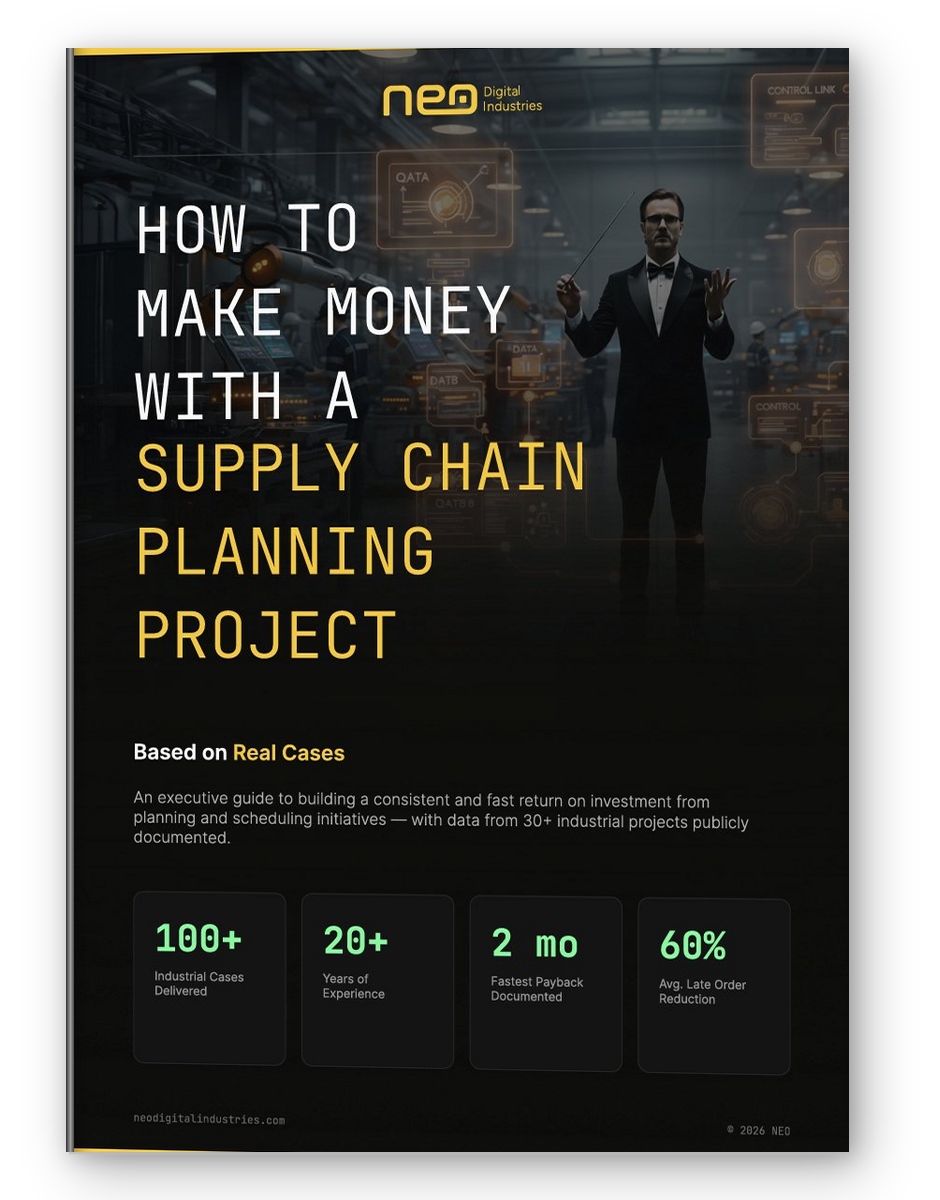
Free Ebook: How to Make Money With a Supply Chain Planning Project
Executive guide featuring data from over 30 documented projects. Discover the three sources of ROI, how to build a solid business case, and a step-by-step payback formula you can apply today.
Talk to one of our APS experts
Get a personalized assessment of your operations from APICS CPIM certified consultants. We will help you identify opportunities for improvement and estimate the return on your project.