

Isolet revolutionizes materials control with Opcenter APS and NEO, raising service level to over 80%
Discover how Isolet, a benchmark in power distribution equipment, uses Siemens Opcenter APS with NEO's support to turn the control of raw materials, semi-finished goods, and finished-goods inventories into a strategic business advantage.


Meet Isolet, one of Brazil's two largest manufacturers of power distribution equipment, with more than 2,000 customers worldwide.
About us
In the dynamic power distribution sector, Isolet Indústria e Comércio Ltda. stands out as one of the two largest companies in Brazil, a benchmark in innovative, reliable solutions for insulators, instrument transformers and metering assemblies. Founded in 1981, the company has a manufacturing plant in Itu (São Paulo) and an operating unit in the United States, serving the Brazilian market, Mercosur countries, the USA and other Latin American markets, with a portfolio of nearly 50,000 SKUs and roughly 2,000 customers, including power utilities, electrical equipment manufacturers and electrical material distributors.
Isolet is dedicated to manufacturing equipment that is essential to power distribution, with a team of more than 300 employees and a strong commitment to quality, backed by ISO 9001 and 14000 certifications.
The company stands out for its use of cutting-edge technology, being the first in Latin America to adopt an automated molding process (APG) that ensures greater precision and durability for its products. It also has a modern manufacturing facility and the ability to develop its own production tooling. This autonomy, combined with in-house laboratories and a dedicated research team, allows Isolet to create custom solutions quickly and deliver extremely reliable products to the market.
The challenge
Before the project, Isolet faced significant operational challenges in a highly complex make-to-order manufacturing environment marked by volatile demand, a wide product variety and a production flow with multiple stages and constraints. Production planning and scheduling relied heavily on spreadsheets and manual routines, which made the process time-consuming, people-dependent and slow to respond to shifting priorities or market urgencies.
The main challenge was to obtain a production sequencing solution that accounted for the finite capacity of resources, production constraints, synchronization between operations and objective criteria for prioritizing production orders. The company sought to raise its service level by reducing delays through prioritizing the most urgent orders based on due dates, to shorten lead time through greater synchronization between operations and reduced waiting times, to cut work-in-process inventory by reducing queues ahead of bottlenecks, to improve productivity with sequencing that reduced setups and losses, and to help lower inventory by analyzing raw-material availability and suggesting transfers between warehouses.
The solution
To address these pain points, Isolet chose Opcenter APS as its advanced production scheduling solution, precisely because of the software's robustness and its ability to model the specific rules of the business in a finite-capacity environment. The choice of NEO as consulting partner was strategic, supported by its track record, transparency in execution and positive market references, seeking joint involvement in process review, constraint modeling and the implementation of Opcenter APS.
Opcenter APS was configured to respect the constraints of critical resources, the synchronization between operations and the order-prioritization parameters, always focused on service level and on-time delivery. The project also involved defining, within Opcenter APS, rules to reduce work-in-process inventory at bottleneck points, improve load balancing between departments and align Production Planning (PCP), Operations and Purchasing, integrating materials, production and customer-service information into a single decision-making environment.
The results
"The project was a major step forward for our company, given the high complexity of the operation. We are pleased with the tool and with the NEO team, which led an implementation aligned with the reality of our production planning. Even at this early stage, we already see clear gains: a 70% reduction in planning time, sequential scheduling by resource, a 34% reduction in WIP, improved customer service, higher revenue and a 4% productivity gain. We remain confident that, as our use matures, we will expand these results and fully meet the project's expectations."
— Rogério Mandrussato, Production Planning (PCP) Supervisor
With NEO's implementation of Opcenter APS, Isolet achieved significant gains in efficiency, predictability and cross-departmental alignment, structurally improving its production planning and scheduling process. This new way of scheduling also created the need to carry out a time study, aimed at further refining the accuracy and performance of operations.
Isolet had already been on a strong growth trajectory between 2018 and 2025, practically doubling its revenue over the period, with average increases of around 12% per year. In this scenario, the traditional planning model would no longer be able to absorb the increased complexity without causing stockouts, team overload and loss of service level, given the continuous growth in orders and the expansion of the product mix.
With Opcenter APS, the planning team began to synchronize demand, capacity and materials in an integrated way, maintaining adequate inventory levels even as the revenue base expanded. On the shop floor, the main bottleneck — WIP in the Finishing department — was significantly reduced thanks to the raw-material alignment provided by APS, alongside training with the department's management, with a drop of nearly 50% in work-in-process volume. This represents a relevant average reduction in capital tied up daily in the operation, plus a 4% productivity increase in the injection department. This working-capital relief, combined with a drop in the share of late parts from 25–30% to 10–15% and a rise in the service level to between 80% and 90%, demonstrates the direct impact of APS on Isolet's financial and operational health.
Future outlook
Beyond the quantifiable gains, Isolet recorded a noticeable reduction in the effort of the production planning team, which began using Opcenter APS as its central decision-making platform, acting more strategically instead of relying on complex spreadsheets — which also made adjustments easier. There was greater synchronization between Production Planning, Operations and Purchasing, better process visibility, improved after-sales feedback and greater agility in rescheduling during urgent situations or changes in priority. This improved integration with Purchasing makes it possible to anticipate material shortages that, before the project, were very hard to foresee, and to provide a more accurate forecast of when each raw material will be needed.
From a strategic standpoint, Opcenter APS strengthened Isolet's scheduling flexibility, enabling it to respond more quickly to market demands and to support decisions on labor reallocation and fixed-asset investment. In the customer's view, NEO became an extension of Isolet's production planning team, continuously supporting the evolution of business rules within Opcenter APS and sustaining a cycle of continuous improvement that reinforces the company's competitiveness in the electrical sector.
SEE MORE RESULTS LIKE THIS AND LEARN HOW TO PROJECT THE ROI FOR A SUPPLY CHAIN PLANNING PROJECT IN YOUR INDUSTRY:
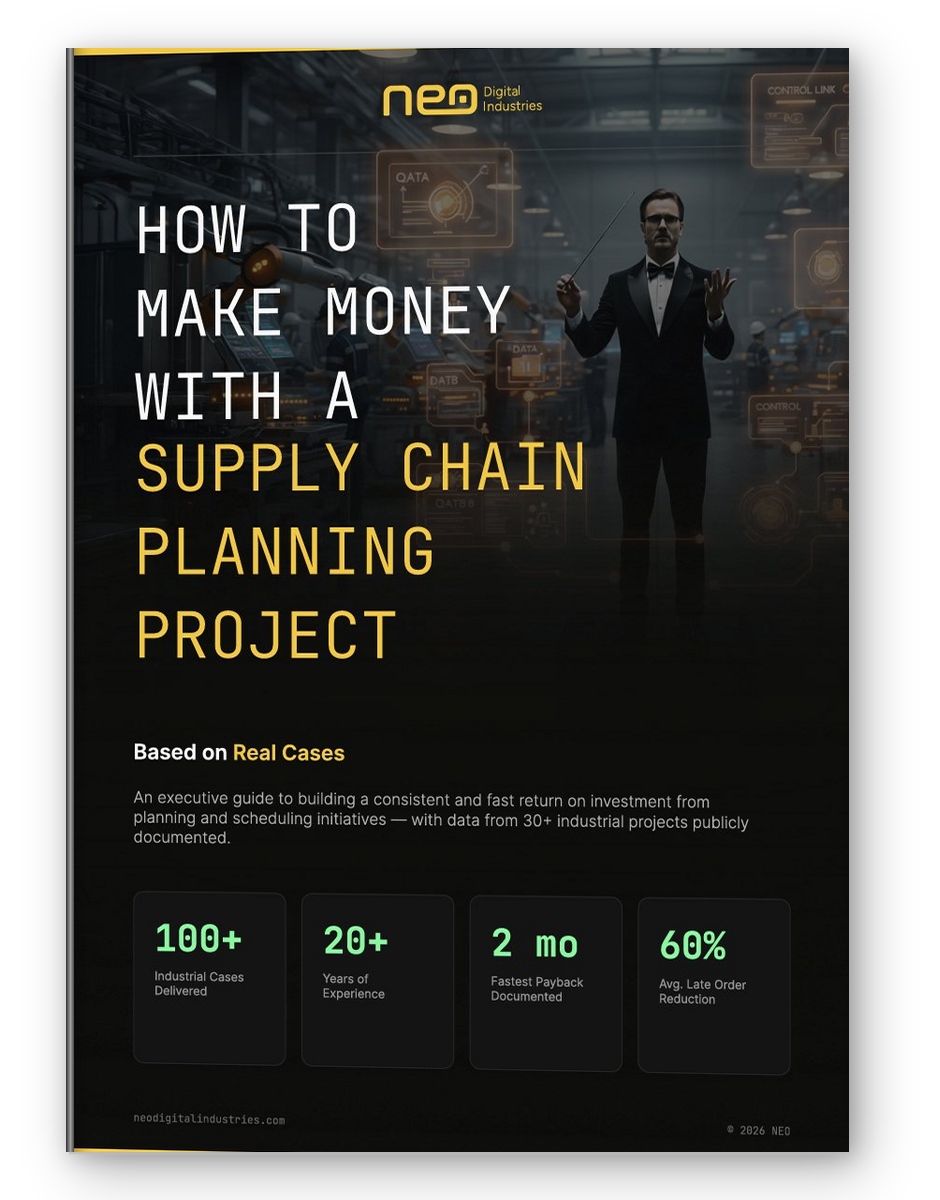
Free Ebook: How to Make Money With a Supply Chain Planning Project
Executive guide featuring data from over 30 documented projects. Discover the three sources of ROI, how to build a solid business case, and a step-by-step payback formula you can apply today.
Talk to one of our APS experts
Get a personalized assessment of your operations from APICS CPIM certified consultants. We will help you identify opportunities for improvement and estimate the return on your project.