

Novus cuts delays by 68% and improves planning with Opcenter APS
Novus Produtos Eletronicos faced challenges in planning and synchronizing production due to its portfolio complexity. Deploying Opcenter APS, in partnership with NEO Digital Industries, transformed that scenario — cutting planning time from hours to minutes and increasing the company's efficiency and output.


About us
Novus Produtos Eletrônicos is dedicated to the development, manufacturing and commercialization of electronic measurement and control instruments for laboratory and industrial applications. The company operates a manufacturing facility in the city of Canoas, in the metropolitan region of Porto Alegre/RS, where its headquarters is also located, with 5,000 m² of built area, of which 3,000 m² are dedicated to the factory. Novus exports more than 50% of its production to over 50 countries across the Americas, Asia, Europe and Oceania.
Novus has an active portfolio of more than 850 SKUs (Stock Keeping Units) serving different market segments. These products are manufactured according to the most rigorous global standards. To deliver this broad portfolio, qualified suppliers are spread around the world, which adds to the supply complexity of more than 10,000 distinct items (including raw materials and semi-finished goods).
The challenge
Synchronization in the manufacturing of intermediate products, including processes such as SMD soldering and PTH component assembly, as well as the production of the instruments' external parts, is crucial to ensure component availability in the final assembly of Novus products. Managing finished-goods inventory is one of the challenges of the electronics industry, especially at Novus, given the number of SKUs.
The need to import raw materials is a common challenge in the electronics sector, requiring careful planning, which represents a significant cost. Therefore, long-term visibility of the production schedule is crucial for communication with the supply department, ensuring the availability of inputs at the time and in the quantity needed to meet commercial demands. The complexity and importance of this visibility are directly proportional to the number of SKUs, the proportion of imported materials and the number of components per SKU. At Novus, certain products have more than 70 components in their structure.
Before Opcenter APS, the planning horizon was limited to one or two days and the process fell short of what was desired, taking at least one shift to complete. This lack of predictability resulted in supply shortages and reactive purchasing of inputs, which made materials management more inefficient and expensive. All sequencing was done in spreadsheets, with an infinite view of capacity, and the routings contained insufficient information to address the complexities of process sequencing. The most critical manufacturing stages required intensive labor, and visibility into the availability of this labor was also limited.
"Everything was done manually. This made the process very difficult, because we had to look at the order book and the inventory, and allocate each production order manually to determine the time required, which was often based on gut feeling. Almost every month-end, when scheduling production, we realized we would not be able to meet the deadlines, resulting in rework to try to honor the orders. It was 100% manual."— Lúcio Lenon Muller, PCPM Analyst at Novus Produtos Eletrônicos
Equipment for electronic testing and for validating the embedded software in the products also imposes constraints on sequencing. To produce the finished product, the software must be validated, so the testing equipment must be available. This communication and integration with engineering departments relied on non-integrated spreadsheets without real-time updates. The information was insufficient and/or outdated.
Another constraint imposed, which is common in labor-intensive processes, is the availability of people. Full use of the installed capacity depends directly on the allocation of labor across the factory's resources. Novus faced the challenge of distributing the available people in order to make better use of the installed capacity.
In addition, the lack of data and solutions capable of understanding the complexity of Novus's setups contributed to worsening the planning problems. Setup times were fixed and disregarded the effect of the operation sequence, which caused a gap between what was planned and what was achieved.
Novus faced a complexity that required a system capable of supplying the production planning department with technology suited to meet the industry's needs and to provide sequencing scenarios quickly and with a long-term scheduling horizon, turning PPCP into a proactive department, prepared to anticipate problems and act with a forward-looking view in its communications with supply, sales and finance.
"OPCENTER APS stood out for its user-friendly interface. In addition, it adapted better to the company's new needs. We found some other tools that were limited, whereas OpCenter APS proved to be more robust and flexible, which was decisive for our choice."— Richard Michel Fantin, PCPM Supervisor at Novus Produtos Eletrônicos
"We were looking for companies that were a benchmark in implementing this type of system, and we also wanted a more local company, one that was close by to resolve any problem that arose, quickly. NEO, by meeting these requirements and for its attentiveness, availability and transparency throughout the process, was the partner we chose."— Richard Michel Fantin, PCPM Supervisor at Novus Produtos Eletrônicos
The solution
The company searched the market for a solution that would meet its challenges. Siemens' OPCENTER APS stood out among the systems studied, and NEO Digital Industries was the implementation consultancy that presented the most concrete competitive advantages, aligned with Novus's expectations.
The implementation was carried out in 2021, with mature use from 2022 onward. Processes, data, culture and people had to reinvent themselves so that the maturity required to use the technologies provided could be developed. With NEO's consulting support, a change management effort covering processes, data and culture was conducted to ensure the success of the implementation. As Richard points out: "When we started the project, many action plans were drawn up together with NEO, such as creating the routings; we did not have the routings properly detailed." Novus succeeded in driving these changes, also thanks to the involvement of the departments directly connected to PPCP, with objectives aligned from the start of the project, horizontally, and with NEO's support.
Opcenter APS performs fine production scheduling. Manufacturing processes are sequenced from beginning to end, from the preparation of materials to supply the production lines, the manufacturing processes of the devices' external parts, such as laser engraving and soldering, to the manufacturing of the boards, such as SMD and PTH, ensuring synchronization in the sequencing of component integration on the assembly and shipping lines.
All scheduling is integrated with the ERP, taking into account the actual availability of materials in stock and future visibility of purchase orders scheduled for delivery. This capability also makes PPCP proactive in anticipating the material-picking processes in the factory's warehouses and in planning and monitoring the purchase of inputs together with the supply department.
Fine production sequencing is done taking into account the finite capacity of resources, the availability of labor, equipment constraints and the validation status of the embedded software, all in a matter of minutes. In addition, the sequenced production orders are integrated with sales orders, allowing greater accuracy in delivery dates and early identification of problems. Beyond sequencing, the solution developed provides information that fosters greater synergy with the sales, purchasing/supply and quality departments.
The solution implemented by NEO makes information available in the form of online reports, generated from the sequencing data provided by OPCENTER APS and integrated with data provided by the ERP. This information ensures an automatic flow of information between the departments that interact with PPCP, providing greater autonomy for data-driven decision-making. The manufacturing department receives the sequencing data online and executes the schedule autonomously and in synergy with PPCP.
The installed solution has direct integration with the ERP, which in turn is integrated with the MES, allowing OPCENTER APS to be updated almost in real time, enabling agile planning and replanning and semi-automatic updating of all integrated systems.
The results
The solution implemented by NEO brought agility and visibility to the PPCP area. What used to be done in one shift, with a horizon of at most two days, is now carried out in minutes, with a horizon of a week or more, as Lúcio Lenon Muller comments: "Today it is also a matter of practicality. With the pre-established settings in the APS, it takes me 10 minutes to sequence 1 week, whereas before it took me a whole morning to sequence 2 days."
With PPCP's greater agility and proactivity, Novus managed to reduce planning-related delays by 68,42% between 2022 and 2024, in addition to a 51,29% reduction in overall delays, while there was an increase of nearly 20% in annual production. The visibility of materials, both in stock and in purchase orders, combined with the synergy between PPCP, sales and the purchasing and supply department, made it possible to reduce material shortages by 45,19% between 2022 and 2024*.
*This indicator does not consider the month in which the climate disasters occurred in the metropolitan region of Porto Alegre/RS, as it is considered an outlier.
Future outlook
The implementation of Opcenter APS at Novus represents a milestone in the leap in efficiency and agility in production planning and sequencing, reflected in expanded visibility and integration with processes that ensured a reduction in delays and material shortages, in addition to supporting the increase in annual production.
With the solution in mature use, Novus already has improvements mapped out for the future, such as intelligent balancing during sequencing, control and monitoring of schedule adherence, as well as an expansion of scope that includes aggregate master production planning and finite-capacity planning solutions, covering inventory policies and inventory health. This expansion promises to integrate the processes even further, raising the level of control and efficiency of the supply chain.
To sustain this evolution, NEO plays a crucial role. Recognized by Novus as a long-term partner, NEO continues to provide consulting and technological support, helping Novus stay at the forefront of production planning and control solutions. The dynamic partnership of continuous improvement ensures that Novus is benefiting from the market's best practices and technological innovations, establishing itself as a benchmark in the electronics sector.
SEE MORE RESULTS LIKE THIS AND LEARN HOW TO PROJECT THE ROI FOR A SUPPLY CHAIN PLANNING PROJECT IN YOUR INDUSTRY:
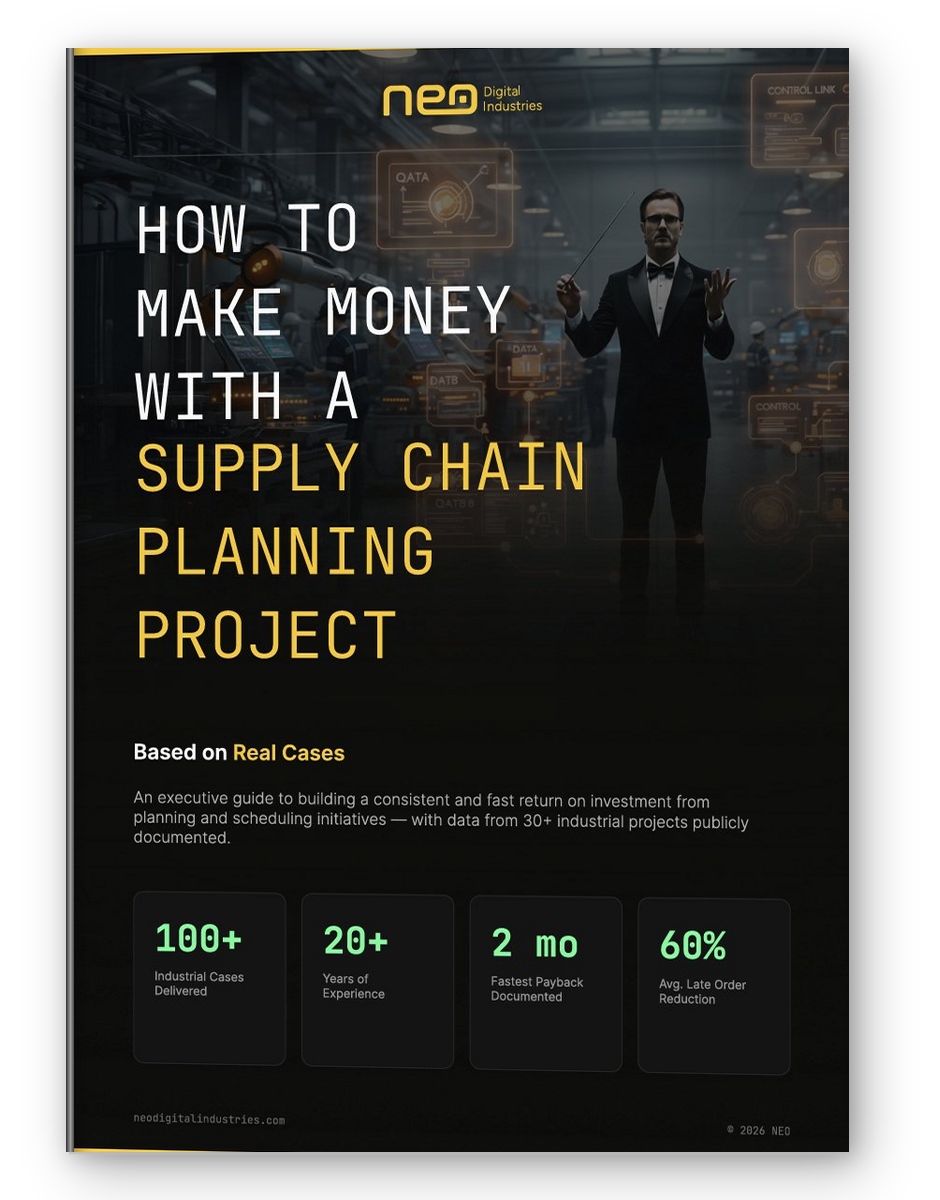
Free Ebook: How to Make Money With a Supply Chain Planning Project
Executive guide featuring data from over 30 documented projects. Discover the three sources of ROI, how to build a solid business case, and a step-by-step payback formula you can apply today.
Talk to one of our APS experts
Get a personalized assessment of your operations from APICS CPIM certified consultants. We will help you identify opportunities for improvement and estimate the return on your project.