

From productivity gains to fewer delays: how Salus, a benchmark in digestive health and animal nutrition, boosted results with Opcenter APS
Discover how Salus, a reference in innovative and reliable solutions for digestive health and animal nutrition and part of Grupo Avril, recovered the capital invested in deploying Opcenter APS — in partnership with NEO — in just 2 months, while achieving a 14% productivity increase and a 60% reduction in total delay volume.


Meet Salus, part of the Avril Group, a benchmark in innovative and reliable solutions for animal digestive health and nutrition
About us
In the dynamic animal nutrition and health sector, Salus stands out as a benchmark in innovative and reliable solutions for animal digestive health and nutrition. From its very first day of operation, the company has followed rigorous principles of safety, quality, governance, ethics and integrity, offering a range of products and services with high quality and relevance for the market.
Specialising in the production and supply of premixes and nucleus products for all animal species, Salus is also responsible for producing a wide range of additives, supported by high-standard technical assistance. Each solution is developed to meet the specific needs of customers, always with a focus on efficiency and the best results, through a work environment geared towards innovation.
Thanks to the excellent work carried out by Salus, the company joined the Avril Group, one of the leading players in French agribusiness. This integration not only strengthens Salus's position in the market but also boosts its growth and innovation in the animal nutrition sector, opening up new opportunities and horizons for the expansion of its operations.
The challenge
Salus's production planning and scheduling process is characterised by extremely high complexity, owing to several interconnected factors. The company offers a portfolio of products with almost infinite formulations, customised to meet the specific needs of each customer. In addition, some products have an extensive structure, containing up to 40 distinct components, which made materials management and production highly challenging.
The manufacturing environment operates on a hybrid model, integrating three distinct approaches: Make To Stock, Make To Order and Engineering To Order. This meant that some products were manufactured in advance to be kept in stock, while other items were produced only on demand. In addition, there were products that required detailed technical analysis by the formulation team in order to meet customers' needs.
Within this scenario, one of the main challenges faced by Salus was the need to optimise the production sequence in order to meet order delivery dates, maximise productivity and comply with cleaning requirements between different products. This process is fundamental for the company, since any error or contamination can compromise product quality and result in financial losses for customers, damaging the brand's reputation. The significant variation in the components of each product made the need for cleaning dependent on the combinations of certain raw materials from one production run to another.
As a result of these challenges, production scheduling at the company became a very time-consuming process that was highly dependent on people. This meant that decisions on how to sequence production were not based solely on real data but were also dependent on the interpretation and judgement of professionals from various areas.
The absence of an optimised process directly affected the company's ability to meet deadlines and to react quickly to market demands. The time required to generate a production plan was long, which resulted in uncertain delivery dates that were difficult to predict. This inefficiency could undermine the company's reliability with customers and hinder adaptation to changes in market needs.
In addition, the lack of an adequate solution for scenario simulation prevented the Production Planning, Scheduling and Control (PPCP) team from effectively assessing the impacts of a change in the schedule. For example, the team could not determine how taking advantage of a cleaning could optimise production without harming the delivery deadline. This made decision-making difficult, as well as suggesting improvements to the production process.
Faced with this scenario, Salus chose to seek a solution on the market that would provide greater predictability, efficiency and automation to its production planning and scheduling processes. To achieve this goal, the company relied on the support of NEO Digital Industries, a consultancy specialising in Supply Chain Planning technology, which, with its expertise in complex production processes, assisted Salus in structuring a digitalisation plan for the Production Planning, Scheduling and Control area.
The solution
Through the partnership with NEO, Salus implemented Siemens' Opcenter Advanced Scheduling software, a system specialising in advanced production scheduling. This choice was motivated mainly by the need to reduce delays in order delivery and minimise the excessive number of setups, two of the main bottlenecks that were impacting the company's operational efficiency.
With the implementation of the Opcenter APS software, it became possible to automate the decision-making process regarding the need to clean the production lines. To this end, specific criteria were developed that enabled a precise and automatic assessment, taking into account variables such as aroma, colouring and critical components. This approach considerably reduced the subjectivity of the process, ensuring more efficient and agile planning.
Another crucial factor for improving the process was the detailed analysis of process times, carried out in partnership with the Salus team. The production line consisted of three main operations: Material Addition, Mixing and Bagging. Identifying which of these stages became the bottleneck for each product was essential. With this knowledge, it was possible to optimise the allocation of production capacity and increase the predictability of deliveries.
In addition, considering the complexity of the products' composition, a significant improvement was the implementation of automatic checking of raw material availability. With this rule, production orders are sent for sequencing only when there is sufficient stock of the necessary components. This helps to avoid unexpected interruptions in the production process and ensures greater reliability in planning.
Finally, the connection between the Opcenter APS software and Salus's ERP was established via web service, allowing fluid and integrated communication between both systems. In this context, Opcenter APS receives updated data on orders, stock and production capacity and automatically generates, updates and synchronises production orders in the ERP system. This continuous flow of information ensures that planning is always aligned with the factory's reality.
The results
With the implementation of the Opcenter APS software by NEO, Salus achieved significant gains in efficiency and predictability, revolutionising its production planning and scheduling process. The company now has a viable and realistic production plan, which ensures that the demands passed on to the factory are in line with production capacity and materials availability.
Among the main results achieved with the APS project at Salus, the following can be highlighted: An increase in daily production targets, allowing greater production capacity without compromising quality; Detailed visualisation of planned vs. actual, providing a level of monitoring that did not exist previously, as well as allowing faster and more effective adjustments; A reduction in the need for same-day delivery production runs, improving predictability and reducing pressure on the team; A reduction in the time required for planning to 20% of the time previously spent, freeing up the team to work on more strategic activities with greater added value; Ease of rescheduling in cases of urgency or change of priority, allowing a faster response to market demands; A reduction of approximately 60% in the total volume of delays, making deliveries more reliable for customers; An increase in productivity, resulting in the company's weekly and monthly production record.
In addition, the financial impact of the project was highly positive. With a productivity increase estimated at around 14%, the return on investment (payback) was achieved in less than two months. This result consolidated the solution as a strategic differentiator for Salus.
With this new digital and automated approach, the company has not only optimised its operations but has also become more competitive, agile and prepared for the challenges of the future.
"This project was a milestone for our company. We were extremely satisfied with both the tool and NEO's implementation team. Our expectations were fully met with APS: we drastically reduced the time required to plan production, improved the quality of sequencing and, as a result, achieved a significant productivity gain. As we work mainly with make to order orders, this advance was essential, since we operate with reduced delivery times. Any time saved represents more agility to serve our customers with excellence!"— Hugo Costa, PMO Manager
SEE MORE RESULTS LIKE THIS AND LEARN HOW TO PROJECT THE ROI FOR A SUPPLY CHAIN PLANNING PROJECT IN YOUR INDUSTRY:
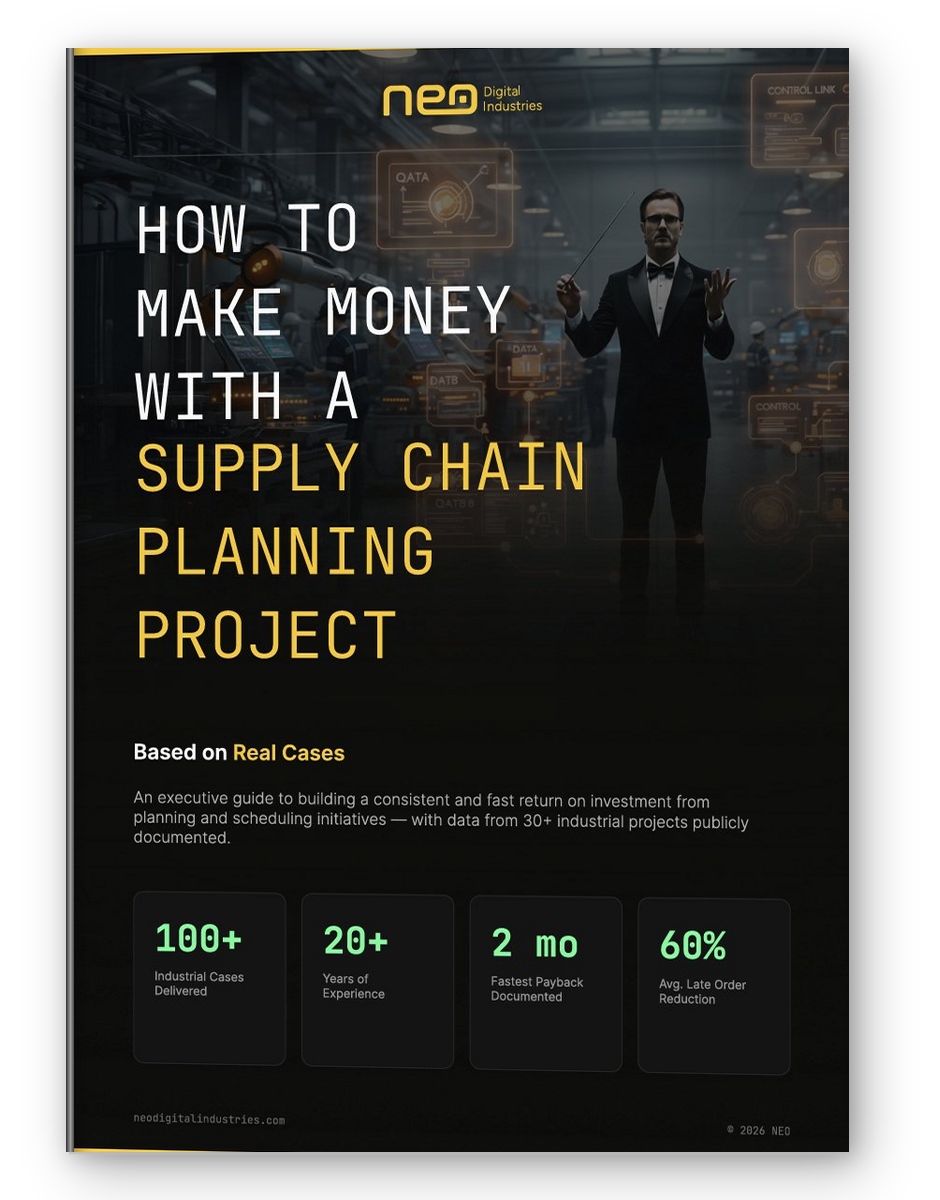
Free Ebook: How to Make Money With a Supply Chain Planning Project
Executive guide featuring data from over 30 documented projects. Discover the three sources of ROI, how to build a solid business case, and a step-by-step payback formula you can apply today.
Talk to one of our APS experts
Get a personalized assessment of your operations from APICS CPIM certified consultants. We will help you identify opportunities for improvement and estimate the return on your project.