

The Recipe for Success: Operational Excellence at Equatorial Coca-Cola Bottling Company
Equatorial Coca-Cola Bottling Company (ECCBC), The Coca-Cola Company's bottling partner in North and West Africa, leads the production, marketing, and distribution of a portfolio of premium global brands — including iconic drinks such as Coca-Cola, Fanta, and Sprite. In this case study, we look at how ECCBC deployed Evocon to improve line performance and achieve operational excellence.


Meet Equatorial Coca-Cola BottlingCompany (ECCBC), a bottling partner of TheCoca-Cola Company with operations in 13countries
About us
With operations spanning 13 African countries, ECCBC effectively connects with over 160 million consumers, serves over 250,000 retail outlets and records 2 billion transactions annually. At the core of ECCBC's operational strategy is a commitment to peak line performance and cost efficiency, ensuring customer satisfaction and business success. All are integrated into a comprehensive ESG impact strategy for 2030, aiming to enhance ECCBC's value by integrating ESG (Environmental, Social and Governance) considerations into core business strategy, linked to the well-being of our environment, local communities and governance practices.
But what is ECCBC's plan to achieve these ambitious goals? To understand this, we will look at the operational ethos of the Equatorial Coca-Cola Bottling Company and gain insights from expert Yassine Akhrif, ECCBC's Performance and Excellence Manager.
To align organizational efforts toward excellence, ECCBC has established a robust framework comprising five strategic pillars and two dynamic enablers:
- Pillar 1: Safety, quality, operational sustainability
- Pillar 2: Service level, production capacity, capability
- Pillar 3: Operations and costs, cash efficiency for supply risks (COGS)
- Pillar 4: Optimization of cash capital
- Pillar 5: Standardization of operational excellence
- Enabler 1: People development
- Enabler 2: Technology and digitalization
The two enablers act as catalysts, empowering the organization to transform the five pillars into actionable strategies. ECCBC Operations teams use this framework as a guiding process for all projects and programs to achieve the company's vision. Ultimately, monitoring and improving line performance (OEE) is at the heart of this framework, allowing the pillars and enablers to work together.
This meant that ECCBC had to find a way to accurately track OEE across all of its plants. To achieve this, they set out to find an OEE software that would meet their needs and requirements:
- Real-time access to data,
- Ease of implementation,
- Visualization of OEE on the shop floor,
- The ability to increase the maturity of shift meetings and daily performance,
- And the possibility of tracking other process metrics.
To achieve the goal of tracking OEE at ECCBC plants, Performance and Excellence Manager Yassine Akhrif initiated a collaboration with Evocon and Mohamed Taher Mouni (founder of Beyond 4.0 and Evocon authorized partner in Morocco). Together, they launched a successful Evocon implementation that changed the way work was done on the shop floor.
The challenge
Entrevista com Yassine Akhrif. Implementação de OEE na ECCBC
In a short interview with Evocon's Head of Product Martin Lääts, Yassine explained his step-by-step approach and choices, which we are happy to share as it is a clear and repeatable OEE implementation process for other large companies.
Martin: What were your first steps in this project?
Yassine: The first step was to define why we need to monitor OEE in real time and what specifications are required for the solution. For us, the WHY was to improve data quality, accuracy, reliability and availability and to go paperless in our factories. It is very important for us to make decisions based on a deep understanding of line performance. For the solution specifications, we focused on ease of use and fast implementation time to ensure solution adoption and scalability.
The second step was to define the team and the pilot project. We chose to run a small pilot on just one line with Evocon in a smaller plant, with the right people, to focus on the implementation and see if Evocon met our needs.
When I say "the right people", I mean motivated people who have the same goal as us and with whom we have smooth and clear communication. Just like our communication with Mouni - he talks about technology and performance at the same time. He knows the exact context and needs of the manufacturing team. Having the same language helped us have a quick implementation of Evocon in our Marrakech plant, and once we showed success, it was easy to get buy-in from others - it happened automatically, as people saw the value.
Martin: And why did you choose Evocon, among all the solutions?
Yassine: There are several factors. First, the rapid implementation enabled by Evocon's IIoT technology, which allowed us to quickly focus and ensure our people were up and running in the application in a short space of time. Second, the visualization that Evocon provides allows us to understand line performance for each shift without the need for unnecessary clicks or navigation. Third, the ability to connect additional metrics such as CO2 and concentrate to calculate yield performance and understand its impact on line performance.
When Mouni first demonstrated Evocon to me, it was clear that it was a good fit. The Shift View clearly presents the performance of each shift, highlighting problem areas and making it easy to analyze. The simplicity and intuitiveness of Evocon's user interface are key to encouraging people to embrace change. Congratulations on this achievement!
The solution
The solution developed by NEO for the Malwee Group initially focused on the Manufacturing processes. Due to the complexity of the production chain and the large volume of data involved, specific solutions were created for each of the four main areas of the process: Cutting, Internal Sewing, External Sewing and Finishing. All the models developed, although independent, are interconnected and have, as their main objective, the optimization of sewing operations.
In this way, the data required for sequencing, such as scripts, production orders, technical sheets, among others, are imported from the SAP ERP to the Opcenter APS software. After data integration, the Sewing schedule is generated, the sequence of which determines the dates required for the previous processes. With the dates defined, the sequencing of the other sectors is carried out.
For sewing solutions, an advanced rule was developed for grouping similar products in order to reduce the time required to change machines in the sewing cell, thus avoiding setup losses. Regarding sewing performed by third parties, the aim was to ensure optimization in similar models, paying attention to meeting the capacities contracted with suppliers, as well as transportation lead times and return times to the unit.
The entire sequencing process for the Malwee Group's models is carried out using NEO's Smart Balancing Rule, nSBR. This rule was developed entirely by the NEO team, using APIs, and enables prioritization of operations based on several parameters configured by the client, balancing production resources. In this case, nSBR allows the sequencing dynamics to be changed according to the collection and the demand at the time of generating the production schedule, with greater autonomy and flexibility for the solution.
Furthermore, as there was a need to increase visibility of production within suppliers, during the APS project, the Malwee Group developed a mobile application to record production carried out by third parties. In this way, the production sequencing generated by Opcenter APS also considers what is in production, from the exact moment it begins. Thus, subsequent Finishing processes, carried out internally, are scheduled with the correct forecast of the return of material from third parties.
Last but not least, the need to create a customized rule for allocating fabrics and knits to cutting orders was identified, since the MRP process in SAP ERP allocated materials based on the general date map, and not the detailed needs of the sewing queues. The business rule developed, therefore, looks specifically at the sewing queue, allocates stocks and generates the purchase and/or production needs of the missing inputs. This allocation rule is used by the reserve team, responsible for releasing materials for the start of the production process in the cutting area.
"The sequencing process in the manufacturing sector today is extremely efficient and well-organized. The way in which the steps are ordered and executed demonstrates a high level of planning and control. The precision in the sequence of operations ensures the optimization of the resources used, resulting in one of the best levels of service to the end customer. In addition, the speed and agility with which the parts are produced is impressive, thus meeting market demands in a satisfactory manner. It is clear that the company invested in this technology and training of its team to achieve this level of excellence in the textile manufacturing process."
- Liliane Soares - Scheduling Coordinator
The results
By improving the management of sewing suppliers, it is possible to achieve concrete results that reflect a more efficient and economical operation. Among the related gains is a 44% reduction in order reallocations between third parties, revealing better coordination and planning of the supply chain. In addition, it was possible to reduce by 89% the reallocation of orders from third parties to the company's internal sewing, significantly improving product quality and delivery times.
The business rule developed for allocating knits and fabrics led to a 10% increase in the so-called "Complete Model", so named because it groups all orders for the same material. The percentage increase in the Complete Model ensured better supply to the seams, both internal and external, in addition to reducing setup times dedicated to changing materials. Additionally, there is a direct impact on the initial processes of the chain, increasing the average cutting batch and, consequently, reducing downtime due to setup.
With the implementation of the solution developed by NEO, it was also possible to improve the identification of gaps in the sectors, as well as the identification of bottlenecks, inefficiencies and delays, allowing a more proactive approach to their resolution. The analytical and strategic vision of the reports developed by the NEO team has assisted the decision-making process in the planning of the areas, allowing an accurate analysis of the operations. In addition, more detailed and close monitoring of the sewing suppliers allowed for better load balancing, prioritizing the distribution of models in a more balanced way among the more than 100 active suppliers.
As a next step, the Malwee Group is focusing its efforts on expanding the implementation of the Opcenter APS software to the entire textile plant, including the Knitting and Finishing sectors. The initiative aims to establish a complete connection of the entire production chain, from the initial stage of knitting to the moment the product is ready to be shipped to the customer. With this expansion, it will be possible to further optimize processes, providing more integrated and efficient management at all stages of textile production.
"Within our process of constant search for operational efficiency, APS is one of the main tools. The tool's usefulness ranges from strategic planning to agile decision-making. Our plan is to connect the entire textile and manufacturing chain through the sequencing system, seeking to optimize the process, reduce costs and waste, and increase delivery efficiency. With constant process updates, APS will allow us to be more adaptable to customer service needs."
- Graciano José Bonetti - Supply Chain Manager
SEE MORE RESULTS LIKE THIS AND LEARN HOW TO PROJECT THE ROI FOR A SUPPLY CHAIN PLANNING PROJECT IN YOUR INDUSTRY:
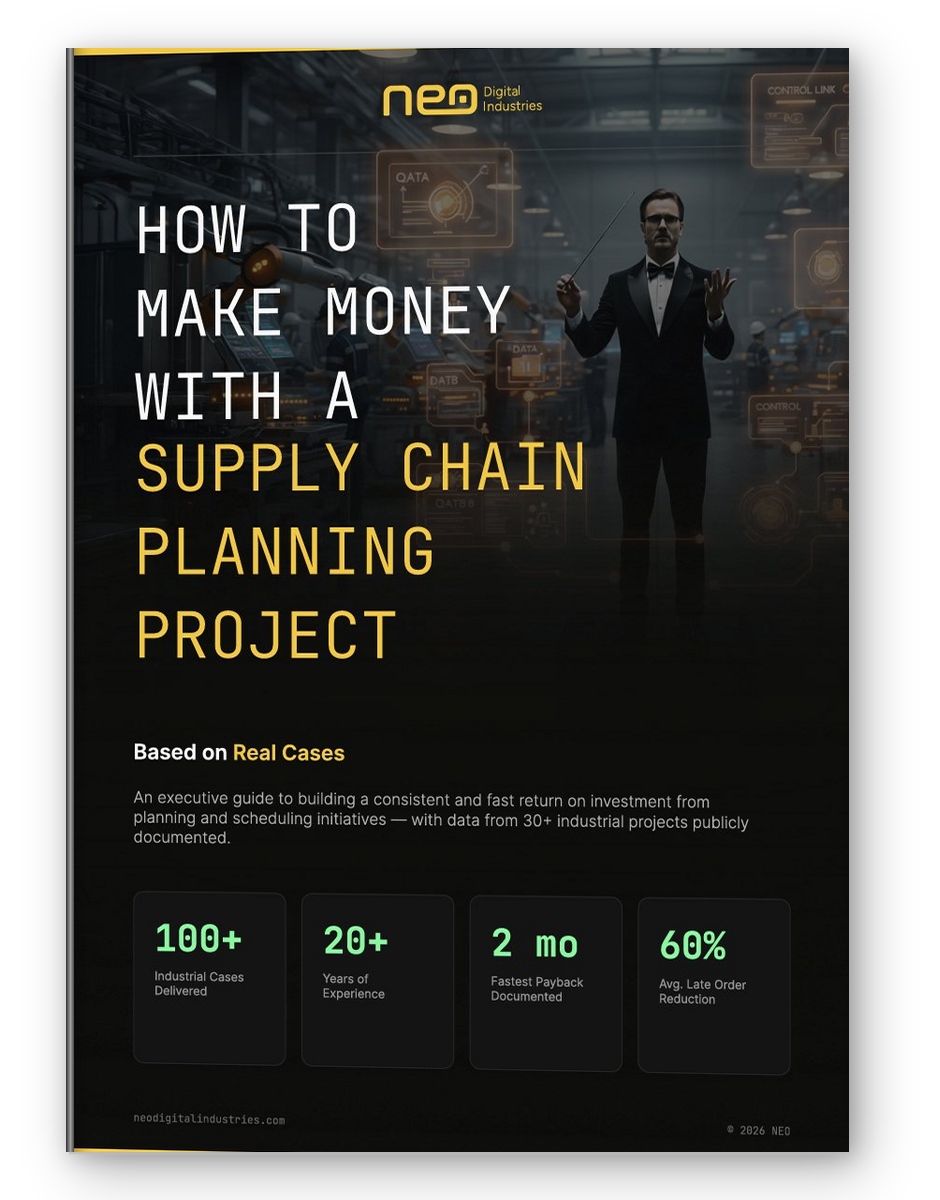
Free Ebook: How to Make Money With a Supply Chain Planning Project
Executive guide featuring data from over 30 documented projects. Discover the three sources of ROI, how to build a solid business case, and a step-by-step payback formula you can apply today.
Talk to one of our APS experts
Get a personalized assessment of your operations from APICS CPIM certified consultants. We will help you identify opportunities for improvement and estimate the return on your project.