

ZEN transforms production scheduling with Opcenter APS and NEO: full synchronization, standardization, and hundreds of hours saved
See how ZEN overcame the complexity of multiple routings and shared resources by adopting a scalable, intelligent planning and scheduling model with Opcenter APS, bringing more stability, agility, and confidence to production decisions.


Meet ZEN S.A., one of the leading manufacturers of automotive components in Brazil, with a broad portfolio of solutions for the original equipment and aftermarket auto parts markets
About us
ZEN S.A., headquartered in Brusque, Santa Catarina, has operated in the automotive sector since 1963 and is today a major global manufacturer of original and replacement parts. With annual production exceeding 15 million components, a portfolio of more than 4,700 items across 18 product lines and a presence in more than 70 countries, the company has established itself as an international benchmark in its segment, serving automakers and the aftermarket on a global scale.
With a strong commitment to innovation, ZEN is continuously expanding its product line to meet customer demands. Its portfolio covers a wide range of products essential to vehicle performance and efficiency, such as alternator pulleys, belt tensioners, timing kits, starter motors, alternators and bearings. In addition, the company also manufactures cold-, hot- and warm-formed parts, with the production capacity to supply a variety of solutions to original equipment customers.
With more than 1,000 employees, strong investment in Research & Development and certifications such as ISO 9001, IATF 16949 and ISO 14001, ZEN positions itself as an innovative organization focused on quality and continuous improvement.
The challenge
ZEN's production planning and scheduling process had always been marked by a high level of complexity, driven both by the wide variety of finished products and by the extensive chain of semi-finished items distributed across multiple interdependent production stages.
Despite its high manufacturing maturity, the existing model showed a low level of synchronization between stages, which resulted in recurring bottlenecks, the formation of intermediate queues and difficulties in the overall balancing of production. Several resources were scheduled in a poorly optimized way, with low adherence to what had been planned, requiring constant intervention throughout the day.
Rescheduling production in the face of changes such as demand variations, machine breakdowns, material delays or commercial prioritizations was a slow, highly manual process with high operational risk. This scenario became even more critical due to the existence of shared resources, batch production and multiple routing alternatives, which exponentially increased the complexity of sequencing.
From a management standpoint, there was low integrated visibility of the production chain, making it difficult to clearly understand the impact of each decision on subsequent stages. The company faced obstacles in reliably measuring and forecasting delivery dates for components and finished products, as well as in assessing the real feasibility of the deadlines committed to. Scenario generation was practically non-existent and, when it did occur, was limited to very specific and poorly structured analyses.
In addition, business rules, prioritization logic and operational dependencies were not formalized in a systemic model. Setup matrices were limited or non-existent, which significantly restricted the optimization of production sequences and the reduction of unproductive times.
This context made the process heavily dependent on human intervention, concentrating critical knowledge in the experience of the schedulers. As a result, there was a lack of standardization among planners, a high risk of knowledge loss, as well as difficulties in covering vacations, absences or job rotation strategies.
Operating in a hybrid manufacturing environment, combining Make to Stock and Make to Order strategies, ZEN needed to evolve its planning process toward a more robust, integrated, scalable and scenario-oriented model.
Given this scenario, in 2021 the company began a structured journey to transform its production planning and scheduling process, seeking to raise the level of synchronization, predictability and reliability of its decisions. To support this initiative, it chose NEO as a strategic partner, motivated by its experience in advanced planning projects in complex industrial environments.
The solution
After a detailed analysis of the master data, production flows and operational rules, the first scope was defined as the implementation of Opcenter APS in the forming and machining processes, considered critical due to the complexity of their routings, high level of constraints, intensive resource sharing and direct impact on the overall performance of the plant.
Together with ZEN's teams, in-depth work was carried out to map operational characteristics, covering capacities, calendars, constraints, machine alternatives, batch production, stamping tools, dependencies between stages and specific business rules. This effort made it possible to structure a single, standardized and scalable planning model, reducing dependence on tacit knowledge.
In parallel, a complete review of the master data was carried out, with cleansing, standardization and the creation of structures that enabled ZEN's own team to maintain and evolve the model autonomously. The company's high maturity in data management was decisive in accelerating this stage.
Integration with the Focco ERP was carried out swiftly, with strong involvement from the internal IT team. From this integration onward, all master and transactional information required for planning began to be imported into Opcenter APS, such as resources, products, bills of materials, routings and production orders. All orders generated by MRP, both planned and firm, became part of the APS horizon, providing an integrated view of the entire production chain.
With the base structured, NEO developed, together with ZEN, a set of fully customized sequencing rules that faithfully reflect the reality of the shop floor. Advanced setup matrices were built, totaling more than 4 million possible combinations, enabling the optimization of the production sequence, the reduction of unproductive times and greater adherence to the plan.
The model began to consider, simultaneously, delivery dates, labor constraints, tool availability, shared resources and batch policies.
This environment made it possible to reschedule production quickly and safely, as well as to run structured scenario simulations, enabling analyses of the impact of demand changes, capacity constraints and commercial priorities before release to the shop floor.
Complementing the solution, routines were implemented to export the schedule to the Focco ERP and several management and operational reports were developed, addressing raw material needs, order tracking, detailed scheduling by resource, load analyses, coverage and promised dates.
Today, ZEN has more than 20 customized reports that support not only PCP but also manufacturing, purchasing and supply chain, significantly expanding visibility, integration and the quality of decision-making.
Opcenter APS has become part of the daily routine of ZEN's PCP, driving significant gains in organization, rescheduling speed, information reliability and adherence to the plan. The planning process evolved from a predominantly operational activity to an analytical, standardized and scenario-oriented model, reducing operational risks and strengthening the strategic role of PCP within the organization.
The results
With the consolidation of Opcenter APS in the PCP process, ZEN began to operate at a new level of maturity in production planning and scheduling. What was once a process highly dependent on manual intervention and tacit knowledge evolved into a structured, predictable model geared toward data-based decision-making.
From a quantitative standpoint, the results were significant as early as the first year of using the APS in the forming areas: an approximate 10% increase in production volume; a reduction of around 15% in total setup time; a drastic reduction in scheduling time: from approximately 2 hours to about 10 minutes to build a production scenario; and greater plan stability and adherence to the schedule.
"The implementation of Opcenter APS represented a structural change in the way ZEN plans and schedules its production. We moved from a model highly dependent on individual knowledge and manual decisions to a much more robust, reliable and sustainable process. Today, we have a much more complete, up-to-date setup matrix that is consistent with the reality of the shop floor, which has brought clear gains in predictability and scheduling quality. In a highly verticalized process such as ZEN's, synchronization between operations is essential, and before the APS we simply did not have this integrated view. The result is faster scheduling, with better delivery forecasting, lower risk of knowledge loss and a solid basis for decision-making."— Gabriel Darosci, Planning Supervisor
From an operational and qualitative perspective, the transformation was equally relevant: standardization of the scheduling activity; a significant reduction in scheduling errors; a substantial improvement in the predictability of delivery dates; a reduction in dependence on the human factor, with critical knowledge incorporated into the systemic model; and the strengthening of PCP's role as an analytical area, geared toward scenario simulation and structured support for decision-making.
As a result, ZEN consolidated a more robust, scalable and integrated planning process, in which Opcenter APS became a central element of production governance, supporting not only short-term scheduling but also scenario analysis, capacity balancing and the alignment between strategy, operations and market service.
"In day-to-day scheduling, Opcenter APS brought a major gain in agility, reliability and clarity of information. The tool allows us to work with a much more complete and reliable setup matrix, which makes scheduling more consistent and reduces dependence on the individual knowledge of the operators. Another key point was the ease of generating different scenarios and quickly assessing the impact of changes in priority, volume or production constraints. This significantly improved the quality of forecasts and the way we relay deadlines and information to both internal and external customers, bringing more security, transparency and credibility to the planning process."— Rodrigo Marques Nunes, Planning Analyst
SEE MORE RESULTS LIKE THIS AND LEARN HOW TO PROJECT THE ROI FOR A SUPPLY CHAIN PLANNING PROJECT IN YOUR INDUSTRY:
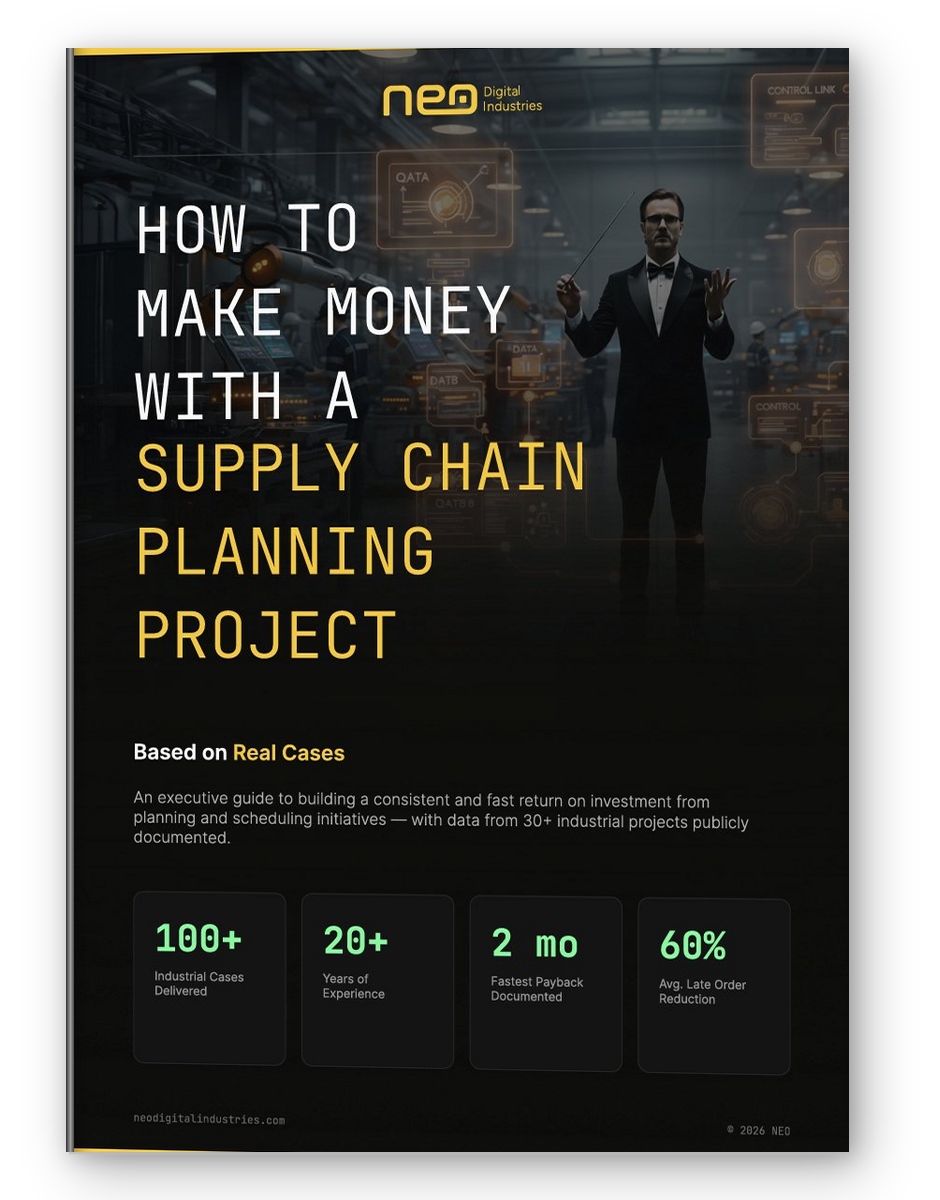
Free Ebook: How to Make Money With a Supply Chain Planning Project
Executive guide featuring data from over 30 documented projects. Discover the three sources of ROI, how to build a solid business case, and a step-by-step payback formula you can apply today.
Talk to one of our APS experts
Get a personalized assessment of your operations from APICS CPIM certified consultants. We will help you identify opportunities for improvement and estimate the return on your project.