
.png)
Scheduling and Maintenance: The Synergy Between APS and TPM
Scheduling and maintenance share more synergy than you think. Learn how to integrate APS and TPM to boost the availability and efficiency of factory resources.
In theory, maintenance management and production scheduling look like very close, interconnected processes — after all, they manage many resources in common and share the same objectives of increasing availability and efficiency. However, the integration between them is little explored in current Brazilian industrial practice. And I understand: both areas have very lean people resources and low future visibility, with lots of uncertainty, which unfortunately makes management need to be as simple as possible, focusing on what's critical, urgent and known.THE LIMITATION FROM LOW VISIBILITY Those working with TPM (Total Productive Maintenance) already have a more solid foundation for joint action with PPCP, since planned maintenance — whether preventive or predictive — is among its pillars. However, that planning is done and usually stays within the Maintenance area, and the information rarely reaches PPCP in a formal way. It comes through a phone call, a meeting or a hallway chat, when the areas interact and Maintenance reports “Hey, PPCP, machine X is going to have 4 hours of maintenance next Thursday at 2 p.m.”This situation is aggravated for those who don't use an APS software, since even if the maintenance plan has a horizon longer than a week, PPCP itself can't see more than a few days into its own production schedule accurately. So maintenance that's further ahead has no clear use. In short, this low-visibility and low-accuracy scheduling scenario limits the synergy between the areas.On the other hand, when we have production scheduling through APS, we can improve these processes.APS + TPM FOR PLANNINGWhen the use of Opcenter APS begins, a very interesting point for seeing finite production capacity is to bring planned maintenance into the Gantt chart, so it's already considered when scheduling, as in the image below. This way, an operation cannot be scheduled at a moment when the resource will already be committed to maintenance.
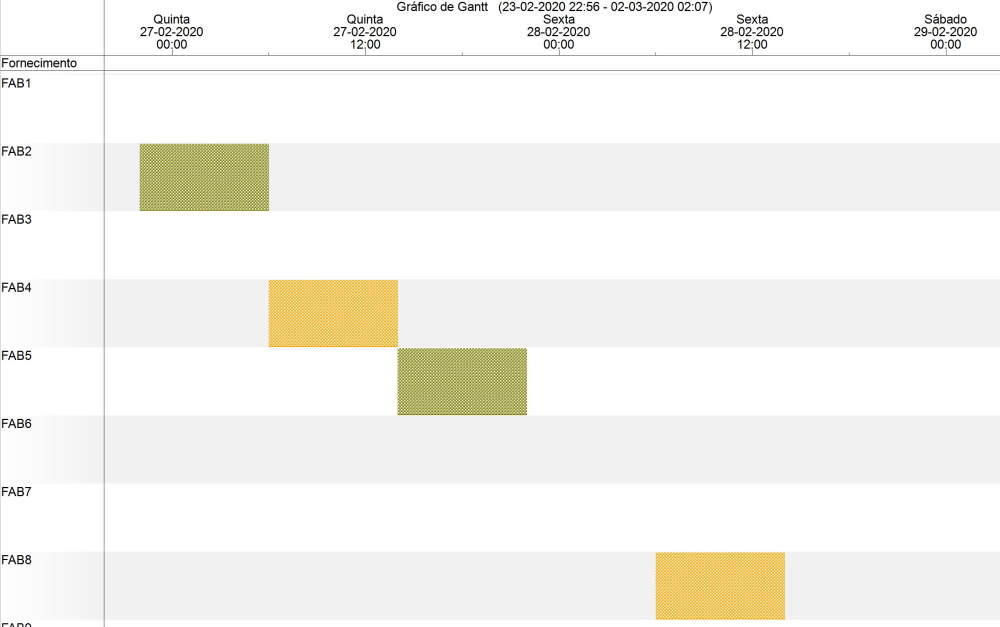
Figure 1 - Pre-schedule Gantt with predictive maintenance in green and preventive in orange
These maintenance events can be registered directly by the Opcenter APS key-user, but ideally they should be imported from another system, whether the maintenance module of your ERP, MES or a specialist maintenance system.A next step of synergy can arise when maintenance doesn't need to happen exactly on that specific day and time but rather within a certain ideal period. In that case, the exact maintenance allocation can be performed after PPCP analyzes the production schedule itself. For example, predictive maintenance software can inform APS when maintenance will be and pin it in the horizon as shown in Figure 1, but could also create a maintenance request to be allocated in a given period — with its exact day and time placed by PPCP in APS, respecting the limits indicated by maintenance and seeing what the best moment is for that maintenance to occur with the minimum possible impact on production.Because the synchronization between operations and each resource's shifts is considered in APS, it becomes possible to visualize situations in which maintenance allocated in the morning or afternoon shift alters productive efficiency. This efficiency impact can occur not only for the resource undergoing maintenance but also for downstream operations that depend on that resource's production. That is, the dialogue between what maintenance needs and what PPCP needs through integrated scheduling unlocks efficiency gains.Of course, performing this change isn't simple — you need a well-structured process with owners and deadlines for these new activities, and you'll need to add more integration layers between systems, since APS will also return scheduled maintenance dates. Still, the efficiency gains and better visibility favor the initiative.
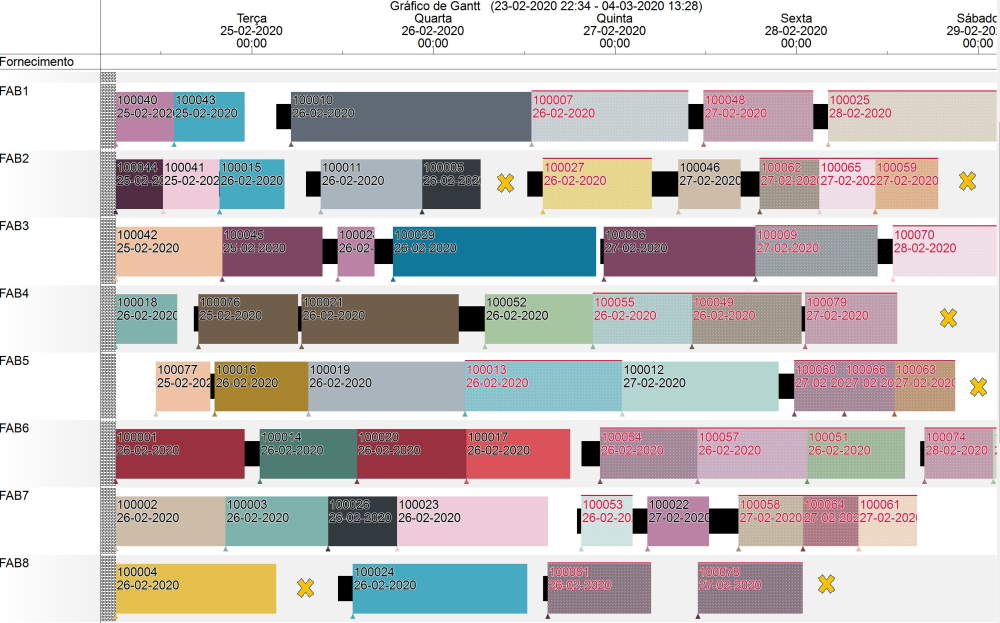

Potential gaps for fitting maintenance
Figure 2 – Post-schedule Gantt with potential gaps for maintenance allocation
AND CORRECTIVE MAINTENANCE?Corrective maintenance is perhaps the most critical to address in an integration between APS and ERP or MES, given the urgent agility of response that PPCP must have when an unexpected event like a machine breakdown occurs and the impact the problem can generate.However, precisely due to that urgency and the scarcity of resources to standardize processes, many industries resolve these issues outside of any system. First, that's a problem for maintenance itself, since stoppage history isn't recorded and indicators like MTBF (Mean Time Between Failures) and MTTR (Mean Time to Repair) are hurt. Second, if it doesn't go into a system, APS will depend on a manual scheduler intervention to insert the corrective maintenance and reschedule production from there. That manual process is viable but loses agility.Good integration between ERP or MES and APS allows that, when a corrective maintenance event occurs, APS can already block the resource during the expected diagnostic time, the MTTD (Mean Time To Detect), and update the maintenance duration according to the MTTR expected for that type of problem once diagnosed.
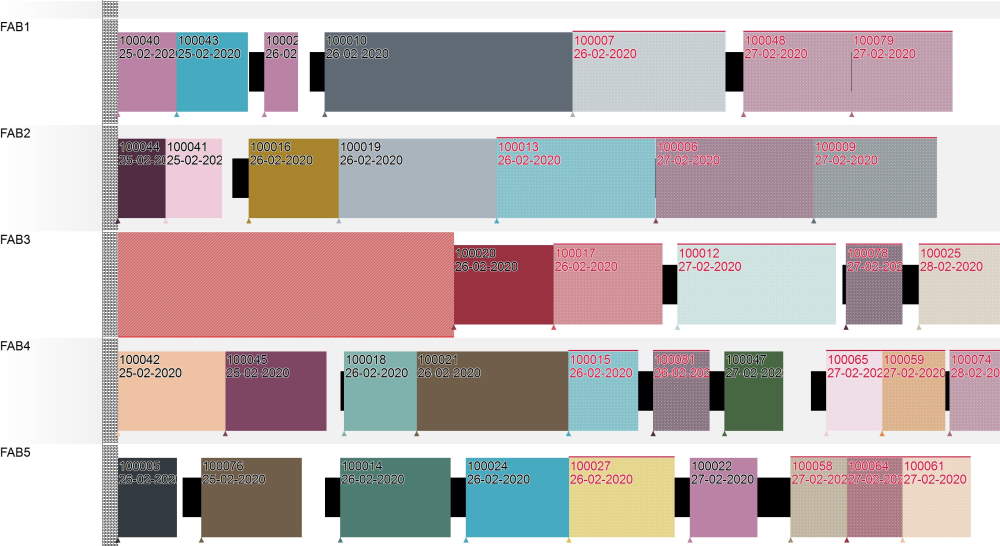
Figure 3 – Gantt with schedule and corrective maintenance in red with time automatically imported by MTTR
It's important to understand that very short stoppages probably don't impact the production schedule (or rescheduling), since they are very short-term events without enough weight (the impact of such issues can be measured by schedule adherence). However, larger stoppages or those on extremely critical resources may require an immediate on-demand response, and this agile integration can become a great differentiator.So, did you like the content?
And how can NEO help your industry?
NEO Engenharia de Produção is a Siemens Smart Expert Partner and offers solutions with business analysis and implementation of APS software. We've built a new concept that values technological vanguard and technical excellence at the same time that we believe in human sensitivity, creative work and personalized, committed relationships.Get in touch through the form below or via our WhatsApp to learn more about our solutions and schedule a tailored analysis for your business needs.Sequence your production with someone who specializes in technological solutions.
Want to take the next step with us toward APS? Leave your contact below and let's talk
Table of Contents
Talk to an expert
Speak with our experts and discover how NEO can transform your planning.
Book a demoDownload the ebook
Deepen your knowledge with our exclusive resources—practical content you can apply directly to your operations.
Download ebook