

The Challenge of Promising a Delivery Date
Make-to-stock, make-to-order, ATO, ETO: understand why promising reliable delivery dates is a challenge in industry and how planning helps you keep them.
PRODUCTION AND DELIVERY DATES
When we work with industry, we see many production system orientations: make-to-stock, make-to-order, assembly-to-order, engineering-to-order, as well as hybrid systems that mix these orientations. It's very common for industries to choose products with high demand and long life cycles to be produced for stock to reduce replenishment lead times to the market and gain productive efficiency, while customized products with low continuous demand or very short life cycles (as in fashion) are produced only to order.
While the make-to-stock (MTS) challenge is producing in the right quantities to avoid obsolescence and high inventory costs, the make-to-order (MTO) challenge is delivering products quickly from the moment a customer places an order, without hurting productive efficiency and — perhaps even more importantly — without missing the delivery date! To be clear, the fact is we have two delivery dates: the one the customer wants to receive the product and the one the industry commits to deliver.
These dates are often very different. There are cases where there's no choice and the customer sets the delivery date the supplier must meet based on market requirements and standards. But there are still cases where there's a dialogue between the companies to define a final delivery date. This is the moment when PPCP plays a crucial role in better customer service (or at least it should).
THE PROMISE
To define a delivery date that production can actually meet, the ideal is for the PPCP/PPCPM area to be responsible, since it's the area capable of analyzing all production variables (current production volume, materials, available resources, shifts, maintenance, tooling, etc.) to see when and how these orders can enter production. In many cases we see companies working with fixed lead times for delivery promises, sometimes with default values for any and every product. But reality shows each product has specific manufacturing routings and needs — one product may be producible much faster than another, so it doesn't make sense for both to share the same lead time. Therefore, it's recommended that the methods and process engineering areas analyze and classify products properly according to each one's productive effort. It's not a problem to work with fixed lead times per product family and, if products are similar, even with a single fixed lead time for all products at the limit. That can be a great enabler for the sales area. However, PPCP needs to analyze these incoming orders, validate on-time delivery and have contingency processes for delays.
Whether an order arrives without a delivery date and PPCP sets it and hands it to sales to communicate to the customer, or an order arrives with a delivery date and PPCP confirms whether or not it can be met, this area must do so in a way that's consistent with the factory's reality — otherwise we're making a promise we don't know we can keep. And there's nothing worse for a company's image, besides product quality factors, than missing delivery dates.
PROMISE WHAT YOU CAN DELIVER
This is where technology can give us the backbone we need to avoid unnecessary delays and disruption. To have a good delivery-date promise process, we need to have two things well in place and embedded across the industrial areas: an agile communication and information process between sales and PPCP, aligned with the company's commercial characteristics (1), as well as an accurate and reliable production scheduling system that can properly assess productive variables (2).
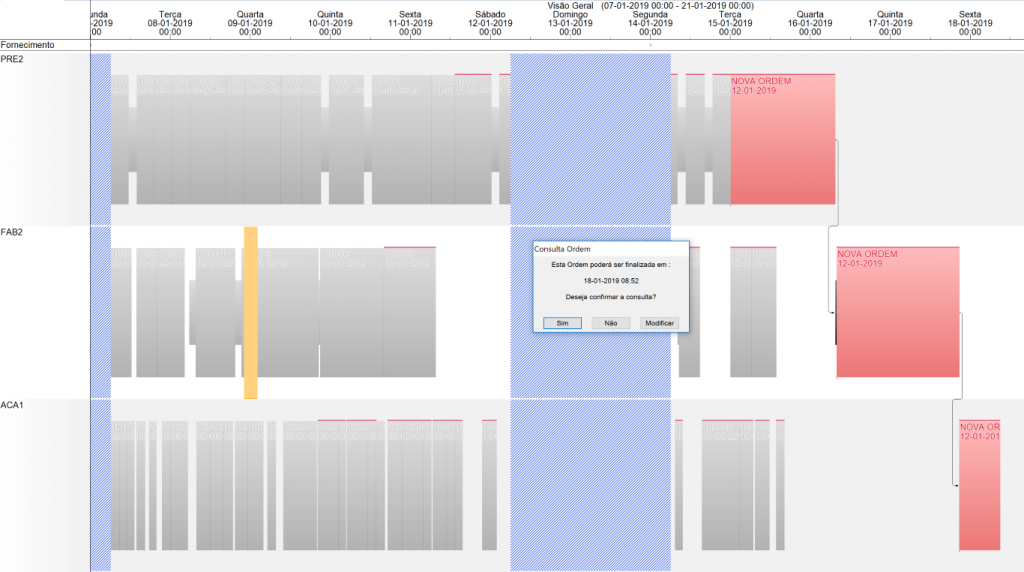
Feasible Delivery Date Inquiry in Preactor APS Software
To establish this process for the first point raised, you need to understand whether the market needs immediate responses to demands or whether it's possible to standardize a process with time windows to analyze orders in batches. The first case requires higher automation, since orders arrive scattered in time and need a quick, individualized response, making PPCP's involvement more focused on creating business rules so that this system can operate without needing a team member available at all times to promise dates. In the second case, where you can work with windows of one or two shifts to return the information, you can create a process with greater area collaboration and scheduled simulations to generate delivery dates for all orders received in a window of time. This allows that, in cases where there's not enough capacity to produce all orders, or where the factory schedule needs to be more deeply modified to meet some need, a well-aligned dialogue and consensus can occur between sales and PPCP to make decisions.
As for the second important point, regarding a reliable production scheduling system, it's essential to consider that our factory(ies) have finite capacity, and that this isn't decipherable just with machine/man load analyses — we need a system capable of handling the most diverse variables possible, from machinery available to produce and synchronization between productive operations, to critical constraints on tooling, labor or even physical space. Otherwise, confirming an order by looking at a spreadsheet or flipping a coin has the same effectiveness.
To learn what those systems can be and how they work, learn more about Preactor APS and get in touch with NEO!
Table of Contents
Talk to an expert
Speak with our experts and discover how NEO can transform your planning.
Book a demoDownload the ebook
Deepen your knowledge with our exclusive resources—practical content you can apply directly to your operations.
Download ebook