

Planning Vs Scheduling: what is the role of APS?
Planning or scheduling? Understand the difference between the two processes and the role APS plays in each one across the production chain.
Do you know what the role of APS is?
There are basically two major processes covered by APS: Planning and Scheduling. And with many advantages, because it lets you build short- to long-term production plans across the entire production chain, considering practically all the variables and constraints of the productive environment.Some terms can be related to the same subject, such as Detailed Production Planning Software or Finite Scheduling Systems, as well as “Advanced Planning Systems” in English. See more about the origin of APS!
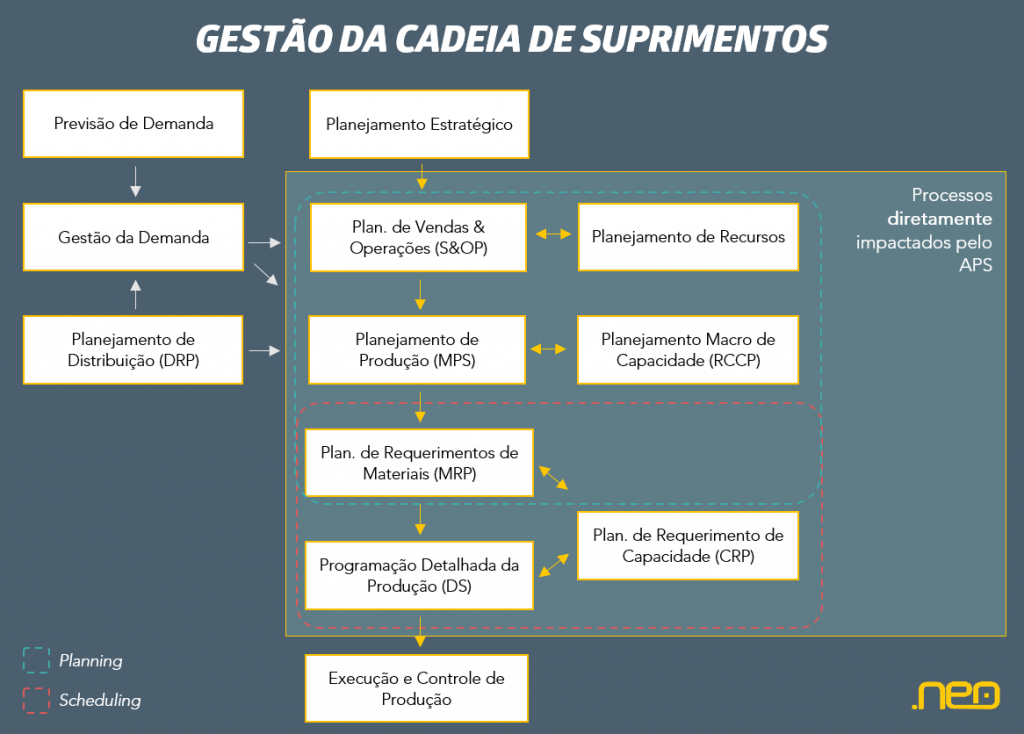
If we look at the main processes of Supply Chain Management, we'll find the configuration below, in which we can identify where Planning- and Scheduling-focused solutions fit.
Production Planning with APS
Many may think that an APS solution focuses exclusively on Detailed Production Scheduling (the first versions didn't include Planning, or at least not with finite capacity, making the perception of the APS concept attached only to Fine Scheduling — Scheduling), but a complete APS covers much more than that. The Production Planning process basically has the goal of defining what to produce in each planning period and in what quantity, represented by the Master Production Schedule.
It is based on the actual and/or forecast demand for each period of a horizon — which can range from weeks to months — and the inventory and service policies each product has (these policies end up being used mainly by companies that produce for stock, but companies that produce to order also need to do their Planning).
This process is usually carried out by the ERP software itself which, as we've seen, has its limitations regarding productive capacity constraints to generate these production plans. Since in Planning we work with a more macro, less detailed view of resources (it doesn't necessarily matter how that production will be executed within each shift and day, but rather how much of each product will be produced in that week), these limitations are therefore less critical.
Still, if some business rule is needed, if bottlenecks can be dynamic, or if SKU volume variety is very high, other constraints not easily handled by ERPs may arise.
It's worth remembering that the Planning process (often attributed in English to Master Scheduling) is, by definition, posterior to S&OP, Sales & Operations Planning. Even so, it can be closely related to APS for two reasons: first, by the S&OP characteristic of using a long horizon, which generates a greater need for scenario simulation against future uncertainties; as well as Resource Planning, which interacts with S&OP and needs to see productive capacity.
Since APS has all its dynamics based on this scenario generation and capacity management, it can greatly support the collaborative sales and operations planning.
The difference in how APS will act in each of these two processes basically consists of the granularity level of each — both by its position in the Supply Chain process cycle and by its objective.
CharacteristicsAPS (Planning) -> S&OP
APS (Planning) -> MPS
While S&OP will look at a longer horizon to support the tactical and strategic level — probably analyzing product families — MPS will work with a horizon linked to the maximum accumulated supply lead time (that is, the longest time path drawn between the purchase, production and delivery of a product).
If we're talking about a Production Planning to support an S&OP process, we could afford to look only at the most critical constraints and work with sales forecasts by family, which would later be disaggregated into SKUs (Stock Keeping Unit, or simply a product). That's enough because, from a capacity perspective, the goal is to see how much capacity will be consumed by the forecasted sales volume and whether any action is needed to modify it or revise the sales plan.If we're trying to support the MPS (Master Schedule) itself, we'll look at the finished-good level by SKU, which generates the formal MPS, and then explode this demand into the other levels of product structures to define what should be produced and bought — assessing capacity impacts in each planning period and taking actions to align capacity and demand in that period. In this process, simplifications made earlier at S&OP can surface here, revealing constraints and idleness that may have gone unnoticed and that will have significant operational impacts.
The material requirements explosion, characterized by traditional MRP/MRPII literature, could be only at the planning level. But we understand that, due to the dynamism material management has today, MRP — even with finite capacity — can no longer be thought of without considering it must support a short-to-medium-term process, recalculating needs based on plan revisions made by Fine Scheduling. That's why it sits within both solutions.
Production Scheduling with APS
The Production Detailed Scheduling process starts from the volumes to be produced previously defined in the MPS — or simply from continuous customer order demands for make-to-order (MTO) industries — with the goal of defining in detail when each demand will be produced and (here's the main critical point of this process) "how."
Here each of the operations needed to manufacture a finished product will be sequenced — or at least the main ones, if the bottlenecks of these processes are stable and defined. Since APS raises the precision level of this process, we call it Fine Scheduling. Let's look at its elements.
First of all, it's important to know what will be scheduled, what we call the Scheduling Object. Each company has its way of managing it, but the most standard nomenclature is the Production Order (PO) or Manufacturing Order. It was created from the MPS we saw earlier, or even from MRP. However, a PO is not just the reflection of net needs coming from MPS and MRP. Production policies must be applied here — such as information on minimum, multiple and maximum lots allowed by the industrial area for executing each process. So MPS may generate a production need of 5,000 units of a product for a given period, but if the maximum lot is 2,500 units, we'll have two Production Orders.If APS receives a Production Order of 5,000 and we need it to split it, performing this split is totally feasible. However, the complexity of managing information integrity between systems — needing to explain to the production-control system or to the ERP itself that the order was split and now each can follow a different path and needs to be managed individually — makes it more efficient to do that split at the source, that is, when generating the PO itself (in whatever system).
Ideally, scheduling allocates demands as production orders on productive resources (a machine or a workstation), according to different heuristics and simulations depending on the objective. With that, each resource receives its list of orders to produce, with the exact sequence to follow.As the main features of classic APS for Fine Scheduling, we can highlight:
- Finite capacity: in this case, the real capacities of resources are considered — work is only allocated to resources up to their limit;
- Finite constraints: to faithfully portray production, scheduling considers all operational constraints in production, such as tooling, operators, dies, gauges, electrical energy, among others;
- Sequence-dependent capacity use: the way capacity will be consumed must vary according to the sequence, from internal Setup time variation to efficiency differences between machines capable of doing the same operation;
- Material management: the interdependence between production and material availability needs to be considered, seeing inventories available for allocation to production orders that will consume them, as well as expected arrivals of more materials and the constraints and allocation priorities they may have;
- Order relationships: production orders can be linked statically or dynamically, ensuring better production control;
- Rescheduling: due to surprises and changes in production, these systems allow instant rescheduling to keep the whole company up to date. This can be a weekly review of what will be produced in agreement with the other areas of the company via S&OE, or a spot change due to an emergency;
- Scenario simulation: because it shows the reality of the company's production, it's possible to simulate performance and cost analyses involving overtime, outsourcing, equipment purchases, lot splitting, etc.;
Comparative summary between the two parts of an APS solution
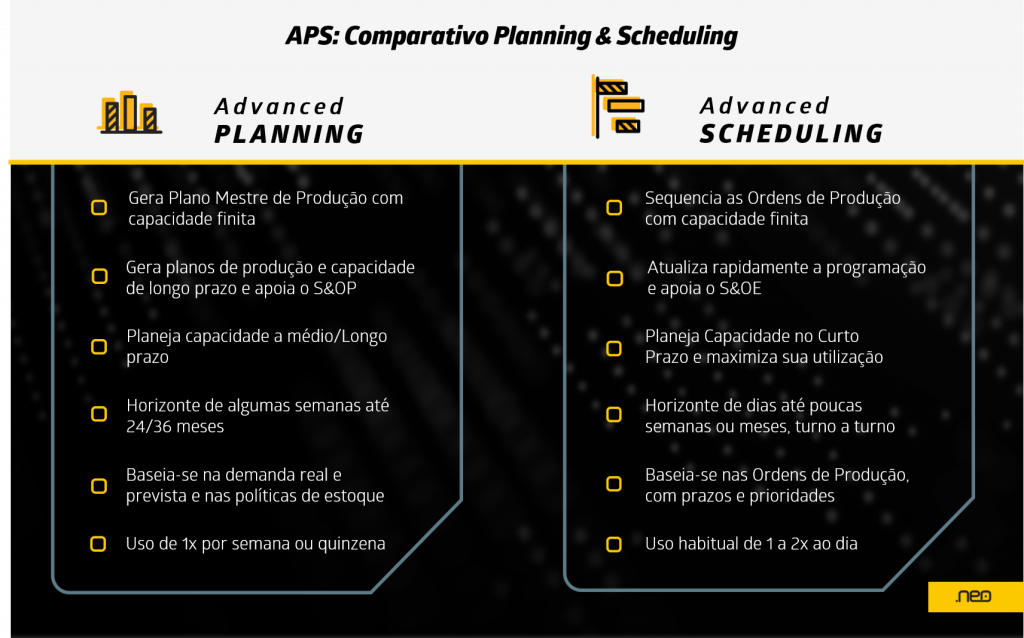
Looking at the whole, we understand that today there's enough technology to perform an increasingly integrated process. There's no reason to run an MPS looking at finite capacity for the finished good while considering only one chosen bottleneck and then exploding the remaining needs through MRP without seeing other constraints.
We must also understand that demand and supply changes will happen and the need to feed back the flow quickly and accurately is growing. We worked that way in the 80s and 90s because there were no alternatives effective enough. Today is different. This evolution is not a fast process, but it's essential for those who want agile, efficient supply chain management.
So, would you like to know more about Supply Chain, APS and other content? Follow the NEO Blog and see, beyond this content, more information related to Production Engineering.
Also follow us on LinkedIn and other social networks to follow more updates.
Table of Contents
Talk to an expert
Speak with our experts and discover how NEO can transform your planning.
Book a demoDownload the ebook
Deepen your knowledge with our exclusive resources—practical content you can apply directly to your operations.
Download ebook