

How Metalúrgica Fey reduced WIP by 35% and compressed its planning cycle from 3 days to 3 hours, then layered AI agents on top
Fey is one of Brazil's largest fastener manufacturers, with over 5,000 MTS items, 3,000 MTO items, 200 production resources, and about 400 weekly orders. The bottleneck was in planning: it was slow, disconnected from execution, and unable to simulate what lay ahead.


Discover FEY, one of Brazil's largest fastener manufacturers for 60 years
About us
Founded in Indaial (SC), Fey is one of Brazil's largest fastener manufacturers. Its 47,000 m² industrial complex houses around 700 employees and has a monthly production capacity of 60 million parts. The portfolio includes nuts, bolts, clamps, pipe and hose accessories, and special parts, serving the automotive, agricultural, tractor, and motorcycle sectors in Brazil and throughout Latin America.
Operational complexity is substantial: over 5,000 MTS items, over 3,000 MTO items, more than 200 production resources, and a weekly demand of approximately 400 production orders, equivalent to about 500 tons.
The challenge
Before NPLAN, Fey's planning had structural limitations that restricted both the speed and quality of decision-making:
- The planning cycle took up to 3 days to execute
- S&OP and production scheduling were disconnected, with no synchronized model between them
- Scenario simulation was not feasible in practice
- Inventory health was compromised, with excess and stockouts coexisting in the same portfolio
- WIP levels were high, signaling a misalignment between plan and execution
The result was a slow review cycle that left the operation exposed to demand fluctuations and production changes that it could neither anticipate nor respond to quickly.
The solution
The implementation of NPLAN structured an integrated planning layer connecting S&OP, MPS, materials planning, and production capacity, fully integrated with SAP S/4HANA. The integration covered materials, resources, routings, bills of materials, production orders, sales orders, and sales plans.
The project ran over four months, in iterative cycles with frequent validation between Fey's Logistics, Planning, Production, and Technology teams and the NPLAN implementation team. Decisions were made collaboratively through operational analysis, indicators, and comparative simulations.
Key technical and methodological elements:
- Integration with SAP S/4HANA covering all relevant planning objects, with no manual data bridges or parallel spreadsheets.
- Parameterization of inventory policies with prioritization criteria by channel and product family, replacing ad hoc decisions with a structured logic.
- Structuring of scenarios allowing for multivariable simulations that simultaneously consider demand, production capacity, inventory policies, and operational parameters.
- Iterative testing rounds (unit, advanced, and integrated) with continuous review of parameters, operational sign-off, and KPI tracking throughout the entire project.
The results
What changed in practice
The planning cycle is no longer the bottleneck
A process that used to take three days now runs in three hours. The team has shifted from spending most of their time executing the plan to analyzing and making decisions.
S&OP and production scheduling are now connected
Previously, the tactical plan and shop floor scheduling lived in different realities. After NPLAN, the production plan became more realistic and directly connected to sequencing, reducing the gap between what was planned and what was executed.
Scenario simulation has become viable
The ability to simulate multivariable scenarios regarding demand, capacity, inventory policy, and operational parameters has changed how Fey's planning team makes decisions. The team now compares alternatives and chooses the best path instead of reacting to events.
Inventory health has improved significantly
With structured policies and a connected planning model, Fey has eliminated the previous coexistence of excess and stockouts. WIP inventory fell by 35%.
The 2026 evolution: AI agents
With the planning platform stabilized, Fey and NPLAN moved to the next phase and introduced AI agents into the planning routine.
The architecture operates in three layers. At the base, SAP S/4HANA remains the transactional system and data source. In the middle layer, the NPLAN calculation engine performs optimization, MRP explosion, and plan validation. At the top, language models interpret orders, explain results, and orchestrate interactions between agents.
The configuration includes specialist agents, such as a dedicated inventory agent, and an orchestrator agent that coordinates interactions between them to compile analyses and respond to operational demands. A concrete use case is multi-scenario comparison, where the orchestrator interacts with the inventory specialist agent to present options, explain trade-offs, and support decision-making.
Security by design
Fey's complete operational dataset is not sent to the AI models. Interactions use only data samples, preserving the confidentiality of the operational database.
Concrete results
- -35% in WIP inventory
- Planning cycle compressed from 3 days to 3 hours
- Significant expansion of simulation capacity for decision support
- More team time available for analysis and identifying opportunities
- Evolution of the teams' analytical and decision-making maturity
- More realistic production plan connected to sequencing
- Greater integration between planning and execution
- Higher reliability of planning data
- Improved Supply Chain governance
Fey's transformation stemmed from the integration of technology, processes, and cross-departmental collaboration. Once this foundation was solid, AI agents were layered on top to enhance analytical capacity and response speed, keeping the planning engine at the heart of every calculation.
The sequence was the key to success: first a viable, connected plan, then analytical intelligence built upon it.
SEE MORE RESULTS LIKE THIS AND LEARN HOW TO PROJECT THE ROI FOR A SUPPLY CHAIN PLANNING PROJECT IN YOUR INDUSTRY:
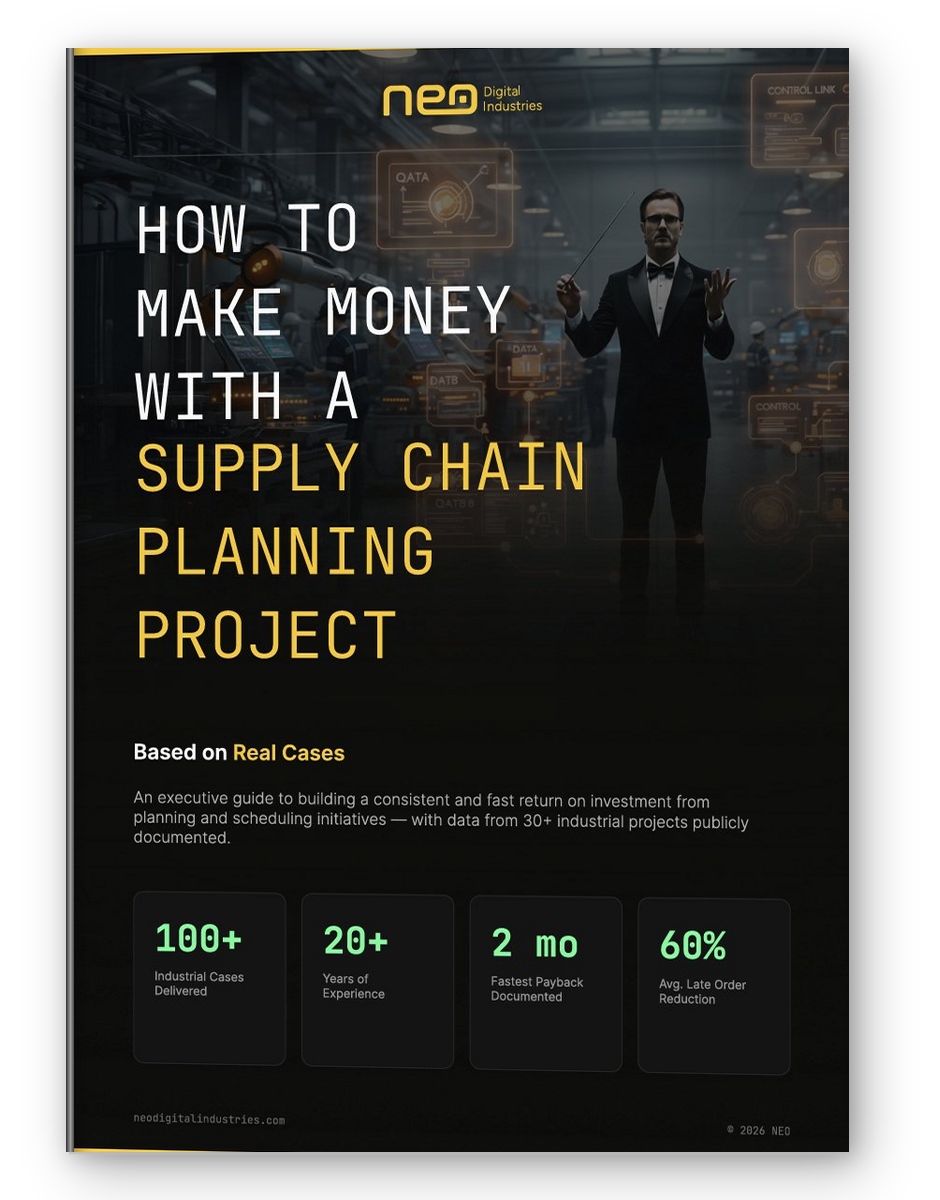
Free Ebook: How to Make Money With a Supply Chain Planning Project
Executive guide featuring data from over 30 documented projects. Discover the three sources of ROI, how to build a solid business case, and a step-by-step payback formula you can apply today.
Talk to one of our APS experts
Get a personalized assessment of your operations from APICS CPIM certified consultants. We will help you identify opportunities for improvement and estimate the return on your project.