Manufacturers that moved sequencing out of the spreadsheet and started scheduling against finite capacity. How much setup time fell, how many hours the production planning team stopped spending on releasing work orders, and how much lead time shrank once the plant's real constraint entered the equation.
From the people who run the solution every day.
“Implementing Opcenter APS was a structural change in the way ZEN plans and schedules production. The result is faster scheduling, better delivery forecasting and far less risk of losing critical knowledge.”GABRIEL DAROSCIPlanning Supervisor, ZEN
“Before partnering with NEO we faced delays of more than 30 days. Today, with Opcenter, we never exceed 10 days — even with far more complex production. And what used to take 10 days now takes minutes.”LEONARDO GALVÃOProduction Planning Manager, Induscabos
“We drastically cut the time needed to plan production. That was essential, because we work with short delivery windows. Every hour saved means more agility to serve our customers.”HUGO COSTAPMO Manager, Salus
When setup is buried inside operation time, nobody optimises what they cannot see. These case studies show the effect of sequencing by colour, format and formula similarity: 15% to 35% less setup time. Worth reading first: how far it pays to minimise setup.
A planning team that spends three days building the schedule has no time left to analyse anything. These are the manufacturers that cut 60% to 98% of that effort and started simulating scenarios before committing the plant. If yours still plans in Excel, this article explains what breaks.
Low adherence is usually a symptom of a plan built on infinite capacity in the ERP. These case studies went from 47% to 95% adherence to the production plan and began creating work orders automatically. To understand the metric, see what schedule adherence is.
A material shortage that only shows up at assembly time is expensive. With pegging and real availability visibility, these case studies cut unnecessary purchasing and tripled the number of critical orders fulfilled in full. See also what types of constraints APS can handle.
Promising a date without knowing the real load is where delays begin. These case studies cut lead time by up to 38% and gained up to 10 percentage points of OTIF. Read the challenge of the delivery date promise.
Scheduling solves the week. Before it comes the plan; after it, execution on the shop floor.
A 30-minute conversation with a team that has delivered APS in more than 120 industrial projects.
Book a conversation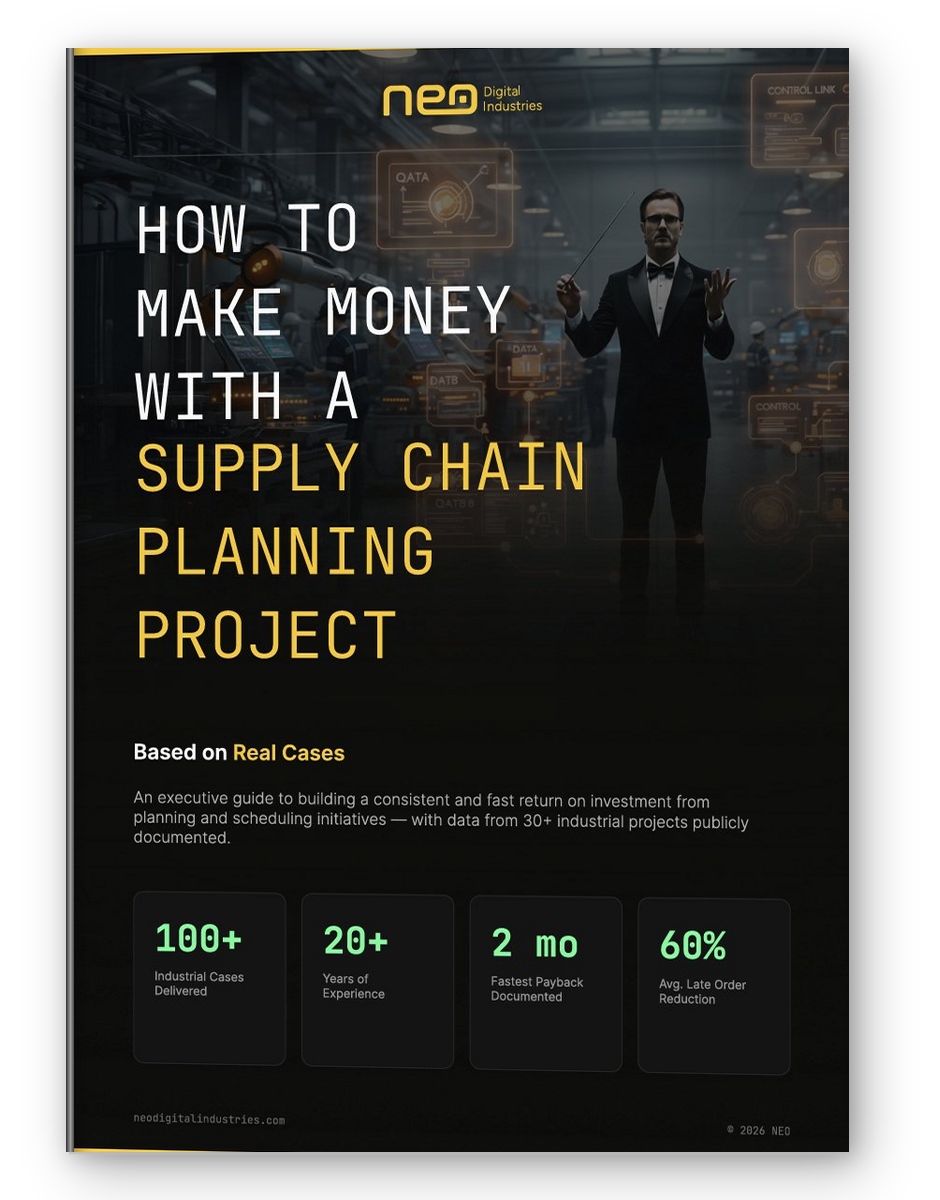
An executive guide with data from more than 30 documented projects. Learn the three sources of ROI, how to build a credible business case, and a step-by-step payback formula you can apply today.
An assessment of your operation by APICS CPIM-certified consultants. We identify where the opportunities are in production planning, scheduling and execution — and estimate the payback of the project.