

From multi-day scheduling to scenario-based decisions in minutes: Peccin triples volume and mix with the same production planning team
Peccin didn't stop after reducing scheduling time by over 80% with Opcenter APS. With execution organized, the bottleneck shifted to decision-making — and that’s where nPlan came in. Today, the company compares four or five scenarios in minutes and makes data-driven decisions, from sales plans to raw material requirements.

Discover the evolution of Peccin, one of the top 6 candy and chocolate companies in the country, which moved from Excel to a simulation-based decision model — in two stages, with NEO by their side every step of the way.
About us
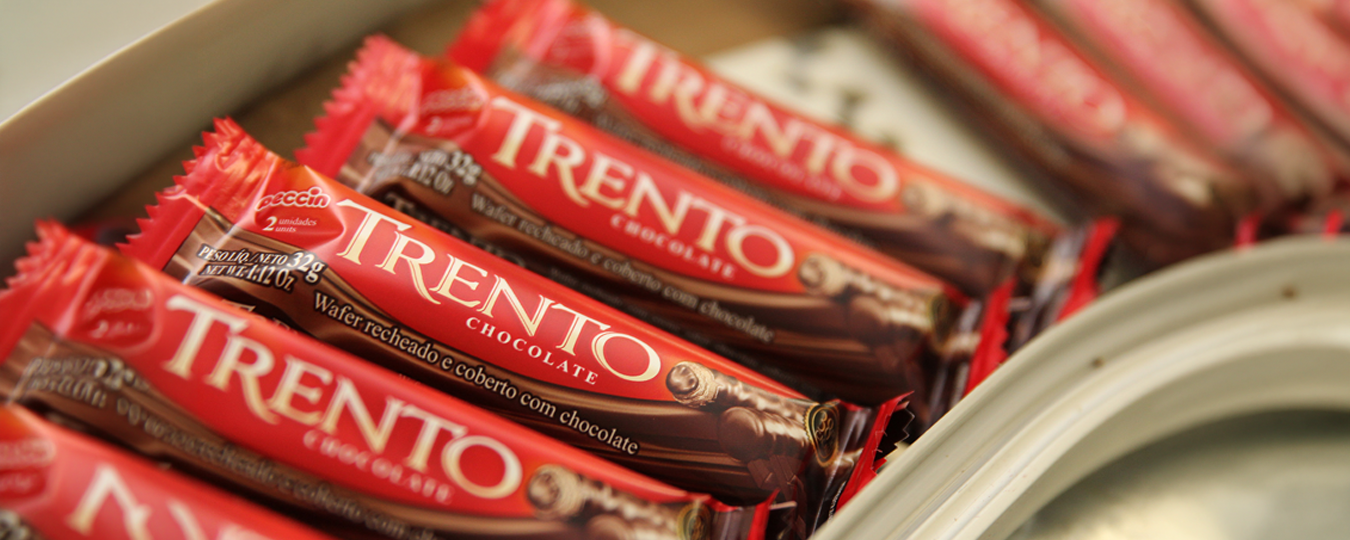
Founded in 1956 by the Pezzin brothers as a small artisanal candy factory, Peccin is now one of the six largest companies in Brazil's candy and chocolate sector. It has approximately 1,300 direct employees, a 40,000 m² industrial park in Erechim (RS) with two independent plants, and a portfolio of over 200 products, including chewy candies, lollipops, gum, and chocolate-covered wafers — supported by brands like Tribala, Blong, and Trento.
The company exports to over 60 countries across five continents, with 84% of its production directed to the domestic market. But the most relevant figure for this story isn't its size: it's the speed of its growth. The operation went from 400 tons/month to over 2,000, multiplied its lines, expanded its plants, and tripled its SKU mix in just a few years.
Growing at this speed has a predictable side effect: complexity grows faster than the decision-making structure. And it was precisely this misalignment that Peccin set out to tackle — in two stages, with NEO as their implementation partner for both.
The challenge
Execution couldn't see the factory
In 2022, Peccin chose NEO as its implementation partner and Siemens as its technology provider to structure production scheduling with Opcenter APS. The starting point was an operation that had scaled volume and mix without evolving its scheduling model: manual sequencing in Excel, outdated records, partial ERP implementation, and manual generation of production orders for the following two weeks.
With a large number of SKUs and manual sequencing, it was necessary to restrict lines and resources to specific product groups — which made balancing units and meeting deadlines difficult. Low visibility of the schedule made fitting in sales orders an exercise in approximation, considering almost exclusively the delivery date.
This project was completed and documented: scheduling time dropped from 3 days to one shift, a reduction of over 80%, and the PPCP team shifted to more analytical rather than operational tasks. Read the full case study of the APS project at Peccin →
The bottleneck shifted
This is the point that most operations discover too late. With execution organized, the bottleneck didn't disappear — it moved up a level. The factory began producing with predictability, but tactical decision-making still relied on manual effort: consolidating demand, evaluating stock coverage, projecting material requirements, and testing alternatives were still spreadsheet-based tasks.
The symptom was clear. Generating scenarios was practically unfeasible within the decision window. Every mix change, line stoppage, or supply shortage was treated as a reaction, not a planned response. New orders were accommodated without visibility into the consequences weeks ahead. The planning horizon was limited to weeks, with a single scenario per week and high preparation costs.
In other words: Peccin had gained control of execution, but planning was still executed, not decided. For an operation growing in volume, mix, lines, and plants simultaneously, this was the next ceiling to break through.
The solution
First, organize execution
Order matters—and it was no accident. Peccin didn't start with tactical planning; it started on the factory floor. Implementing Opcenter APS structured actual production sequencing, accounting for setups between flavors, brands, and weights, as well as capacity, labor and tooling constraints, allergens, product mix, and process flow.
More important than the time saved was the elimination of a structural process error: previously, the plan didn't account for real-world constraints. Afterward, the plan began to respect the factory's reality. The direct results were the elimination of rescheduling due to intermediate material shortages, consistent sequencing across lines and processes, and full visibility into setup times and the impact of every changeover.
"The implementation of Opcenter APS at Peccin is a major milestone for the beginning of the company's digitalization journey."
— Bruno Bortolatto, Project Manager at NEO
Note the word: beginning. Without this foundation, any tactical planning model would be simulating scenarios based on an execution that doesn't actually happen. A nice plan, but low adherence.
Next, structure decision-making with nPlan
With execution organized, Peccin moved on to nPlan, a Supply Chain Planning platform that connects demand, inventory, capacity, and materials into a single planning model with an extended horizon and continuous updates.
The core change wasn't just gaining another report. It was the shift to simulation. Scenarios that used to take days to build—and still offered low reliability—began to be generated in minutes. The production planning team stopped managing spreadsheets and started comparing structured alternatives, with integrated visibility into capacity, materials, and inventory, to then choose the best course of action.
In practice, the model began operating in two connected layers: nPlan answers what to produce, when, and with which materials, considering demand, inventory policy, and finite capacity over a multi-month horizon; Opcenter APS answers in what sequence to execute, down to the resource and shift level. A decision made at the planning layer reaches the factory as a viable sequence, not just a target.
"We generate a scenario and compare several alternatives to make a decision in five minutes."
— Jades Romano Costa, PPCP Coordinator at Peccin
The common thread: NEO Kaizen Support
There is a gap between the first and second project that is usually ignored in case studies — and it is precisely where most implementations deteriorate. A tool implemented without support becomes an outdated tool: the data ages, business rules change, the modeling no longer reflects the operation, and the user goes back to spreadsheets.
At Peccin, this gap was filled by NEO Kaizen Support, NEO's support and continuous improvement program. The program's logic reverses the usual expectation of support: today, 90% of the time dedicated to the service goes toward improvements and training — not fixing problems. Kaizen includes:
- Troubleshooting solution functionality, including integrations with other systems and custom routines for business rules
- Developing improvements to the solution
- Maintaining and creating standard and custom reports
- Basic training for new users and advanced operational simulations with the tool's user team
- Updating modeling to ensure compatibility with new software versions
- Support from a team specialized in S&OP, APS, and PPCP, in Portuguese, English, French, and Spanish
It was this continuity that kept the solution aligned with operations while Peccin doubled in size — and that prepared the technical and cultural ground for the next stage. When nPlan was introduced, it didn't enter an abandoned base: it entered a living model with mature users and reliable data.
"NEO's support ensured the tool worked to meet our specific needs, developing rules that make daily life easier without impacting what was already working. The partnership between NEO and Peccin is very important for the tool's sustainability. Today, we get quick and productive answers."
— Jades Romano Costa, PPCP Coordinator at Peccin
The metric NEO uses to measure this commitment is NPS: 9.64/10, based on the satisfaction of over 100 clients served by the program.
The results
Operational speed
Scheduling time dropped from 3 days to just a few hours. Scenario simulation, previously unfeasible, now happens in minutes. The planning horizon, once limited to weeks, has been extended to months—and the single weekly scenario, which was costly to prepare, has given way to multiple simultaneous scenarios.
Scaling without team growth
Operations grew from 400 to over 2,000 tons/month, with three times as many SKUs, more lines, more plants, and more constraints. The production planning team remained the same size.
Elimination of structural errors
Previously, intermediate supplies would run out during execution, rescheduling was constant, and the plan did not reflect the reality of the factory floor. After structuring with Opcenter APS, critical supply shortages due to scheduling errors ceased to occur.
Real replanning capability
Peccin now operates with a firm production horizon, visibility weeks and months ahead, and structured replanning. When a line stops, the impact is recalculated forward. When the mix changes, the system shows the consequences for capacity and inventory.
Scenario-based decision-making
This is the core point. Decisions that were once made in isolation are now compared. Instead of betting on a single plan, the team generates four or five scenarios, evaluates trade-offs, and chooses the best path based on data.
Where the difference is most visible
The gain is not limited to daily routines—it shows in the tough decisions. When cocoa prices skyrocketed, Peccin didn't react in the dark: they simulated the impacts on the mix, raw material consumption, portfolio, and supply contract extensions, comparing alternatives in minutes.
Decisions of this scale, previously unfeasible within the commercial window, are now structured, documented, and supported by scenario analysis. And the effect on the team was equally remarkable: the production planning work shifted from being mostly operational to mostly analytical.
"Before nPlan, our production planning team spent days putting together spreadsheets to plan a single week of production. Today, in just a few minutes, we generate complete scenarios that show the operational and financial impact of every decision: a line stoppage, a mix change, or a variation in cocoa prices. We tripled our volume and mix while keeping the same team, gaining speed, predictability, and the intelligence to make data-driven decisions. Integrated planning has become a true competitive advantage."
— Jades Romano Costa, Production Planning Coordinator at Peccin
Peccin didn't just improve its planning; it changed its decision-making model. The operation moved from an effort-based process to a simulation-based one—and sustained the company's growth even as complexity continued to increase.
The path, however, matters as much as the destination. First execution, then decision. And between the two stages, a support structure that kept the solution alive. It is this sequence—APS, Kaizen, SCP—that separates a software project from a real change in how to operate.
SEE MORE RESULTS LIKE THIS AND LEARN HOW TO PROJECT THE ROI FOR A SUPPLY CHAIN PLANNING PROJECT IN YOUR INDUSTRY:
Free Ebook: How to Make Money With a Supply Chain Planning Project
Executive guide featuring data from over 30 documented projects. Discover the three sources of ROI, how to build a solid business case, and a step-by-step payback formula you can apply today.
Talk to one of our APS experts
Get a personalized assessment of your operations from APICS CPIM certified consultants. We will help you identify opportunities for improvement and estimate the return on your project.