

How Premier Pet went from one week to 3 minutes in scenario simulation and scaled its operation without increasing its production planning team
Premier Pet grew rapidly: new factories, more lines, more products, more complexity. It moved from a manageable context to an operation with over 500 SKUs, hundreds of raw materials, and multiple factories and distribution centers. The challenge shifted from production to planning.


Meet PremieRpet, one of Brazil's largest pet food companies and a pioneer in the manufacturing of super premium food for dogs and cats in the country.
About us
Founded in 1995 in Dourado (SP), PremieRpet was the first Brazilian company to manufacture natural super premium food for dogs and cats, a segment it helped create in the country. Throughout its journey, the company has expanded its industrial footprint and today brings together brands such as PremieR, GoldeN, and Vitta Natural, which together total more than 300 items aimed at different life stages, sizes, and specific nutritional needs of pets.
PremieRpet's operation combines multiple production plants — the Dourado (SP) complex, with three integrated factories, and the Porto Amazonas (PR) unit, the largest pet food factory in Latin America, built with an investment exceeding R$ 1.1 billion. Together, the units produce about 40,000 tons of food per month. The company also stands out for its environmental commitment: it is the only one in its segment in Brazil to operate with 100% solar energy in all factories, reinforcing its position as a benchmark for innovation, quality, and sustainability in the pet market.
The challenge
The planning model could not keep up with the growth. There was a heavy reliance on Excel, manual processes, low simulation capacity, and slow decision-making. Generating a single scenario could take an entire week of work, which completely limited decision-making and kept the team busy managing the plan instead of deciding on the plan.
The need was not just to improve. It was to enable growth. The team itself saw the limits of the previous model, and two objectives guided the decision: eliminate manual work and make the team more analytical, moving away from spreadsheets as the central point of the operation.
"During the pandemic, demand grew exponentially, which was one of the reasons that accelerated the opening of the new factory in Paraná. With new factories, new lines, and new products, Excel has certain limitations. We needed a complete solution: planning, scheduling, and distribution center replenishment, all in one."
Antenor Neto · PPCP Manager, Premier Pet
The solution
Premier Pet structured its planning into three connected layers: master planning with NPLAN, sequencing with APS, and distribution with DRP. Everything is integrated with the ERP and factory systems.
The workflow became unified: demand → scenario → decision → orders → sequencing → execution → feedback. No rework and no parallel spreadsheets.
The results
What changed in practice
Simulation is no longer a bottleneck
Previously, it was one scenario per week with high manual effort. Today, multiple scenarios are generated in minutes, allowing for the comparison of alternatives and higher-quality decision-making.
Planning became automated
Previously, the master plan was built in Excel and orders were entered manually. Now, the plan is generated automatically and orders are created in seconds.
Purchasing no longer relies on intuition
Previously, purchasing decisions were based on history and perception. Today, they are driven by the actual plan, with exact visibility into what needs to be purchased and within what timeframe.
Structured inventory policy
Previously, the policy was undefined, and operations would often halt due to excess inventory. Today, the policy is structured by curve and capacity, preventing downtime and adjusting coverage levels to the profile of each item.
Sequencing no longer creates bottlenecks
Previously, the flow was decided by floor operations, and bottlenecks occurred almost daily, with stoppages due to a lack of silos or capacity. Today, the flow is automatically optimized by the APS, ensuring continuity.
"Before the APS, the operations team decided the flow between silos and bagging machines on the factory floor. We had some kind of bottleneck almost every day. Sometimes the line would stop because there was no silo available to receive the product. Today, the system ensures in advance that the flow will be followed in the most optimized way possible."
Antenor Neto · PPCP Manager, Premier Pet
Rescheduling is no longer manual
Previously, any stoppage required redoing the plan in Excel. Today, rescheduling is fast and structured, maintaining consistency between demand, materials, capacity, and distribution.
Scale without increasing the team
The operation has grown significantly: more factories, more lines, more SKUs, and more raw materials. The production planning team, however, did not need to grow at the same rate because the nature of the work has changed.
"With new factories, new lines, and new products, Excel reached its limit. We needed to keep up with growth and couldn't afford to miss deliveries. The work is still the same, but today we are much more analytical than operational."
Antenor Neto · PPCP Manager, Premier Pet
Real visibility for decision-making
Previously, decisions were made without seeing the full impact. Today, the team can track inventory behavior over time, identify surpluses and shortages, evaluate line idle time, and anticipate problems.
This visibility is used practically, including for scheduling maintenance at the best possible time by identifying windows with the least impact on the production plan.
"Today I can see that there is an idle window on the line during the week of March 26th. So I go to the maintenance team and say: this is the ideal week for you to work. Before, this visibility simply didn't exist."
Antenor Neto · PPCP Manager, Premier Pet
The main takeaway
Premier Pet didn't just gain efficiency; it gained decision-making power. It shifted from an effort-based model to a simulation-based one, allowing the company to scale in complexity without losing control.
SEE MORE RESULTS LIKE THIS AND LEARN HOW TO PROJECT THE ROI FOR A SUPPLY CHAIN PLANNING PROJECT IN YOUR INDUSTRY:
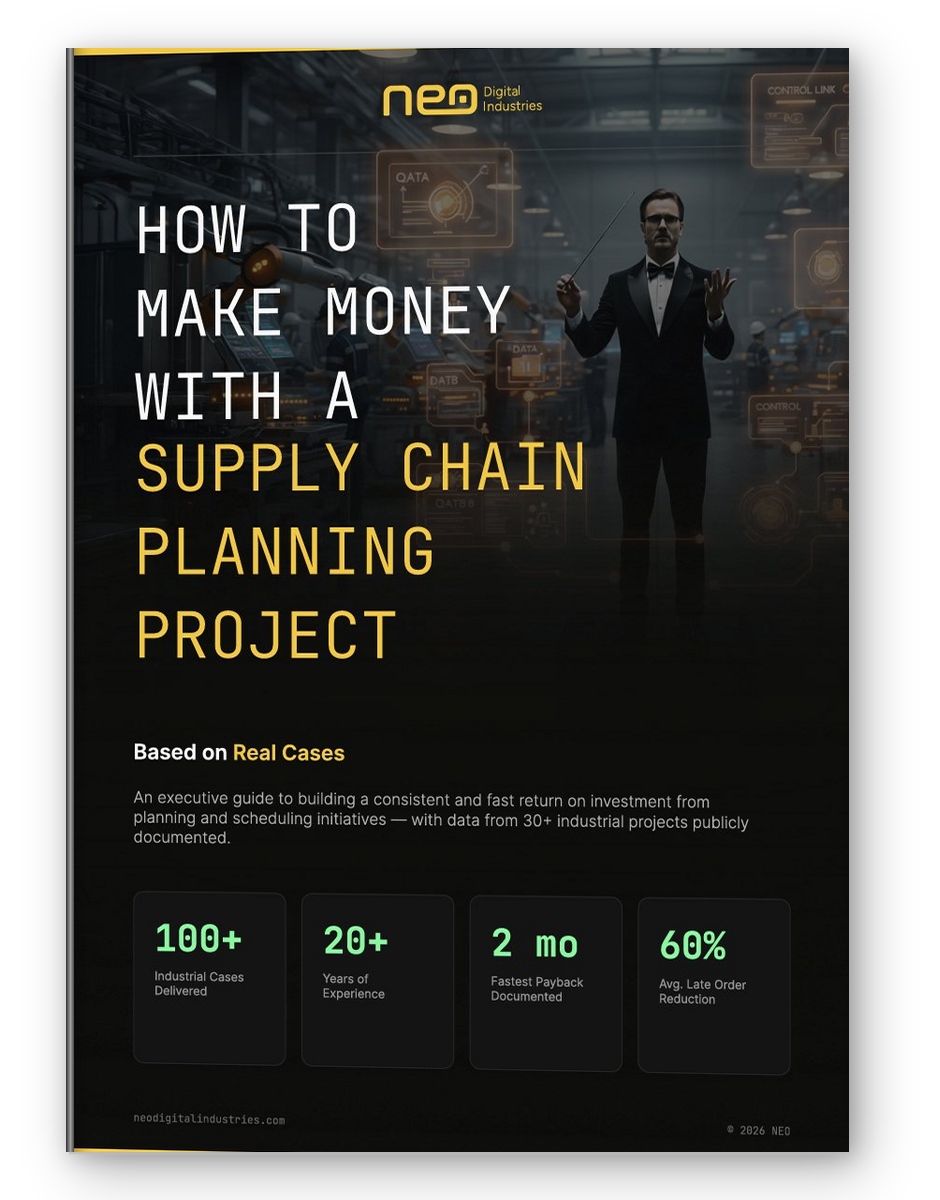
Free Ebook: How to Make Money With a Supply Chain Planning Project
Executive guide featuring data from over 30 documented projects. Discover the three sources of ROI, how to build a solid business case, and a step-by-step payback formula you can apply today.
Talk to one of our APS experts
Get a personalized assessment of your operations from APICS CPIM certified consultants. We will help you identify opportunities for improvement and estimate the return on your project.