
.png)
Schedule Adherence: the dilemma and how it can be measured
What is schedule adherence, why it's decisive in production planning and how to measure this indicator without falling into conflicting metrics.
Eliyahu M. Goldratt, one of the greatest production engineering gurus, has a famous saying: “Tell me how you measure me and I'll tell you how I'll behave.” Thus, schedule adherence plays a fundamental role within production engineering.
It looks easy to understand, but when we talk about measuring industrial production, the application isn't so simple. That's because there are conflicting management metrics. Today we'll talk about one of them and its paradoxes, with a widely used indicator: schedule adherence.
What is Schedule Adherence?
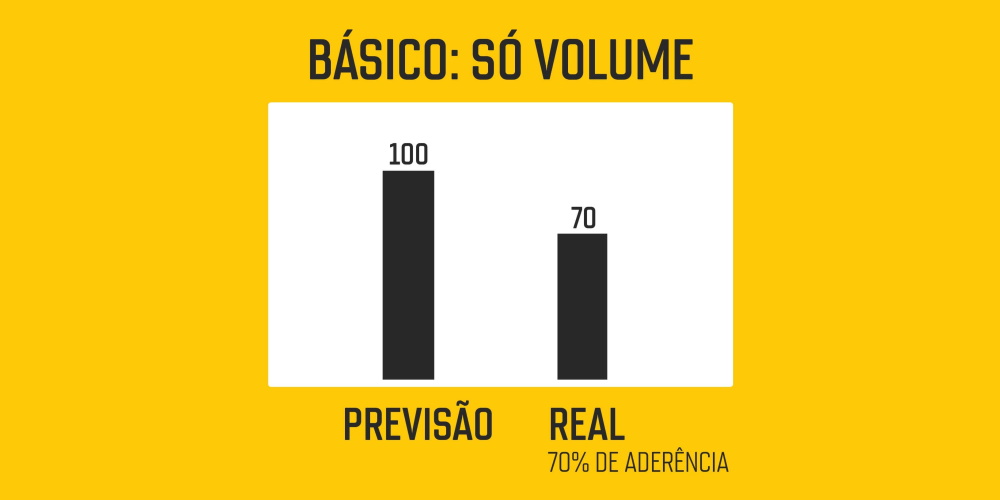
It's a very useful indicator that can be interpreted in several ways, depending on the company and its level of refinement. Some companies measure adherence just by comparing the planned or promised production volume against the actual one. That's a very superficial evaluation that doesn't consider the effectiveness of how what was made is used.
Even though this is the format most used by industries that produce for stock, since service is less sensitive to production variations, the risk is hurting the health of inventories and their turnover.
Probably the most common use is looking at the “planned vs. actual” relationship by SKU — this lets you understand whether the amount scheduled was actually produced. This view is useful but is often sabotaged by how the industrial area is measured, usually by produced volume. That's because what was scheduled is often not what generates the most volume, since it's harder or slower to produce.
If a company rewards its workforce by volume produced, harder items — which can sometimes have higher margin or be more strategic — may “take the penalty.” The operator will be incentivized not to follow FIFO (first in, first out) or LIFO (last in, first out) logic, but rather MIIFO (most interesting in, first out). Enter Goldratt's spirit to warn us!
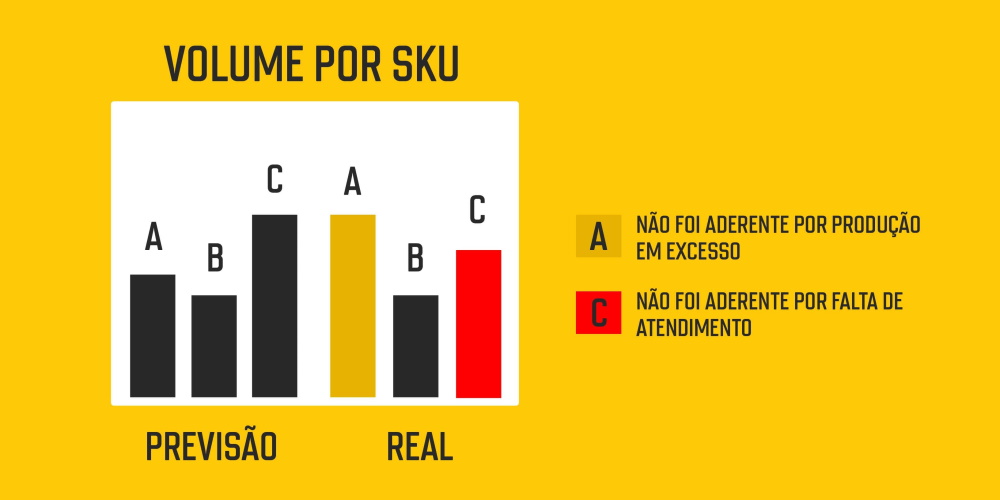
However, it's no use pivoting the evaluation to purely look at adherence and demand from production a product-volume mix it can't meet. This is, indeed, a harder KPI to be accurate about.
Comparing volumes ends up being simpler, easily replicable empirically. That's why it's natural for it to be one of the most widespread evaluation forms for variable compensation. We need to trust the model when it comes to people's pockets.
It's precisely to bring that maturity to the adherence indicator that APS solutions exist. Through them, viable and reliable plans can be created. Not only because of the advanced rules and algorithms used, but because they are usually built with the support of production, which knows the factory's constraints.
Thus, the indicator gains new meaning and importance, and can really become the most effective control mechanism between PPCP and the Industrial area. A daily or per-shift adherence frequency is ideal for being more assertive, although you can start with a weekly cadence.
There are still opportunities to gain sophistication and robustness from this indicator by asking: “Did you make the right volume of each item? In the correct sequence? And on the correct machine?” Deepening the measurement can be very useful for those with many operations to transform a product, since a sequence change can have very negative impacts on downstream processes that were counting on the scheduled sequence of their predecessors.
Scheduling on different resources can also alter not just efficiency — which can differ between machines — but also product cost, if it's calculated considering the resource actually used for manufacturing and that's compared to the cost planned for the item.
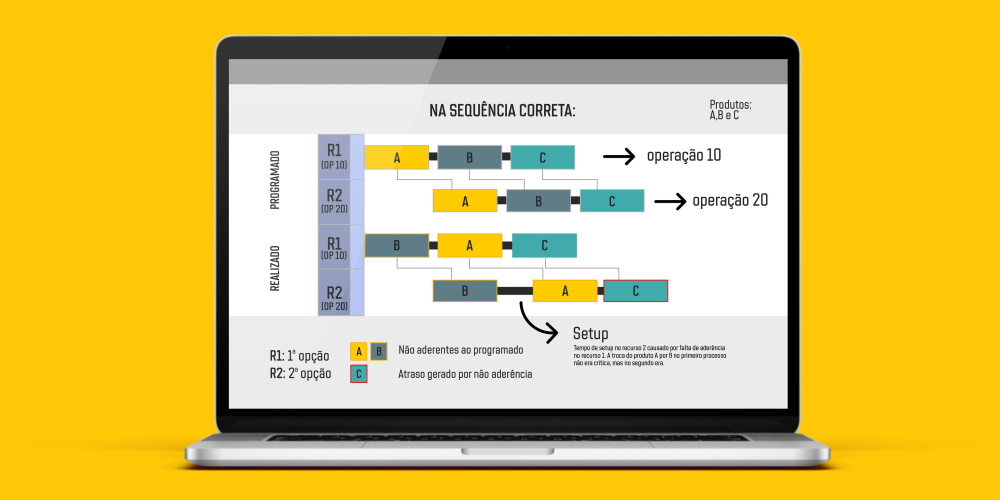
There are several ways to dive into the “planned vs. actual” evaluation once the “planned” becomes more accurate. The consequence is a management that doesn't just look at volume and asset utilization maximization, but has a holistic company view — balancing efficiency with service level, considering process interdependencies, the company's strategic priorities and thus creating the right incentive.
Want to explore more on this subject? Watch the Ciborgues da Indústria episodes where we talk with Ricardo Lauri from Grupo Lunelli about the topic, and the conversation with Ariel Possebon from Produttare where we also discuss Theory of Constraints.
How can NEO help your industry?
NEO Digital Industries is a Siemens Smart Expert Partner and offers solutions with business analysis and implementation of APS software. We've built a new concept that values technological vanguard and technical excellence at the same time that we believe in human sensitivity, creative work and personalized, committed relationships.
Get in touch through the form below or via our WhatsApp to learn more about our solutions and schedule a tailored analysis for your business needs.
Table of Contents
Talk to an expert
Speak with our experts and discover how NEO can transform your planning.
Book a demoDownload the ebook
Deepen your knowledge with our exclusive resources—practical content you can apply directly to your operations.
Download ebook